Should You Redesign Your Team Uniform or Bring Back a Classic?
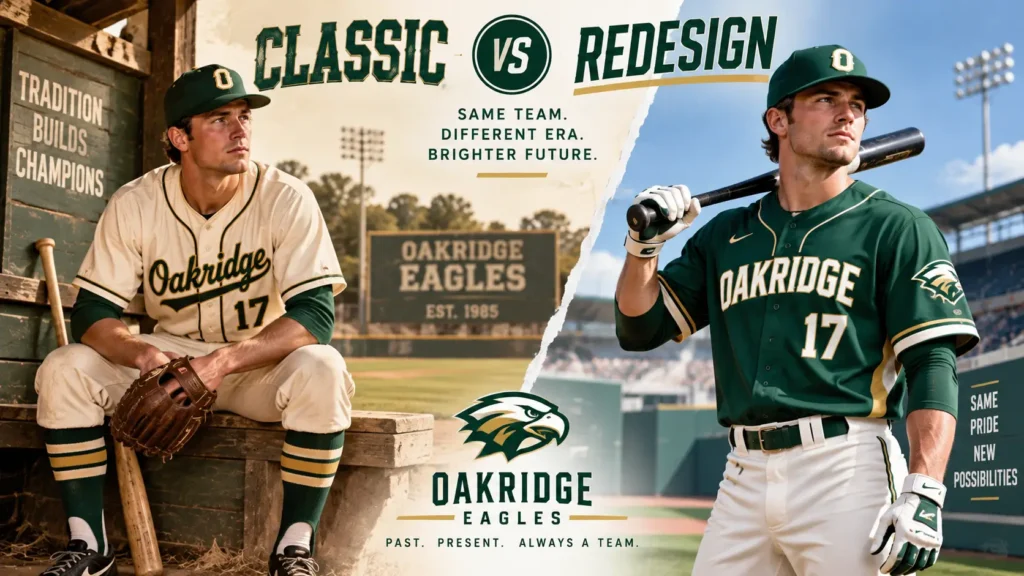
A new season doesn’t automatically mean your team needs a completely new uniform design. Sometimes the smartest move is a modest refresh. Sometimes the existing look still works and only needs better materials or cleaner details. In other cases, an older design may carry more identity than the latest trend ever could.
The challenge is knowing whether you are fixing a real problem or simply changing the uniform because change feels exciting. A full redesign can affect supplier choices, decoration methods, reorder consistency, home-and-away combinations, how much it costs, and even how easily your organization can replace individual pieces later.
Before you start collecting ideas, decide what the uniform is supposed to accomplish first. Does the current design look dated? Is it hard to reproduce? Are the colors inconsistent? Has the club changed its logo or identity? Or are players, alumni, and supporters attached to a classic look that still represents the organization well?
This post should help you choose between a light refresh, a design evolution, a complete redesign, or bringing back a classic—without losing sight of cost, practicality, and future reorders.
The Key Point
Do not redesign a team uniform until you know what problem you’re solving. Preserve the parts of the identity that still work, change only what has a clear reason to change, and test the new direction against the budget, supplier capability, reorder needs, and long-term consistency before production even begins.
Uniform Redesign at a Glance
Audit First
Identify what is working, what is dated, and what is actually causing problems.
Keep the Identity
Protect the colors, marks, or visual cues people already associate with the team.
Choose the Level
Decide whether you need a refresh, an evolution, or a full redesign.
Consider a Classic
An older look may still have stronger identity than a brand-new concept.
Approve Carefully
Check design, cost, production, and reorder implications before signing off.
Why Teams Redesign Uniforms
Uniform redesigns usually begin for one of a few practical reasons.
- A club may have updated its logo or colors.
- The current uniform may be difficult to reorder because the supplier discontinued the line.
- The design may reproduce poorly across different garments,
- The decoration method may no longer suit the way the organization buys uniforms.
- There can also be a genuine identity problem. A uniform that looked modern ten years ago may now feel disconnected from the organization.
- Numbers may be difficult to read.
- The color balance may be weak.
- Sponsors may have been added without a clear visual system.
- Small changes accumulated over several seasons can leave the team with a uniform that no longer looks intentional.
Those are useful reasons to redesign because they point to specific problems that can be fixed. What is less useful is starting with “we want something different” and then trying to invent a problem afterwards. A redesign without a clear objective often produces more opinions, more revisions, and more unnecessary changes than the team needs.
Why Classic and Throwback Looks Keep Returning
Older uniforms often return because they carry something a brand-new design cannot manufacture overnight – recognition. A long-standing color arrangement, stripe pattern, crest treatment, or number style may remind players and supporters of successful teams, important seasons, or the history of the organization.
That does not mean every old uniform should be revived. Some classic designs were limited by the fabrics, printing methods, or garment cuts available at the time. Others may look better in memory than they would on a current team. The strongest throwback is that classic-inspired uniforms usually preserve the recognizable parts while adapting them to current materials and production methods. The result feels familiar without pretending that nothing has changed.
If your organization has a history worth drawing from, a classic design can also reduce the pressure to chase short-lived visual trends. The team already owns an identity. The design work then becomes a question of how to use it well.
Audit the Current Uniform Before Changing It
Before sketching anything new, put the current uniform under review. Look at it as both a design and a product. Ask:
- whether the colors are still correct
- whether the logo is current
- whether numbers are easy to read
- whether sponsor marks are positioned consistently
- and whether the design works across all required sizes and garment cuts
Then move beyond appearance and examine the ordering side.
- Can the supplier still reproduce the uniform reliably?
- Are reorders easy?
- Does the same design work across youth, adult, women’s, men’s, or unisex cuts where needed?
- Are some details expensive to reproduce?
- Does the team keep making one-off exceptions because the original design is too restrictive?
Write the answers down. A simple audit can reveal whether the team needs a total redesign or whether two or three targeted changes would solve almost everything.
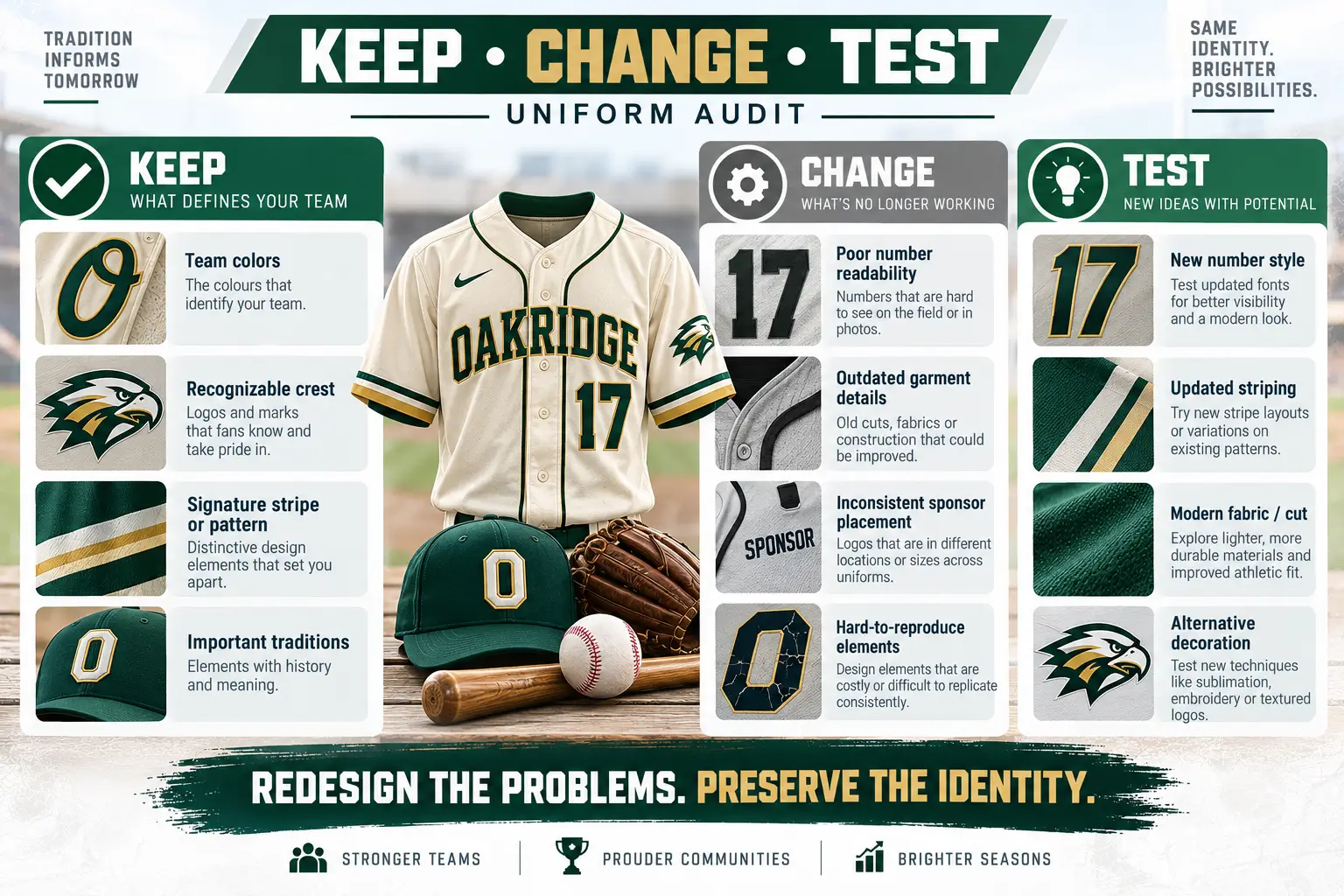
Keep, Change or Test: Uniform Audit
Use this worksheet to organize your initial review. Record the action required for each uniform element before deciding how extensive the redesign should be.
| Uniform Element | Keep | Change | Test | Reason / Action |
|---|---|---|---|---|
| Team Colors | □ | □ | □ | Color accuracy and consistency |
| Logo / Crest | □ | □ | □ | Artwork and team identity |
| Numbers | □ | □ | □ | Legibility and placement |
| Striping / Trim | □ | □ | □ | Design consistency |
| Fabric / Fit | □ | □ | □ | Comfort and available sizes |
| Sponsor Marks | □ | □ | □ | Placement and reproduction |
| Decoration Method | □ | □ | □ | Production compatibility |
| Reorders | □ | □ | □ | Future product availability |
This is a reference worksheet, not an interactive form. The boxes can be marked on a printed copy.
What Should Remain Recognizable?
A redesign does not have to erase your existing identity. In fact, the strongest redesigns often keep the elements that people already recognize and improve the parts that are weak. For one team, that may mean preserving the primary colors and crest while simplifying the striping. For another, the essential element may be the number style, a shoulder pattern, or a particular balance between two colors. A school program may need to maintain strict consistency with institutional branding even while changing the garment design.
Identify the non-negotiable elements before you begin. This creates boundaries for the design process and prevents every revision from reopening questions the organization has already answered. It also makes future reorders easier. If the visual identity is built around a few stable elements rather than one complicated template, the team has more flexibility if garment lines or suppliers change later.
Ask Players, Coaches, Alumni and Supporters But Do Not Design by Committee
People who wear, manage, or support the uniform can provide useful feedback, but they do not all need equal control over every design decision. Players can tell you whether the current uniform feels dated, whether certain details are unpopular, and whether there are practical fit or comfort issues. Coaches and managers understand ordering, durability, and replacement problems. Alumni may know which historical designs still carry meaning. Supporters can help identify which parts of the visual identity remain recognizable outside the team itself.
Collect that input around focused questions rather than asking everyone to “design the new uniform.” Broad design-by-vote processes tend to produce conflicting preferences and compromise designs that nobody strongly supports.
A better approach is to let a small decision-making group use the feedback to define requirements, then evaluate a limited number of design directions against those requirements.
Stakeholder Feedback Checklist
Check off each topic after the feedback has been collected and reviewed.
Use the agreed requirements to evaluate design options.
A Refresh, an Evolution or a Complete Redesign: Three Levels of Change
Not every uniform project needs the same level of change. It helps to separate the options into three categories.
1. Refresh
A refresh keeps the basic identity and most of the current design. The team may update the fabric, simplify trim, clean up number placement, standardize sponsor positioning, or make small adjustments to the color balance. This is the lowest-risk option when the existing uniform is still fundamentally sound.
2. Evolution
An evolution keeps the recognizable identity everyone knows but changes the presentation more noticeably. The team might modernize striping, revise panel shapes, update typography, or adjust how the logo and colors are used. The uniform looks new without feeling unrelated to what came before.
3. Complete Redesign
A complete redesign changes the visual system substantially. This may be appropriate after a re-brand, merger, major identity change, or when the old design no longer serves the organization at all. It creates the most freedom, but it also carries the greatest risk of losing the recognition aspect and of creating expensive production complications.
Compare the Three Redesign Approaches
| Decision Factor | Refresh | Evolution | Complete Redesign |
|---|---|---|---|
| Design Change | Minor adjustments | Noticeable modernization | Major visual changes |
| Team Identity | Mostly unchanged | Recognizable elements retained | May be substantially revised |
| Typical Work | Trim, placement, fabric | Stripes, panels, typography | Overall design system |
| Production | Check garment compatibility | Test revised details | Validate complete new design |
| Cost Considerations | Usually narrower scope | May require new artwork or samples | May require broader replacement |
| Best Fit | Current identity still works | Identity works; presentation needs updating | Existing system no longer meets needs |
Costs and production complexity depend on the supplier, garment construction and decoration method.
When Bringing Back a Classic Makes Sense
A classic uniform is worth considering when the old look still has strong recognition, the team’s history matters to players and supporters, and the design can be reproduced effectively with current garments and decoration methods. It can also be a smart choice when the organization has gone through several redesigns and lost visual consistency. Returning to a familiar base can restore a clearer identity without inventing another completely new direction.
Before committing to a throwback, confirm which parts of the old design are actually worth preserving. Sometimes the strongest memory is the color combination or crest rather than the entire garment. Bringing back the best element can be more successful than copying every historical detail.
A classic should also be tested against the needs of the current team. If the old design depends on a narrow garment cut, hard-to-source trim, or a production method the supplier cannot reproduce reliably, use the classic as inspiration rather than as a rigid template.
Classic Revival vs. Modern Redesign
| Consideration | Classic Revival | Modern Redesign |
|---|---|---|
| Team Identity | Builds on familiar historical elements | Can establish a new direction |
| Recognition | May already be familiar to supporters | May require time to become recognizable |
| Design Freedom | Guided by heritage | Greater creative flexibility |
| Production | Historical details may need adaptation | New artwork and production testing may be needed |
| Main Risk | Recreating impractical historical details | Losing familiar team identity |
| Best Fit | History remains central to the team | Current identity no longer meets requirements |
Modernizing an Old Design for Current Fabrics and Decoration
Modern uniform production gives teams more options than many older designs originally had. Lightweight performance fabrics, sublimation, heat-applied graphics, embroidery, sewn decoration, and other methods can change how a classic concept is executed. The goal should not be to force every historical detail onto a modern garment.
A better approach is to identify the parts that create the visual identity and rebuild them in a way that suits the current product.
For example, a heavy sewn stripe from an older jersey may be recreated through sublimation if that method is appropriate for the sport and garment. A historical crest may need artwork cleanup so it reproduces clearly. A number font that once worked at a large scale may need minor adjustment for legibility on youth sizes.
Ask the supplier to explain how the proposed design will be produced, not just how the digital mock-up looks. A good mock-up can still become a disappointing final cut if the decoration method, fabric, or construction does not support the design.
Numbers, Logos, Typography and Color Consistency
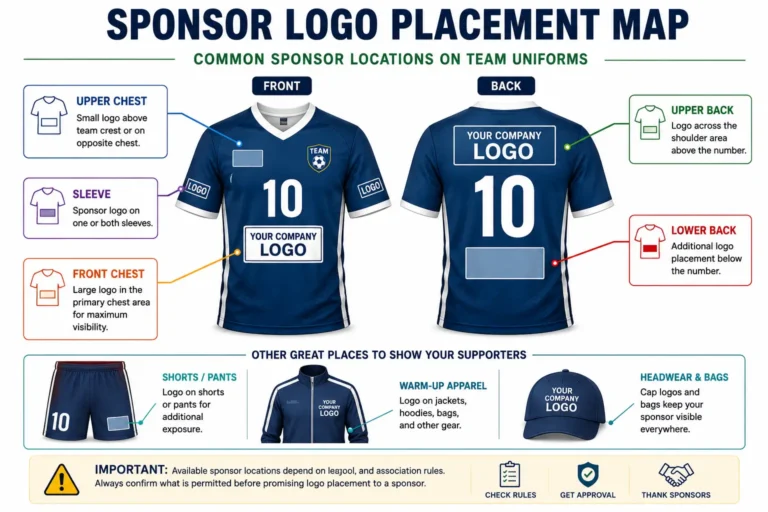
Small details often determine whether or not a uniform feels professional or improvised. A redesign is a good time to standardize them. Confirm official versions of the team logo, crest, sponsor marks, wordmarks, and number styles before production. Decide where each element belongs and how large it should be. If the organization uses several suppliers, provide consistent artwork rather than allowing each vendor to recreate the identity independently.
Color choices deserve the same attention as well. A team may describe its colors as “royal blue and gold,” but different suppliers can interpret those words differently. Use approved color references where possible and review physical fabric or print samples when color matching is important.
Number legibility should take priority over decorative novelty. Contrast, outline thickness, font style, and placement all affect how easily officials, coaches, spectators, and teammates can identify a player during competition. If the design only looks right on one mock-up but becomes difficult to reproduce across different sizes, garment cuts, or uniform sets, it is not yet a stable team system.
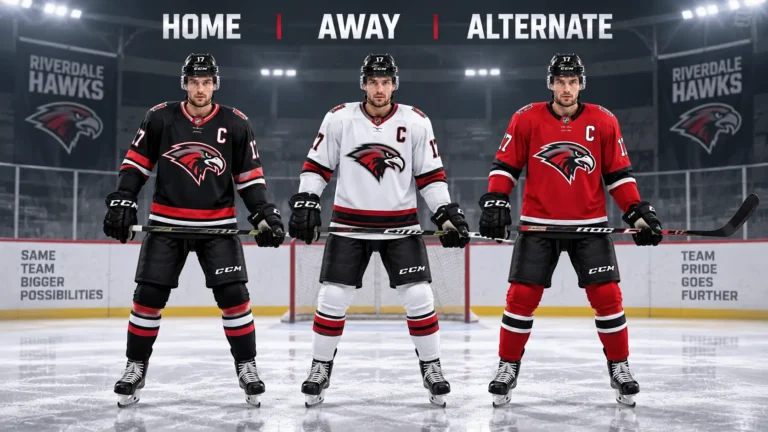
Consider Home, Away and Alternate Uniforms as One System
If your team uses more than one competition set, redesign them together. The home, away, and alternate uniforms should look related even when their dominant colors are different. That does not mean they must be mirror images. One set may use a light base and another a dark base. An alternate may introduce a different accent or historical reference. The important point is that they still share enough visual language—logo use, typography, striping, trim, or other elements—to clearly belong to the same organization.
Planning the sets together also helps prevent color conflicts. A new primary uniform may create a need for a different away color than the team used previously. Before approving the redesign, compare the complete set strategy using the guidance in Home, Away and Alternate Team Uniforms: How Many Sets Do You Need?.
Budget and Reorder Consequences of a Redesign
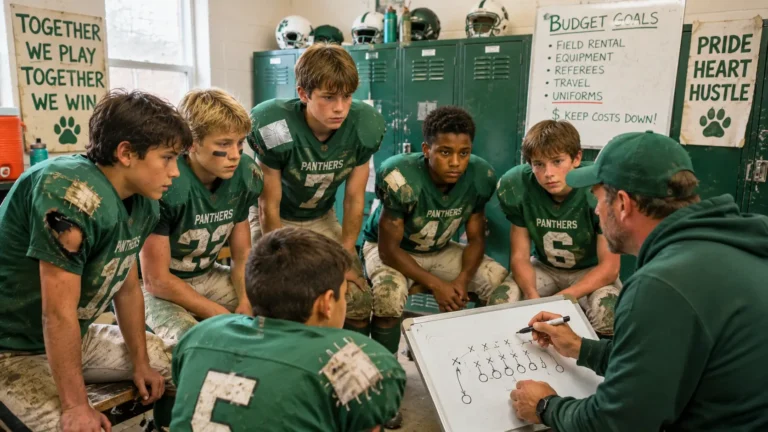
Every design choice has an operational cost. Extra colors, complex decorations, specialty fabrics, custom trims, multiple garment cuts, and different home-and-away combinations may all affect the final price. The first order is only part of the calculation. Teams also need to replace lost or damaged pieces, outfit late additions, handle roster turnover, and order new uniforms in future seasons. A design that is difficult or expensive to reproduce can become a recurring problem long after the initial excitement has passed.
Ask the supplier how long the design will remain available, whether individual pieces can be reordered, what happens if the garment line is discontinued, and whether the same artwork can move to a replacement product later. Also consider whether a complete redesign forces the organization to replace apparel beyond the game uniform. Warmups, bags, coach apparel, spirit wear, and supporter merchandise may all use the old identity. If the redesign changes logos or colors, the cost can spread far beyond the competition kit.
Our article How Much Do Custom Team Uniforms Cost in 2026? 2027 Outlook examines the broader cost structure of a custom team uniform order.
Uniform Redesign Decision Checklist
Before approving the new direction, make sure the organization can answer these 10 questions clearly:
- Problem: What specific problem are we trying to fix?
- Identity: Which colors, marks, traditions, or visual elements should remain recognizable?
- Level of change: Are we doing a refresh, an evolution, or a complete redesign?
- Stakeholders: Have we collected useful input without turning the process into a design-by-committee exercise?
- Classic option: Is there an older design or historical element worth preserving or reviving?
- Production: Can the supplier reproduce the design consistently across all required garments and sizes?
- Multiple sets: Do the home, away, and alternate uniforms work together as one system?
- Legibility: Are names, numbers, logos, and sponsor marks clear and consistent?
- Budget: Have we priced the complete redesign rather than just the base jersey?
- Reorders: Can individual pieces be replaced later without rebuilding the entire program?
Uniform Redesign Approval Checklist
Check each requirement when confirmed. Your progress is saved in this browser.
The team can proceed to its final design approval review.
Document the Design Direction Before Approaching Suppliers
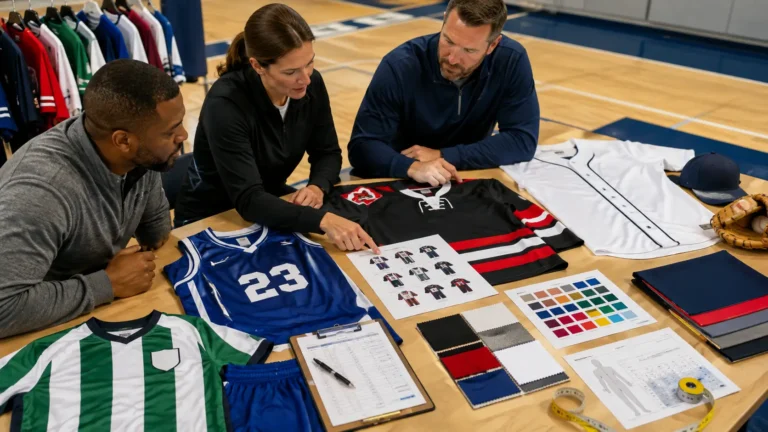
Once the organization agrees on the direction, write it down before asking suppliers for mock-ups. A short design brief keeps the process focused and gives each vendor the same information. The brief should identify the team colors, approved logos, required home-and-away structure, the parts of the current design that must remain, the parts that can change, preferred garment cuts, decoration preferences, budget range, and any historical references the supplier should understand.
If the team is bringing back a classic design, include clear reference images or original artwork when available. If the project is a refresh, identify exactly which elements need adjusting so the supplier does not interpret “modernize it” as permission to redesign everything. A written direction also makes it easier to compare suppliers. You are no longer comparing unrelated creative concepts. You are comparing how well each supplier solves the same design and production problem.
Once the design direction is stable, you can move into sizing, quantities, and final order preparation. The next guide titled How to Size Team Uniforms: A Step-by-Step Guide for Coaches, covers the sizing process in more detail.
Frequently Asked Questions
How often should a team redesign its uniforms?
There is no fixed schedule. Redesign when the current uniform no longer fits the team’s identity, production needs, or practical requirements. A strong design can remain effective for many seasons if it is easy to reproduce and still represents the organization well.
Is it better to redesign completely or make small changes?
Small changes are usually lower risk when the existing identity still works. A complete redesign makes more sense when the team has rebranded, merged, changed direction, or outgrown the old visual system entirely.
Can a classic uniform be modernized without losing its identity?
Yes. Preserve the recognizable elements—such as colors, crest, stripes, or number style—while adapting the design to current fabrics, garment cuts, and decoration methods.
Should players vote on the new uniform?
Player feedback is useful, especially for practical concerns and general preferences, but a full vote on every design detail can create inconsistent results. A smaller decision-making group should use stakeholder input to guide a limited number of design choices.
Should home and away uniforms be redesigned together?
Yes, ideally. Planning them as one system helps maintain a consistent identity, improve color contrast, and avoid producing two uniforms that look unrelated.
What should we ask a supplier before approving a redesign?
Ask how the design will be produced, whether the same look can be maintained across sizes and garment cuts, how long the uniform line is expected to remain available, how individual reorders work, and what happens if the underlying product is discontinued.
Does a redesign usually increase cost?
It can. The cost depends on the garment, fabric, decoration method, number of colors, personalization, custom construction, number of sets, and whether the redesign also affects warmups, coach apparel, bags, or spirit wear.
Your Next Step: Turn the Design Decision Into a Buildable Uniform
At this point, your team should know if it’s keeping the current look, making it a focused refresh project, evolving the design, starting over, or bringing back their former classic design. The next stage is not more inspiration. It’s execution. Confirm the supplier, garment options, design files, home-and-away structure, decoration method, sizes, quantities, and reorder process before any team uniform production begins.
If the project still feels too broad, return to the design brief and reduce the number of decisions that need to be made. A strong uniform system should be easy to explain. The team should know what it is keeping, what it is changing, and why it’s happening.
If you have not yet decided how many competition sets your team needs, review Home, Away and Alternate Team Uniforms: How Many Sets Do You Need?.
If the overall apparel package is still unclear, start with Team Uniforms vs. Team Apparel: What Should Your Organization Order?.