But Finding the Right Sponsors
Can Help Youth Teams Every Season
Team uniforms can become a substantial expense once jerseys, shorts or pants, socks, decoration, player names, numbers, shipping, and replacement pieces are included. For youth sports organizations, that cost ultimately has to be absorbed somewhere—by the club, through registration fees, through fundraising, or by individual families.
Local sponsorship can reduce that pressure. A business contributes toward the cost of the team’s uniforms, while the team provides appropriate recognition in return. Done properly, this is more than asking a business owner for a donation. It is a small community partnership in which the team receives financial help and the sponsor gains visibility among local families, spectators, and supporters.
The most successful approach starts before anyone contacts a prospective sponsor. Teams need to know how much money they actually require, what recognition they are allowed to offer, and how sponsor logos will affect the uniform order itself. This guide walks through that process from calculating the funding gap to keeping sponsors involved for future seasons.
Before You Approach a Sponsor
- Calculate the actual uniform funding gap instead of asking businesses for an arbitrary contribution.
- Check league, club, school, or association rules before promising logo placement on a uniform.
- Approach businesses that already have a connection to your players, families, club, or local community.
- Give prospective sponsors a clear proposal showing what their contribution will fund and what recognition they will receive.
- Collect sponsor artwork and approve placement before the uniform order reaches production.
Youth Team Sponsorship at a Glance
Calculate the Gap
Know exactly how much of the uniform bill still needs to be funded.
Check the Rules
Confirm what sponsor recognition your league or organization permits.
Find Prospects
Start with businesses that already have a connection to your community.
Build the Proposal
Explain the team, the funding need, and what the business receives.
Create Sponsor Levels
Offer contribution options that are based on the actual funding requirement.
Define the Benefits
Tell sponsors exactly how and where their support will be recognized.
Plan the Logos
Settle artwork and placement before uniforms enter production.
Keep the Relationship
Turn a one-season contribution into continuing community support.
Why Businesses Sponsor Youth Sports Teams
Youth sports sponsorship works best when both sides receive something worthwhile from the relationship. A local business may want to support programs that benefit families in its service area while also increasing awareness of its name within the community. A team receives financial assistance, while the business becomes associated with an organization that local players, parents, volunteers, and spectators already know.
That makes sponsoring a youth sports team different from an anonymous charitable contribution. Depending on the rules of the sport and organization, sponsors may receive recognition on team apparel, the club website, social media, banners, tournament materials, newsletters, or other communications.
The team should therefore approach sponsorship as a partnership rather than simply asking, “Will you give us money?” A stronger conversation explains what the team needs, what the business will be supporting, who the program serves, and how the organization intends to recognize that support throughout the season.
Decide Exactly What You Need Before Seeking Sponsors
Before contacting a single business, determine the actual cost of the uniform program. Start with the complete supplier estimate rather than the advertised price of one jersey. Your total may include jerseys, shorts or pants, socks, goalkeeper apparel, names, numbers, team logos, sponsor logos, setup charges, shipping, taxes, and additional pieces required for coaches or replacement players.
Then subtract money that is already available. The club may be contributing part of the cost, families may already be responsible for a fixed amount, or previous fundraising may have created a uniform fund. The difference is your sponsorship funding gap.
If the uniforms will cost $5,000 and $2,000 is already covered, the sponsorship objective is not simply “find some sponsors.” It is to find a practical way to fund the remaining $3,000. That number makes it much easier to create realistic sponsorship levels and explain exactly what business contributions will accomplish.
You can also use the Custom Athletic Apparel Budget Calculator to estimate your broader apparel budget before setting a sponsorship target.
Team Uniform Sponsorship Funding Planner
Enter the estimated cost of your team uniforms and the funding already available. The planner will calculate the remaining sponsorship need and show one possible contribution structure.
Example Contribution Structure
This is one possible way to divide the sponsorship target. Adjust the number of sponsors and contribution levels to fit your team and the businesses you approach.
Check Sponsorship Rules Before You Promise Anything
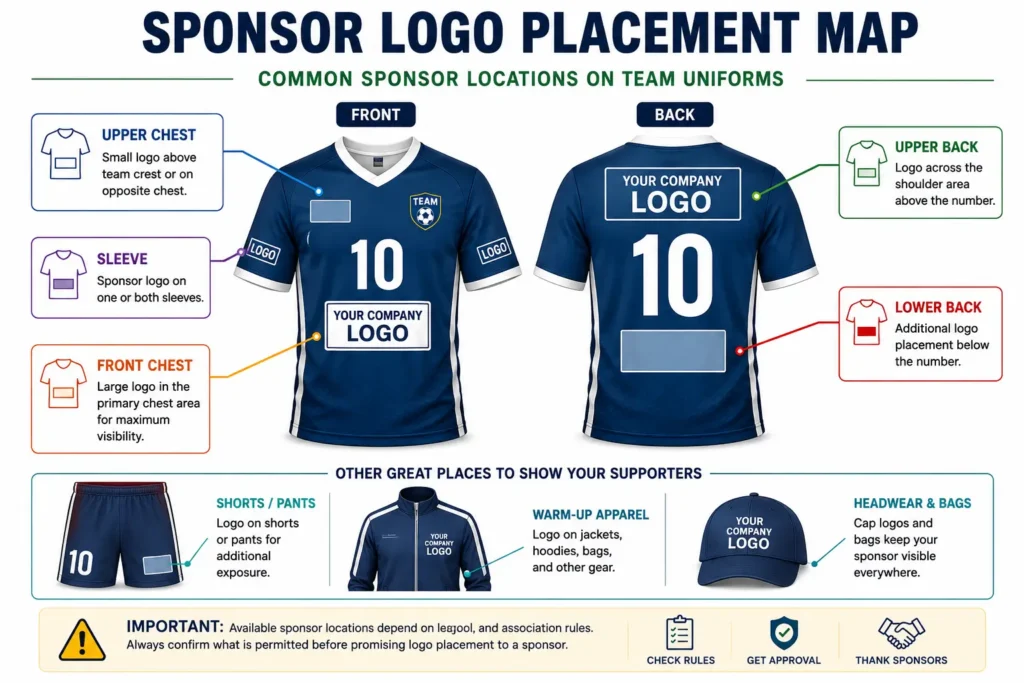
Before offering jersey space to a sponsor, find out what your league, governing association, school, club, or tournament rules permit. A sponsor may be delighted by the idea of having its logo displayed across the front of a jersey, but that promise becomes a problem if the league only permits a small sponsor mark in a particular location.
Restrictions can involve logo size, placement, the number of commercial marks allowed, or the types of businesses that may be promoted. Your uniform supplier may also have production requirements that affect how many logos can be included and how those logos need to be supplied.
The safest approach is simple: determine the available sponsorship inventory before selling it. Once you know which uniform locations and other recognition opportunities are actually available, you can build sponsorship packages around benefits you know the team can deliver.
The Best Businesses to Approach
When figuring out how to get sponsors for youth sports, begin close to the team rather than sending identical requests to every business in town. The strongest prospect is often a company that already has some connection with your organization. A player’s parent may own a business, a former player may operate a local company, or an existing club vendor may already understand the value of supporting the program.
Businesses serving local families are also natural prospects. Restaurants, automotive businesses, insurance agencies, real estate offices, financial services companies, physiotherapy and health clinics, sporting goods stores, tradespeople, contractors, and other locally owned companies may see value in being visible to the same community they serve.
Look for relevance as well as financial capacity. A smaller neighborhood business with a genuine relationship to your club may become a better long-term partner than a larger company receiving dozens of generic sponsorship requests every month.
Create a Professional Sponsorship Package
A sponsorship package does not need to look like a corporate annual report. It does need to answer the questions a business owner is likely to have before agreeing to support the team. Explain who the team is, the age group or program being supported, approximately how many players are involved, where the team plays, and what the sponsorship money will help purchase.
Include the season schedule or general playing area when it helps demonstrate local visibility. Explain the sponsorship opportunities being offered and how recognition differs between the available contribution levels. If uniform logo placement is included, identify the proposed location while making it clear that final placement remains subject to applicable uniform and league requirements.
The proposal should also contain the name and contact information of one person who will manage the relationship. Businesses should not have to contact several coaches, parents, and committee members to obtain an answer about the same sponsorship.
Make the Request Specific
“We are trying to fund the remaining $2,400 of our youth team uniform order” gives a prospective sponsor much more useful information than “We are looking for donations.” The business immediately understands the objective and can see how its contribution fits into the project.
Offer Sponsorship Levels That Match the Funding Gap
Bronze, Silver, Gold, and Title Sponsor packages can make the decision easier because a business can select a contribution that fits its budget. The important part is not the names. The contribution amounts should be designed around the amount your team actually needs to raise.
Suppose the remaining uniform cost is $3,000. You might decide that one lead sponsor could cover a large portion of the cost while several smaller businesses fund the balance. Another club may prefer six equal sponsors. There is no requirement that every team use the same structure.
Each level should also represent a genuine difference in recognition. If four sponsorship levels all receive almost identical benefits, there is little reason for a business to choose the larger contribution. A higher-level sponsor might receive more prominent recognition, additional website or social exposure, or inclusion on a team banner, provided those benefits can realistically be delivered.
What Sponsors Receive in Return
Uniform recognition is often the first benefit teams think about, but it should not be the only one. Where permitted, a sponsor logo might appear on a jersey, warm-up garment, practice apparel, or other team clothing. A club may also recognize sponsors through its website, social media accounts, email newsletters, tournament programs, field or arena banners, team photos, or season-end appreciation material.
Choose benefits the organization can consistently deliver. Promising weekly social media promotion sounds impressive during the sponsorship pitch, but it creates a problem if nobody on the team has the time or responsibility to post it. A smaller package of benefits that the club reliably provides is more valuable than a long list of promises that disappear once the season begins.
It also helps to document what each sponsor was promised. That record protects the relationship when coaching staff, volunteers, or committee members change during the season.
Plan Sponsor Logos Before You Order the Uniforms
This is where sponsorship becomes part of the actual uniform-ordering process. Do not wait until the uniforms are ready for production before asking sponsors for their logos. By that point, artwork problems or placement changes can create delays.
Once sponsorship agreements are confirmed, collect the required logo files and send them to the uniform supplier. Ask the supplier what file format is preferred and whether the supplied artwork is suitable for the chosen decoration method. Colors should also be checked, particularly when the sponsor normally uses a logo that may be difficult to reproduce against the team’s uniform colors.
The sponsor mark should appear on the uniform proof before production is approved. The team should verify spelling, logo orientation, colors, placement, and size at the same time it checks player numbers, names, team crests, and other decoration.
Think about replacement uniforms as well. If another jersey is ordered halfway through the season, the supplier should have enough information to reproduce the sponsor treatment consistently rather than creating a visibly different replacement garment.
Do Not Approve Production Too Early
A signed sponsorship agreement is not the same as approved uniform artwork. Confirm the sponsor logo on the supplier proof before giving final production approval.
Build Sponsor Relationships That Last Longer Than One Season
The easiest sponsor to approach next season may be the one already supporting the team this season. That only works if the business hears from the organization after the cheque has been deposited and the uniforms have arrived.
Send a genuine thank-you when the sponsorship is received, and follow it with something tangible during the season. A team photo showing the completed uniforms, a short update about the season, or an invitation to an appropriate club event can demonstrate that the contribution was noticed and appreciated.
At the end of the season, provide another update and thank the sponsor again. Keep accurate contact information and a record of what the business contributed and received. When planning begins for the following season, you are no longer making a cold sponsorship request. You are asking an existing community partner whether it would like to continue the relationship.
Sponsorship Mistakes That Can Cost Your Team Support
Many sponsorship problems begin because the team approaches businesses before completing its own planning. Asking for money without knowing the total uniform budget makes the request difficult to explain. Asking one company to cover an unrealistic portion of the order can have the same effect.
Another common mistake is focusing entirely on what the team needs while saying very little about what the sponsor receives. Businesses understand that youth programs need financial help, but a sponsorship proposal should still explain the partnership clearly.
Uniform promises are particularly important. Do not sell logo space until you know that the location is available and permitted. Likewise, do not send uniforms into production while sponsor artwork is still being collected or approved.
Finally, do not disappear after receiving the money. A business that hears nothing from the team for the rest of the season has little reason to feel connected to the program when another sponsorship request arrives the following year.
Youth Team Uniform Sponsorship Checklist
Use this checklist from the first budget calculation through sponsor recognition at the end of the season. Your progress is saved automatically in this browser.
Sponsorship Plan Complete
You have covered the major steps from budgeting through sponsor recognition. Keep the completed checklist with the team’s uniform-order records so sponsor commitments, artwork, and renewal information are available next season.
Turn This Season’s Sponsor Into Next Season’s Partner
Finding sponsors for youth team uniforms becomes much easier when the process begins with a real budget and a specific funding goal. Teams that understand their costs can make clearer requests, build sponsorship levels around actual needs, and avoid relying entirely on families to absorb the uniform bill.
The uniform order and the sponsorship process also need to stay connected. League restrictions should be checked before benefits are promised, sponsor artwork should be collected before production, and logo placement should be approved along with the rest of the uniform proof.
Most importantly, treat sponsorship as a relationship rather than a one-time transaction. Deliver the recognition you promised, keep the business informed, and acknowledge its contribution after the uniforms have been handed out. A local company that feels genuinely connected to the team may be willing to help again next season—and that can make future uniform planning considerably easier.
Continue Your Uniform Planning
Once funding is in place, continue through the Team Uniform Guide to work through budgeting, sizing, design, supplier preparation, ordering, and other decisions involved in outfitting the team.