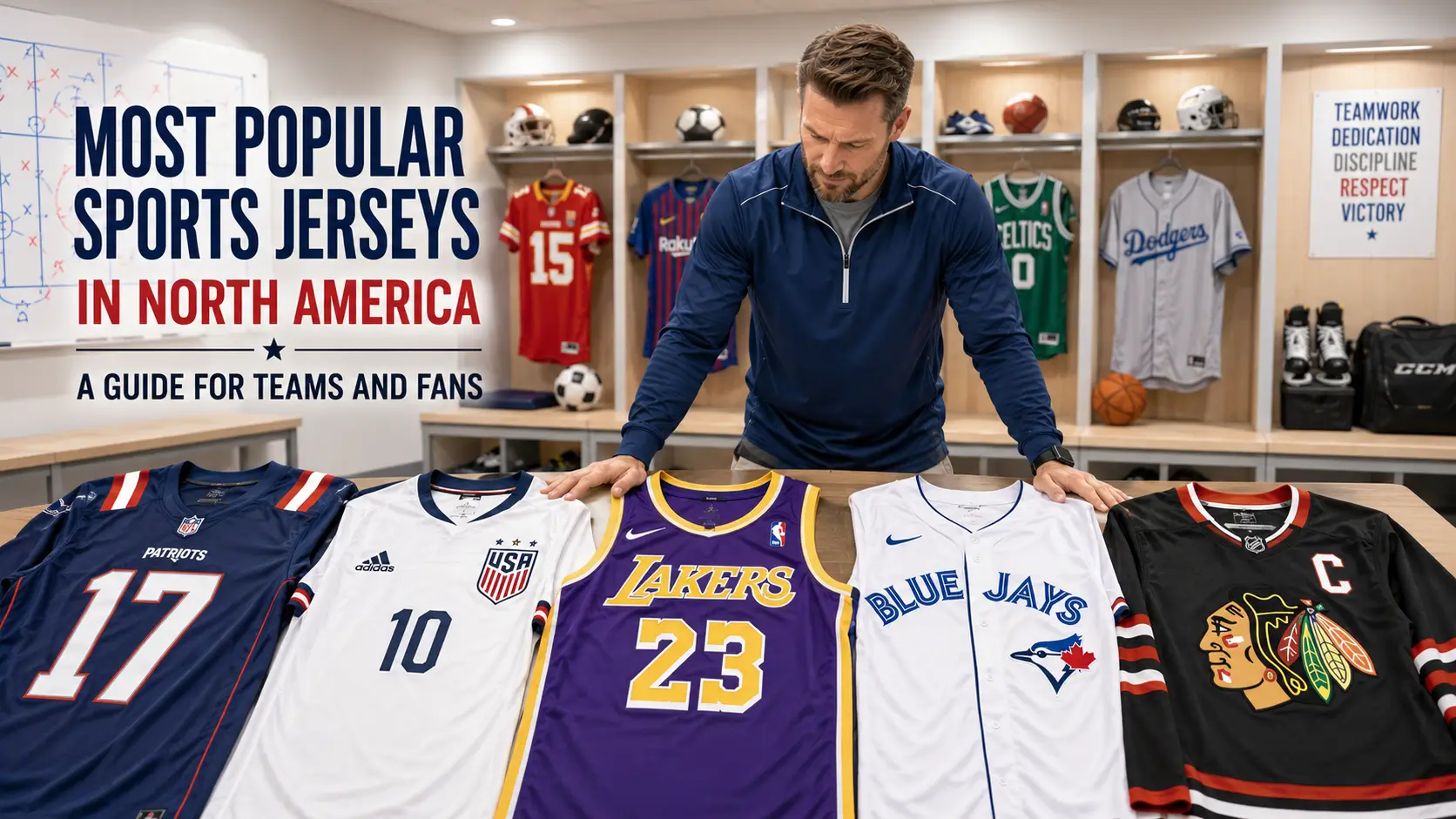
Sports jerseys are more than fan clothing. They represent teams, schools, cities, leagues, athletes, and entire communities.
Football, hockey, baseball, basketball, and soccer all have distinct jersey traditions in North America. Some jerseys are built primarily for athletes. Others are designed for fans, schools, youth teams, adult recreation leagues, tournaments, and community organizations.
The differences go beyond appearance. Each sport has its own fit, fabric requirements, decoration methods, and expectations for durability, comfort, and movement.
This guide looks at the most popular sports jersey styles in North America and explains what teams, coaches, schools, and organizations should consider before ordering custom jerseys.
✔️ Key Takeaway
The best sports jersey depends on who will wear it, how it will be used, and what the sport demands. Football, hockey, baseball, basketball, and soccer jerseys all require different fits, fabrics, and construction. For team orders, focus on comfort, durability, clear personalization, sizing, deadline, and reorder flexibility rather than choosing by appearance alone.
At A Glance
01
Compare Jersey Styles
Football, hockey, baseball, basketball, and soccer jerseys each have different fits, fabrics, construction, and design traditions.
02
Know What Makes One Good
Comfort, breathability, durability, readable numbers, and strong team identity matter more than appearance alone.
What Sports Jerseys Do for Teams and Fans
A sports jersey does something ordinary clothing does not: it connects the person wearing it with a team.
That team might be a professional franchise, a high school program, a local soccer club, a church league, a company tournament team, or a youth sports organization.
For fans, jerseys show loyalty. For athletes, they create a visible team identity. For coaches and managers, they help organize the roster and present the group as a coordinated team.
Schools and community organizations can also use jersey-inspired apparel for spirit wear, fundraising, tournaments, and events.
That emotional connection is one reason jerseys remain recognizable even when fashion trends change. A jersey can become a game-day tradition, a keepsake, a collectible, or a reminder of a particular season.
The most recognizable jersey styles in North America come from sports with large professional audiences, strong school programs, youth participation, and recreational leagues.
Most Popular Sports Jerseys in North America
Football Jerseys

Football jerseys are among the most recognizable team jerseys in North America. They are associated with professional football, college football, high school programs, youth leagues, flag football, and fan apparel.
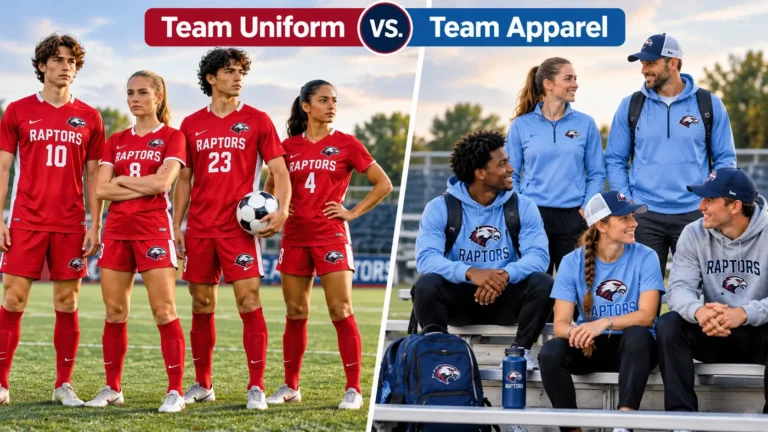
Player jerseys need enough room through the shoulders and chest to accommodate protective equipment. Fan versions are usually lighter, less structured, and easier to wear casually.
Custom football jerseys may include team colors, player numbers, names, sleeve details, school logos, and league marks.
For teams, durability is especially important because football jerseys can face pulling, contact, grass stains, weather, equipment friction, and repeated washing.
For fans, comfort and visual authenticity may matter more than on-field durability.
Hockey Jerseys

Hockey jerseys, often called hockey sweaters, have one of the strongest visual identities in sports.
Large front crests, sleeve numbers, shoulder patches, striping, and heavier construction are common features.
Player jerseys need enough room to fit over protective equipment without becoming excessively loose. Fan jerseys can often use a more casual cut because they are not being worn over full hockey gear.
For custom hockey teams, artwork quality and placement are especially important because the crest, sleeve details, numbers, and shoulder areas can all become major visual elements.
Baseball Jerseys
Baseball jerseys work equally well as athletic uniforms and casual sportswear.
Traditional button-front styles, pullovers, and lightweight performance jerseys are all common.
Typical design elements include script team names, chest lettering, player numbers, sleeve patches, piping, and contrasting trim.
Baseball-style jerseys are also popular for softball leagues, corporate events, schools, tournaments, and fan apparel because the design translates well beyond competitive play.
Basketball Jerseys
Basketball jerseys are lightweight, sleeveless, and designed for unrestricted upper-body movement.
They are used by school teams, youth leagues, clubs, adult recreation teams, tournaments, and fans.
Breathability and fit are especially important because basketball involves constant movement, repeated acceleration, jumping, and frequent changes of direction.
Custom basketball jerseys commonly include front and back numbers, team names, player names, and matching shorts.
Sublimation is often used when teams want gradients, patterns, multiple colors, or fully coordinated uniform sets.
Soccer Jerseys
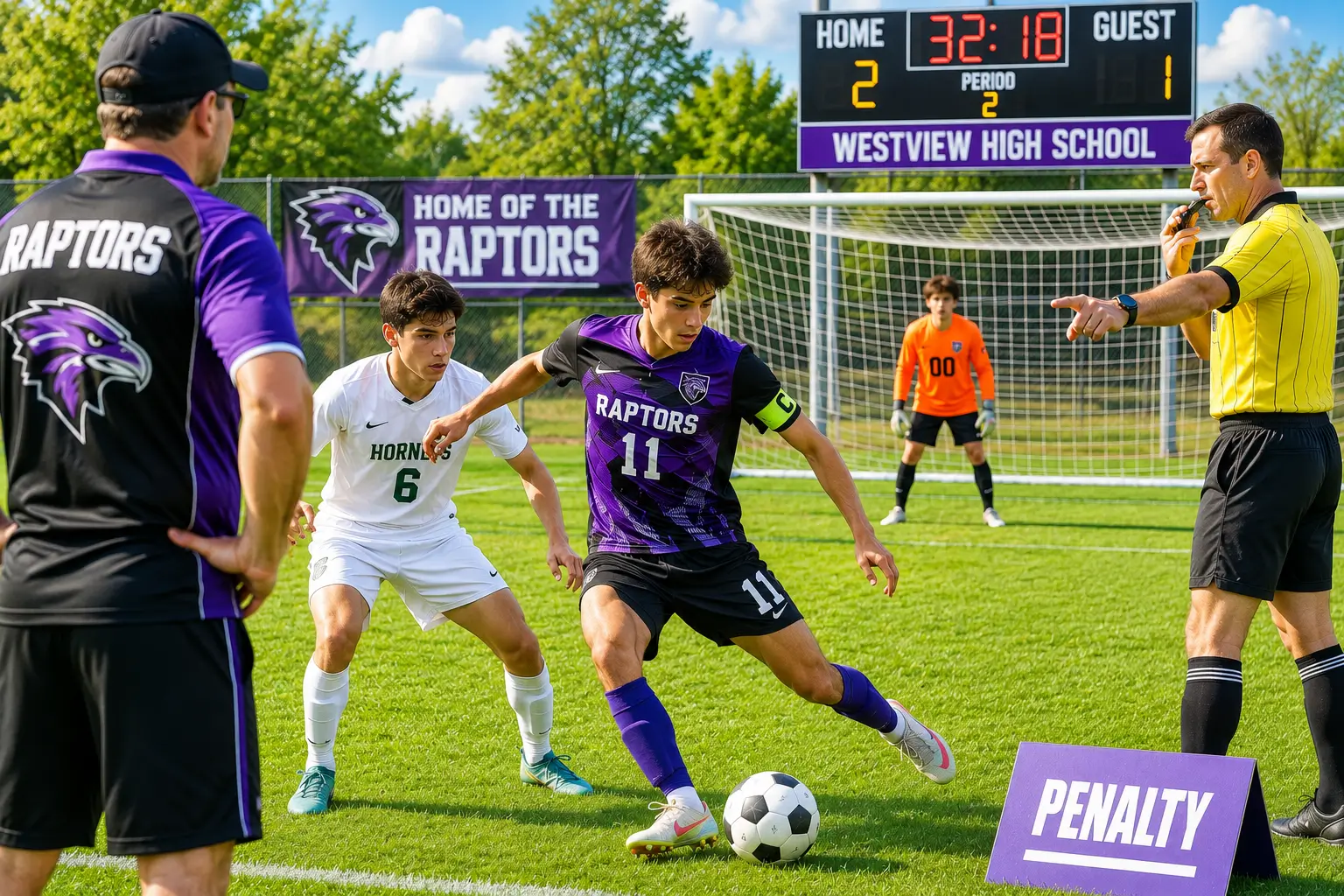
Soccer jerseys are among the most versatile sports jerseys because they are lightweight and can work well for both players and fans.
They are used by youth teams, school programs, clubs, adult leagues, indoor teams, tournament teams, and supporters.
Soccer jerseys typically emphasize breathable fabrics, moisture management, team crests, player numbers, sponsor placement, and compatibility with matching shorts and socks.
For organizations ordering custom soccer uniforms, the jersey is only one part of the full kit. Goalkeeper jerseys, shorts, socks, training apparel, warm-ups, and staff clothing may also need to coordinate visually.
Although the sports look different, the basic qualities of a good jersey are surprisingly consistent.
Five Qualities of a Good Team Jersey
1. Comfort
A jersey should allow the wearer to move without feeling excessively heavy, stiff, scratchy, or restrictive.
Fabric weight, texture, flexibility, fit, and construction all affect comfort. Lightweight polyester is common because it can provide durability without unnecessary weight. Mesh can improve airflow, while stretch fibers can help the garment move more naturally with the athlete.
2. Breathability
Sports jerseys often use polyester or performance fabrics because they can be lightweight and manage moisture effectively.
Breathability is especially important for soccer, basketball, training, indoor sports, and warm-weather competition.
3. Durability
Team jerseys need to survive repeated use and washing.
Depending on the sport, they may also face contact, equipment friction, sweat, outdoor weather, dirt, and rough handling.
Fabric and decoration should be selected so the jersey remains usable throughout the intended season or program.
4. Clear Names and Numbers
Player numbers should be readable from a distance by referees, scorekeepers, coaches, players, and spectators.
Fonts, colors, outlines, and placement should support readability rather than compete with the overall design.
5. Team Identity
Colors, logos, striping, patterns, sponsors, and typography should look deliberate and coordinated.
A successful jersey should make the team recognizable without becoming visually cluttered.
Buying custom jerseys for an entire team introduces decisions that do not exist when someone purchases one fan jersey.
Seven Things Teams Should Consider Before Ordering Custom Jerseys
1. Purpose
Start with how the jersey will be used.
A game jersey, practice jersey, tournament jersey, fan jersey, fundraiser jersey, and event shirt may not require the same fabric, construction, or decoration.
2. Fabric
Polyester is widely used for performance jerseys because it is lightweight, durable, and compatible with several decoration methods.
Mesh, moisture-wicking fabrics, stretch blends, and sublimation-ready polyester may also be useful depending on the sport.
3. Fit
Some jerseys are designed to fit loosely over equipment. Others require a closer athletic fit.
Youth, adult, extended, and gender-specific sizing may all matter within the same organization.
Use the supplier’s size chart or physical samples rather than guessing.
4. Decoration Method
The decoration process should match the garment, design, sport, quantity, and budget.
Sublimation, screen printing, heat transfer, DTF printing, and embroidery each have different strengths.
For a more detailed comparison, see our guide to team uniform decoration methods.
5. Budget
The required quality should reflect how the jersey will actually be used.
A full-season game jersey may justify a larger investment than apparel intended for a single tournament or promotional event.
6. Deadline
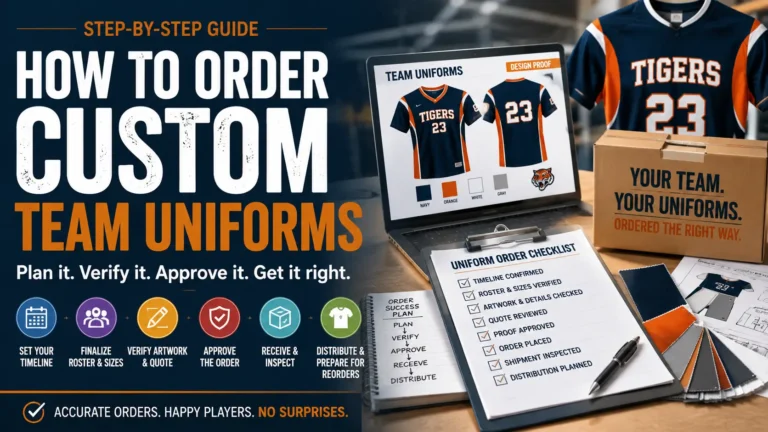
Custom team jerseys require time for sizing, artwork, proof approval, production, shipping, inspection, and distribution.
Do not build the schedule only around the advertised production time.
7. Reorder Plan
Late players, damaged jerseys, sizing changes, and future seasons make reorders an important part of the original decision.
Ask whether the supplier can reproduce individual jerseys later and whether minimum reorder quantities apply.
Common Fabrics Used in Sports Jerseys
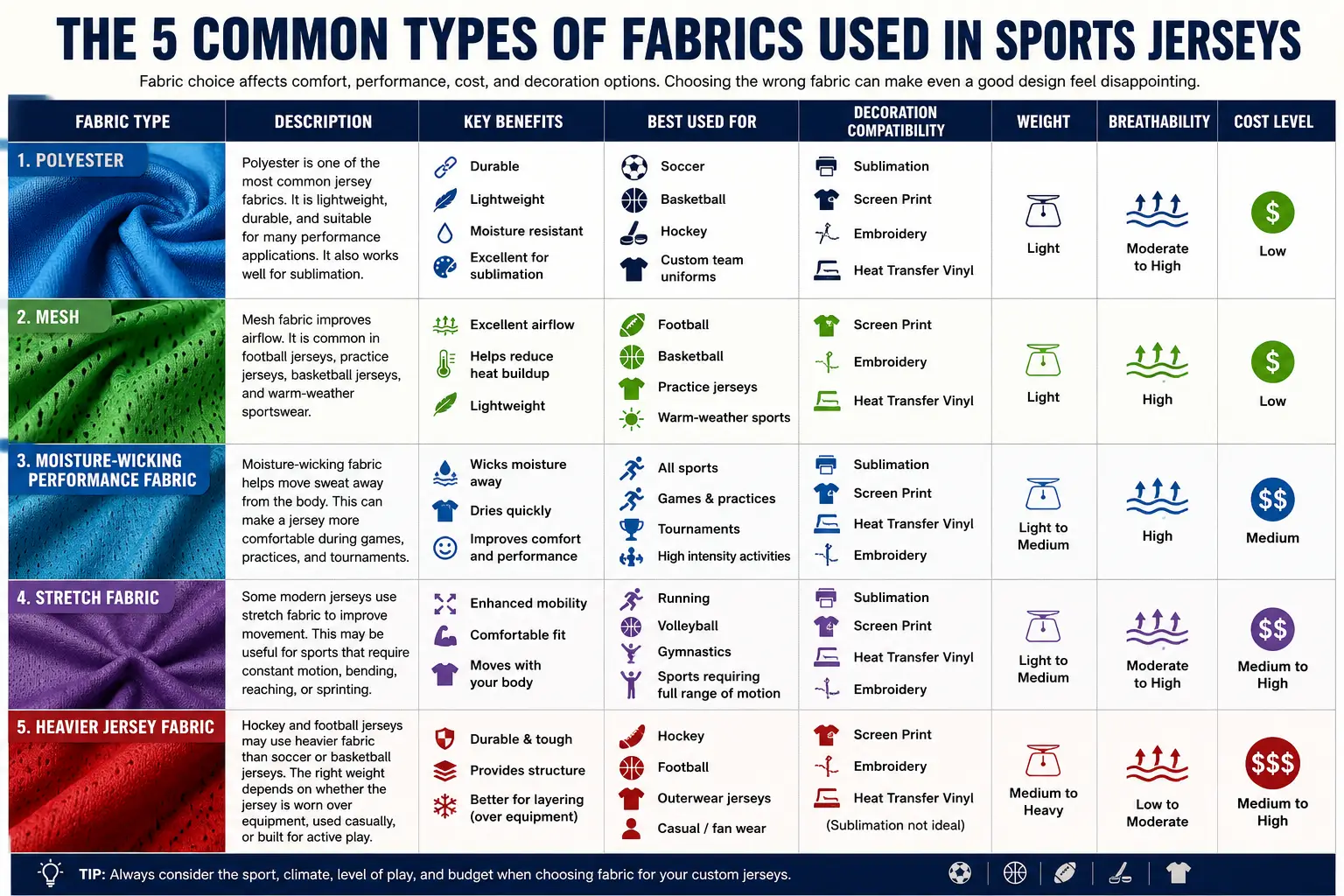
Fabric affects comfort, durability, weight, appearance, and decoration compatibility.
Polyester
Polyester is one of the most common jersey fabrics because it is lightweight, durable, quick-drying, and well suited to many performance applications.
Mesh
Mesh improves airflow and is often used in football jerseys, basketball jerseys, practice garments, and warm-weather sportswear.
Moisture-Wicking Performance Fabric
Moisture-wicking materials help move perspiration away from the body so the jersey does not remain as wet during activity.
Stretch Fabric
Polyester blended with elastane or other stretch fibers can provide greater flexibility for sports involving frequent reaching, bending, sprinting, and rotation.
Heavier Jersey Fabric
Football and hockey may require heavier or more structured materials than soccer and basketball, especially when the jersey is worn over protective equipment.
Jersey Printing and Decoration Methods
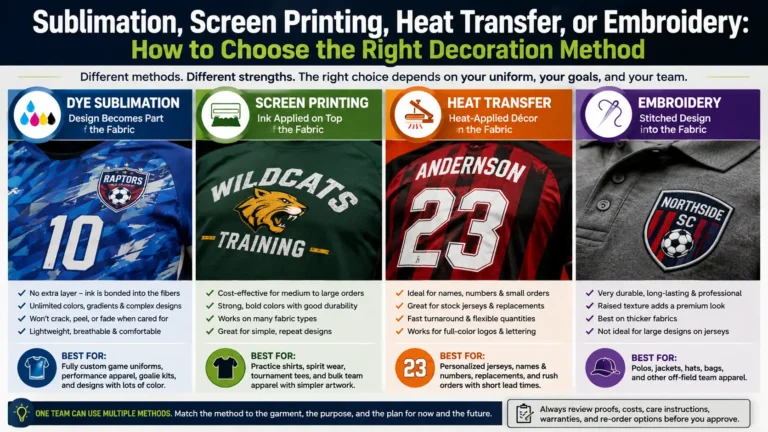
Sublimation
Sublimation allows full-color graphics to become part of polyester fabric rather than sitting as a separate layer on top.
It is widely used for soccer, basketball, hockey, esports, and other fully custom jerseys containing patterns, gradients, logos, names, and numbers.
Screen Printing
Screen printing works well for simpler repeated designs, practice shirts, team apparel, fan clothing, and larger quantities.
Heat Transfer
Heat transfer is commonly used for player names, numbers, smaller quantities, and late additions.
DTF Printing
DTF printing can accommodate detailed full-color graphics and flexible order sizes.
Embroidery
Embroidery is usually better suited to polos, jackets, hats, bags, and staff apparel than lightweight game jerseys.
Most ordering problems come from incomplete information or decisions made too late.
Seven Tips for Ordering Sports Jerseys for Your Team
1. Confirm the Roster
Create one complete player list containing names, numbers, sizes, and special requirements.
2. Choose Numbers Early
Resolve duplicate number requests before submitting the order.
3. Use the Supplier’s Size Chart
Do not assume sizing is identical between manufacturers. Physical samples are even better when available.
4. Approve Artwork Carefully
Check spelling, logo placement, team colors, sponsors, number styles, and every personalized detail before approving production.
5. Order Early
Allow time for design revisions, production, shipping, inspection, and corrections.
6. Plan for Extras
If the budget allows, consider spare jerseys in useful sizes for late additions or emergency replacements.
7. Keep the Design Information
Save the final artwork, color references, supplier information, roster, sizes, and order details so future reorders do not have to start from scratch.
School and Youth Team Jerseys
School and youth team orders often contain a wide range of sizes and may involve players, coaches, assistants, and volunteers.
Consistency becomes especially important when several teams represent the same organization. Shared colors, typography, logo placement, and design rules can help different teams look like part of the same program.
Youth jerseys should also be practical for families to maintain. Easy-care fabrics that wash and dry reliably can make a meaningful difference over a full season.
Fan Jerseys and Spirit Wear
Not every jersey needs to perform on the field.
Fan jerseys and spirit wear can support schools, booster clubs, tournaments, community teams, and fundraising programs.
A fan jersey may place greater emphasis on comfort, appearance, affordability, and everyday fit than competition-level construction.
Team stores can also expand beyond jerseys to hoodies, T-shirts, jackets, hats, and other branded apparel that carries the same identity.
Sports Jersey Trends
Retro Designs
Classic logos, striping, typefaces, and color combinations continue to appeal because they connect modern teams and fans with sports history.
Lightweight Performance Materials
Teams continue to prioritize jerseys that feel light, breathable, and comfortable during extended play.
Fully Custom Designs
Sublimation and other modern production methods allow more teams to use gradients, patterns, sleeve treatments, and integrated graphics.
Matching Team Apparel
Jerseys increasingly form one part of a larger apparel system containing warm-ups, hoodies, polos, bags, hats, training gear, and fan products.
Online Team Stores
Online ordering systems can reduce the administrative burden on coaches and volunteers by allowing players and supporters to purchase approved apparel directly.
Common Custom Jersey Mistakes to Avoid
- Ordering too close to the first game or tournament.
- Guessing sizes instead of using the supplier’s sizing information.
- Forgetting youth, extended, or goalkeeper sizes.
- Approving artwork without verifying spelling and numbers.
- Choosing fabric primarily because it is inexpensive.
- Using colors that do not match the organization.
- Failing to ask about reorders.
- Ignoring care instructions.
- Choosing a decoration method that does not suit the garment.
- Leaving no plan for late roster additions or replacements.
Frequently Asked Questions About Sports Jerseys
What are the most popular sports jerseys in North America?
Football, hockey, baseball, basketball, and soccer jerseys are among the most recognizable jersey categories across North American professional sports, schools, youth programs, recreational leagues, and fan culture.
What is the best fabric for custom team jerseys?
Polyester performance fabrics are common because they can be lightweight, durable, quick-drying, and compatible with several decoration methods. The best fabric still depends on the sport and intended use.
Are sublimated jerseys better?
Sublimation can be an excellent choice for full-color polyester jerseys because the design becomes part of the fabric. It is particularly useful when the jersey includes patterns, gradients, multiple sponsors, names, and numbers.
What is the difference between a fan jersey and a team jersey?
Fan jerseys are primarily designed for casual wear and team support. Player jerseys may require sport-specific fit, performance fabrics, league-compliant colors and numbers, and greater durability.
How early should a team order custom jerseys?
Teams should allow enough time for sizing, artwork, proof approval, production, shipping, inspection, and possible corrections before the first required use date.
Should teams order extra jerseys?
Spare jerseys can be useful for late registrations, damage, replacement needs, and sizing issues when the budget permits.
Can custom jerseys be used for fundraising?
Yes. Fan jerseys and replica-style apparel can work well as spirit wear and fundraising products for schools, clubs, booster groups, and community organizations.
What should be included on a custom jersey?
Common elements include the team name, crest, player number, player name, sponsor marks, school or organization name, sleeve details, and team colors. The design should remain readable and uncluttered.
The Best Jersey Fits the Sport and the People Wearing It
Football, hockey, baseball, basketball, and soccer jerseys all have different traditions and performance requirements, but they share one basic purpose: they identify the people wearing them with a team.
For fans, that connection represents support. For athletes, the jersey is part of the uniform. For schools and clubs, it can become part of a larger apparel system that includes warm-ups, staff clothing, spirit wear, fundraising products, and fan gear.
If you are ordering custom sports jerseys, start with the purpose of the order. Then work through the fabric, fit, decoration method, budget, timeline, personalization, and reorder plan.
The best jersey is not necessarily the most expensive or elaborate one. It is the jersey that fits the sport, the team, the season, and the people who will actually wear it.