 How to Size Team Uniforms
A Step-by-Step Guide for Coaches
Team uniform sizing seems simple enough, at least until the order has already gone into production. A player says they are a size medium. A parent remembers last season’s size. A coach copies old roster information. Then the new uniforms arrive and the fit is wrong because the supplier’s sizing, garment cut, protective equipment, or player growth was different from what everyone expected.
Once the names, numbers, logos, and other personalization have been added, fixing those mistakes can become expensive. Exchanges may be limited, individual replacements can take time, and the team may end up with inconsistent sizing across the entire roster.
The safest approach is to treat uniform sizing as a short process rather than as a best guess. Instead, start with the exact supplier and product, then build the roster, collect measurements, use samples or a sizing kit when possible, test the garments in realistic conditions, record each player’s choices, and verify the final list before production.
This guide walks coaches, managers, and uniform coordinators through that process – step by step.
What to Take Away
Do Not size a team from last season’s labels or from memory. Use the supplier’s product-specific chart, try on sample garments when possible, account for sport-specific layers and growth, record each garment size separately, and have the player or parent verify the final selection before the order is approved.
Team Sizing at a Glance
Use the Right Chart
Size against the exact supplier, product, and garment cut you plan to order.
Measure
Collect useful body measurements instead of relying on old size labels.
Try It On
Samples reveal fit issues that a chart alone cannot show.
Record Everything
Track jersey, shorts, pants, and special-role sizes separately.
Verify Before Production
Review the roster and get confirmation before personalized garments are made.
Why the Label on an Old Uniform Isn’t Enough
A size label is only useful when it refers to the same product, supplier, garment cut, and fit standard. A size medium from one manufacturer may not fit like a size medium from another manufacturer. Even within the same brand, two product lines can use different dimensions or construction methods.
Old uniforms also change over time. Garments can shrink, stretch, or become distorted through repeated washing and wear. A player may have grown or changed their build since the previous season. Protective equipment and base layers may be different. All of those factors make “I wore a medium last year” a weak basis for a new custom order. Use old uniforms as a reference if they help the player explain what they liked or disliked about the fit. But don’t use the label as the final answer.
Use the Supplier’s Product-Specific Size Chart
Once you know which garment the team plans to order, get the exact size chart for that product. Do not use a general chart from another supplier or a different jersey line just because it looks close. Pay attention to what the chart is measuring. Some charts provide body measurements, such as chest, waist, or hip size. Others provide finished-garment measurements. Those are not the same thing. A garment measurement includes the way the product is constructed and the ease built into the fit.
Also check whether the supplier offers separate youth, adult, women’s, men’s, or unisex cuts. A size medium in one cut should not be assumed to match a medium in another. If the chart is unclear, ask the supplier how they recommend using it before collecting the team’s sizes. This is especially important when the order is personalized or non-returnable.
Build a Complete Roster Before Collecting Sizes
Uniform sizing works better when the team starts from one master roster rather than collecting information through scattered messages, emails, or paper notes. List every athlete who will receive a uniform and identify any role that changes the garment package.
Goalkeepers, catchers, or other special positions may require different jerseys, pants, or equipment allowances. If the team includes coaches or staff in the same apparel order, keep them in a separate section so game-uniform quantities do not become confused with staff apparel.
The roster should have space for each garment individually. A player can be one size in a jersey and another in shorts or pants. Treating the entire uniform as one size creates avoidable mistakes.
Also mark players whose status is not final. Late registrations, tryouts, injuries, or roster changes should be visible so the team knows which sizes are confirmed and which still require follow-up.
How to Take Useful Body Measurements
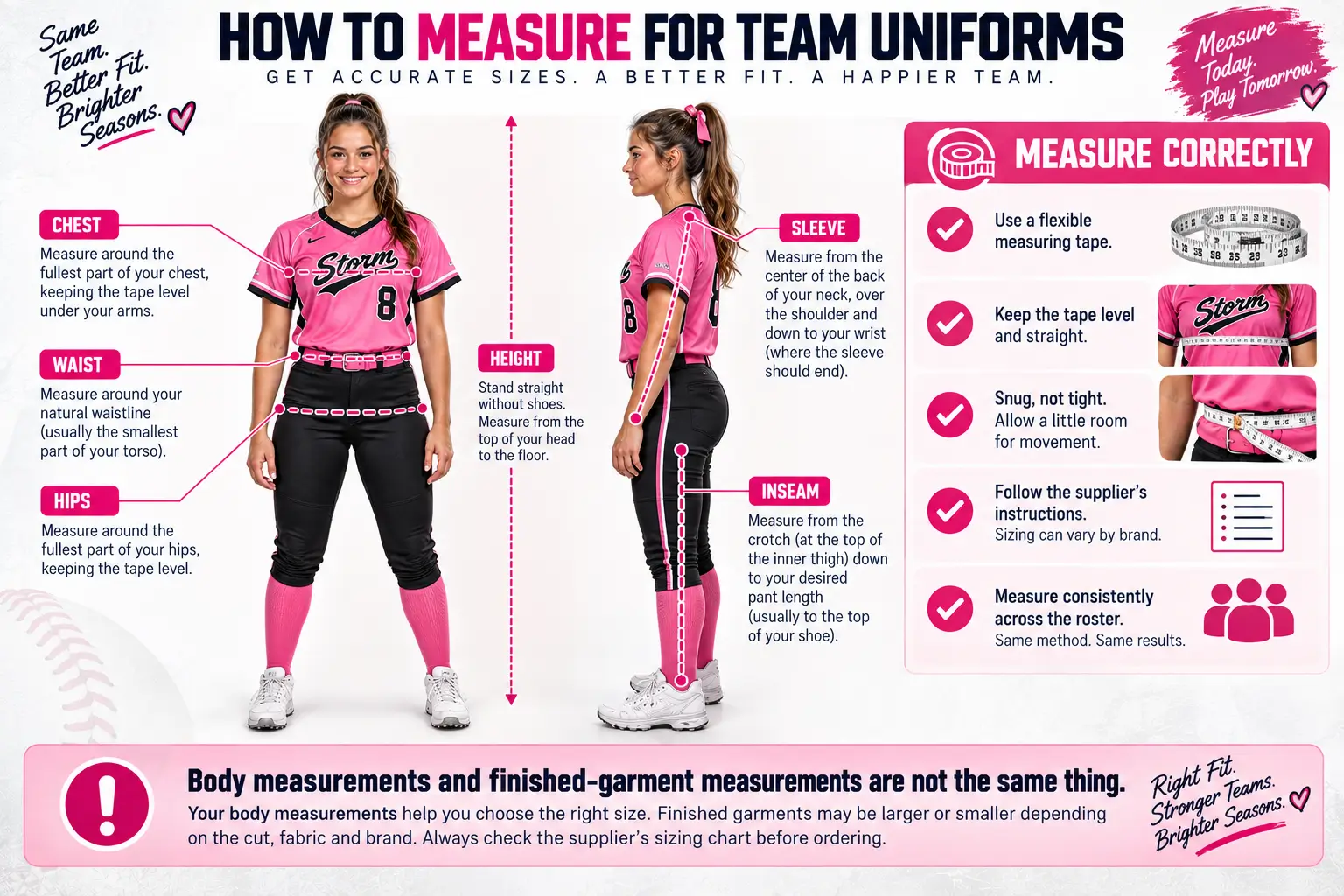
Measurements are most useful when they are taken consistently. Use a flexible measuring tape and follow the supplier’s instructions for the specific garment. If the chart asks for chest, waist, hip, inseam, or another measurement, take that measurement the way the supplier defines it. Avoid pulling the tape too tight or allowing it to hang loosely. The goal is not to make the number smaller or larger. It’s to give the supplier’s chart an accurate reference point.
For team orders, one person or a small group should handle the measuring process whenever possible. That reduces variation between players. If families are measuring at home, provide the same instructions to everyone and make it clear which measurements are required.
Measurements are a starting point rather than a guarantee of fit. Two athletes with similar measurements may prefer different amounts of room depending on the garment, sport, and way they move.
Why Sample Garments and Sizing Kits Are Better Than Guessing
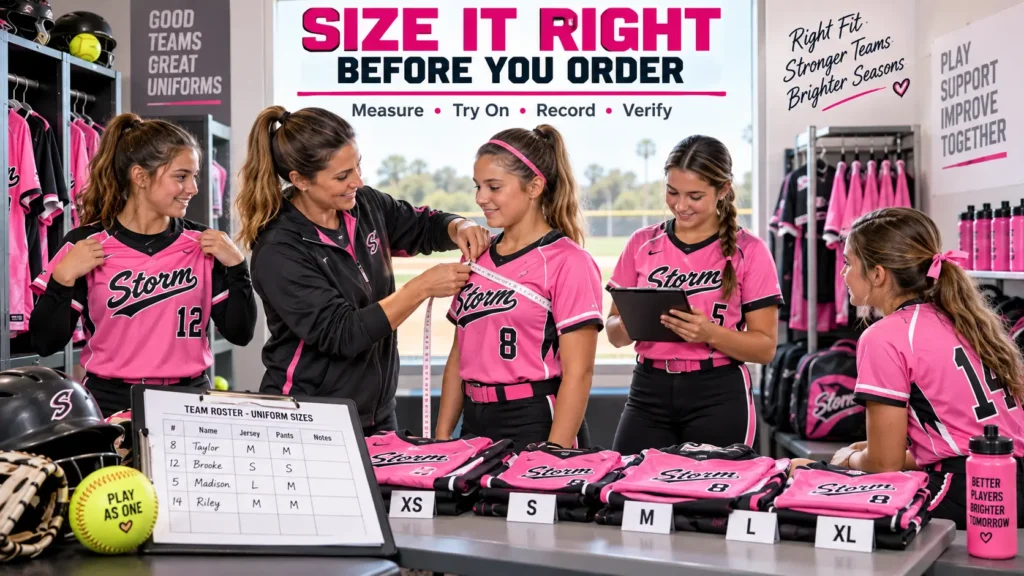
If the supplier offers a sizing kit or sample garments, use them. Trying on the actual or equivalent product gives the athlete information that a chart can’t provide: shoulder room, sleeve length, torso length, waistband feel, movement, and how the garment sits over any required layers.
A team fitting session also makes the process more consistent. Players can compare adjacent sizes instead of choosing blindly. Coaches or managers can record the final selection immediately rather than trying to reconstruct it later from text messages.
When samples are limited, schedule players in groups and keep the garments organized by size. Make sure the sample label is readable before recording the choice. A sizing session can create more confusion rather than less if people are passing garments around without tracking what was tried on.
If a supplier does not provide samples, ask if a comparable stock garment uses the same cut. That can still be more useful than relying entirely on a chart if the supplier confirms the fit is equivalent.
Account for Protective Equipment and Sport-Specific Layers
Some uniforms are worn directly over a base layer. Others must fit over substantial protective equipment. The sizing process should match the conditions in which the garment will actually be used. Hockey jerseys are a clear example. A jersey that looks correct over a T-shirt may be too tight once shoulder pads are added. When possible, players should try the sample jersey while wearing the protective equipment they normally use.
The same principle applies to goalkeeper gear, sliding shorts, chest protection, compression layers, cold-weather base layers, or other sport-specific equipment. If the garment needs to accommodate something during competition, include it in the fitting decision. Do not solve this by automatically ordering everything one size larger. Test the actual fit. Oversizing can create its own problems with movement, appearance, and safety.
Youth Athletes: Allow for Growth
Without Buying Uniforms That Are Too Large
Youth teams often face the hardest sizing decisions because players can grow between the fitting date and the end of the season. Some growth allowance can be sensible, particularly when the uniform is expected to last more than one season. That doesn’t mean every child should automatically move up a full size. A garment that is too large now may interfere with movement, create excess fabric, sit poorly under equipment, or simply look and feel uncomfortable for most of its useful life.
Use the sample garment to see how much room the next size actually adds. Consider the age of the athlete, the length of the season, expected reuse, and how forgiving the garment cut is. A small amount of usable room is different from buying a uniform the athlete must grow into.
When parents are involved in the final decision, explain the trade-off clearly. The goal is to find a practical fit for the present time while avoiding an unnecessarily short life for the garment.
Record Jersey, Shorts and Other Garment Sizes Separately
Don’t record one size beside a player’s name and assume that it applies to the entire uniform. Bodies are not built in standardized sets, and uniform pieces are often cut differently. A player may need a large jersey and medium shorts. Another may require youth sizing in one piece and adult sizing in another. Goalkeeper pants, warmups, base layers, or alternate cuts may introduce additional size choices.
Because of this, your roster should have a separate field for every garment being ordered. That becomes especially important when the team has home and away uniforms. If both sets use the same garment model, the sizes may match—but they should still be recorded clearly rather than assumed.
This same roster will later help with quantities, numbering, packaging, and distribution, so accuracy here saves work in several stages of the order.
Numbers, Goalkeepers and Special-Role Fit Notes
Record player numbers and special roles beside the sizing information before the order is finalized. This helps prevent a correct garment size from being personalized for the wrong player.
Goalkeepers and other special-role athletes may need additional fit notes. A goalkeeper jersey may require room for equipment. A catcher or other protected athlete may wear different pants or layers. Some players may need a longer or shorter cut where the supplier offers options.
Keep those notes with the master roster rather than relying on memory. The more personalized the order becomes, the more important it is to have one accurate source of information.
Have the Player or Parent Verify the Final Size
After the fitting is complete, show the recorded selection to the player or parent before production. This simple step catches transcription mistakes and prevents later confusion about what was chosen. Verification is particularly useful for youth teams, where a parent may be paying for the uniform and may want to confirm growth allowance or garment length. For adult teams, the player should confirm their own final choices whenever possible.
The verification should cover more than the size label. Confirm the player name, number, each garment size, and any special cut or fit note. If the uniform includes home and away pieces, make sure both are represented correctly. Keep the confirmation with the team’s master sizing record. You do not need a complicated system; you need a clear record that shows which entries are final.
Handle Missing Players, Late Additions and Uncertain Sizes Separately
Almost every team order has someone who misses the fitting session. Don’t let those incomplete cases weaken the rest of the roster. Mark missing players as unconfirmed and follow up through a separate process. If possible, schedule another fitting or provide access to the sample kit. If a player must measure at home, send the exact supplier chart and instructions rather than accepting a guessed size.
Late additions should go through the same sizing process as everyone else. Avoid assigning them a spare size simply because that garment is available unless the player has actually confirmed the fit. If a size remains uncertain close to the order deadline, document the risk and get explicit approval before submitting it. At least, that’s better than silently making the choice on someone else’s behalf.
Run a Final Sizing Review Before Production
Before the supplier starts its production, review the sizing roster one final time. Look for blanks, duplicate numbers, unusual size combinations, missing goalkeeper information, unverified entries, and anything else that changed after the fitting session.
Check that the garment names match the supplier’s order form and that youth, adult, women’s, men’s, or unisex cuts are clearly identified. A size medium is not enough information if the order includes multiple garment cuts.
Don’t forget to compare the sizing roster with the quantity plan. The number of confirmed garments should match the number the team intends to buy, including home, away, alternate, goalkeeper, and approved spare pieces. Once that review is complete, the team has a defensible sizing record rather than a collection of guesses.
Common Team Uniform Sizing Errors to Avoid
Most sizing problems come from shortcuts rather than from unusually difficult measurements. Watch for these 8 common mistakes:
- Using last season’s size labels: The player, product, or supplier may have changed.
- Using a generic size chart: Always size against the exact garment being ordered.
- Recording one size for the entire uniform: Jerseys, shorts, pants, and other pieces may require different sizes.
- Skipping samples when they are available: A fitting kit can expose issues a chart cannot.
- Ignoring protective equipment: Fit the garment the way it will actually be worn.
- Automatically sizing youth athletes up: Growth allowance should not make the uniform unusably large.
- Failing to verify the roster: Names, numbers, cuts, and sizes should be checked before production.
- Guessing for missing players: Keep incomplete entries visible until they are resolved.
Our companion article How to Measure Players and Avoid Costly Team Uniform Sizing Mistakes goes deeper into measurement technique and error prevention.
Frequently Asked Questions
Should we use measurements or let players choose a size?
Use both when possible. Measurements help narrow the range, while trying on the actual or comparable garment helps the player confirm comfort, movement, and preferred fit.
Do uniform sizes run the same across brands?
No. Sizing can vary between brands and even between product lines from the same supplier. Always use the chart for the exact garment you are ordering.
Should youth players order one size larger for growth?
Not automatically. Consider the player’s age, season length, expected reuse, and the actual difference between sizes. A little usable room can help; an oversized garment may create fit and performance problems.
What if a player falls between two sizes?
Try both sizes if samples are available and compare movement, length, equipment clearance, and personal preference. Record any fit note that explains the final choice.
Do players need to wear protective equipment during fitting?
If the uniform is worn over protective equipment, fitting with that equipment is strongly preferred. This is especially important for garments such as hockey jerseys and goalkeeper apparel.
Should home and away uniforms use the same size?
If both sets use the same garment model and cut, they usually will. Record them clearly anyway, especially if the team uses different products, cuts, or suppliers.
Who should be responsible for recording sizes?
Use one coordinator or a small consistent group whenever possible. That reduces duplicate records, mixed instructions, and transcription errors.
When should sizing happen?
Size the team after the garment and supplier are known but early enough that missing players, sample fittings, corrections, and final verification can be completed before the production deadline.
Your Next Step: Move From a Sizing Process to a Confirmed Team Record
The goal is not simply to collect a size beside every player’s name. The goal is to create a sizing record the team can trust before personalized garments go into production.
- Use the exact product chart
- Measure consistently
- Fit samples where possible
- Include sport-specific equipment
- Record each garment separately
- And verify every player’s final selection
- Then compare that record against the roster and quantity plan.
This is the role of the Stage 4 Sizing & Fit Tool in the Preferred Sports Wear planning system: turning individual fit decisions into one organized roster that can be reviewed before the team order moves forward.
If you are still deciding how many home, away, or alternate sets the team needs, review Home, Away and Alternate Team Uniforms: How Many Sets Do You Need?.
And if you are still settling the overall look, see Should You Redesign Your Team Uniform or Bring Back a Classic?.