Choosing a good pair of running shoes can be trickier than you think. Good shoes to get you through the day doing what you need to do can get expensive and can even affect your body more than you think. Even if you just need a good pair of shoes for general living (errands to the store, visiting, walking the dog, etc. ) can take some thought. You’ll agree with me come the end of the day and your feet are sore.
Road shoes, trail shoes, daily trainers, racing shoes, cushioning levels, support features and different shoe shapes can turn a simple purchase into a long comparison, but it will be worth it because, well, your feet won’t be sore. And NO. you don’t need to understand every footwear technology before buying a decent pair. But on the other hand, the more knowledge you have will make your next purchase that much faster and easier.
But this post is about running shoes. If you like to run and need great shoes for running, then the first question you might want to ask yourself is – Where will I run? How will I use these great shoes I want to buy? Will they fit my feet comfortably? Does their cushioning, support and construction make sense for my routine?
This guide walks you through those decisions in that order. It will also point you to more detailed footwear guides as you go deeper to making your decision.
✔️ Key Takeaway
- Choose the shoe for the activity first. Match it to your running surface and intended use
- Check fit, cushioning, support and construction.
- Compare individual shoes only after you’ve narrowed those requirements
- Brand name and price should not be making the decision for you.
Start With Where and How You Run
Before comparing brands, cushioning systems or technical specifications, identify what you expect the shoes to do. A runner covering regular distances on sidewalks and paved paths has different footwear requirements from someone running over loose dirt, rocks and roots. A recreational runner looking for one dependable pair also has different priorities from someone shopping for a specialized racing shoe.
Start with two questions:
- Where will I use these shoes most often? Roads, paved paths, trails, a treadmill or a mixture?
- What will I use them for? Everyday training, occasional jogging, walking and running, faster workouts or racing?
Those answers narrow the field before details such as cushioning, support and shoe construction enter the comparison.
Why the Running Surface Matters
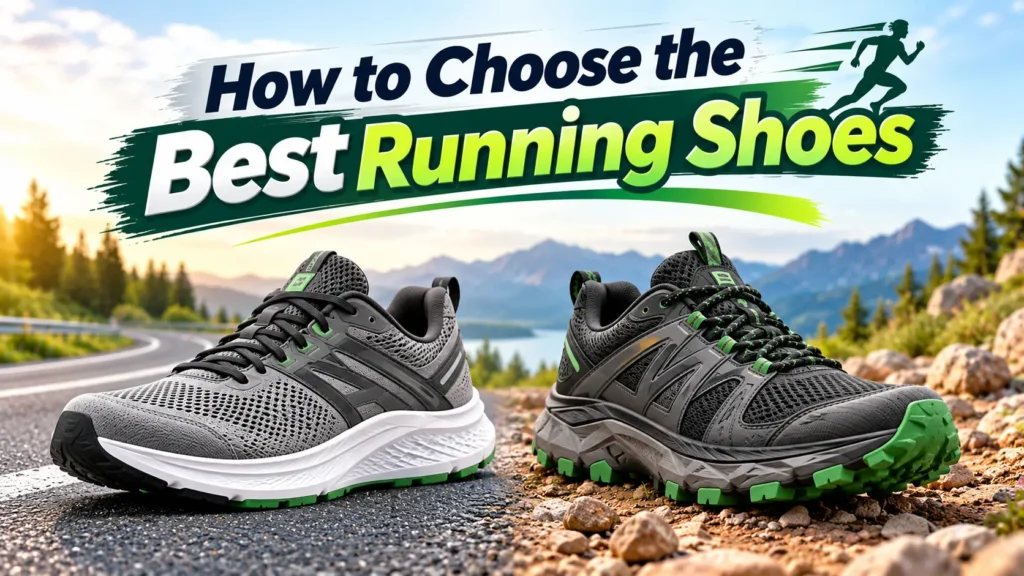
Shoes meant for running on roads are generally designed around predictable surfaces and repeated forward movement. A trail running shoe, on the other hand, may use a more aggressive outsole and additional protection for uneven terrain. The difference isn’t that one is inherently better. It’s that each shoe is built around a different job.
Why Your Main Use Matters
Many recreational runners need an everyday daily trainer. Others eventually add footwear for trails, faster workouts or races. A specialized shoe can make sense when you have a specialized need. It doesn’t automatically make sense simply because it’s lighter, more technical or more expensive.
Start here: Identify your main surface and primary use before looking at individual models. That eliminates many unsuitable shoes before fit, cushioning or brand enter the decision.
Choose the Running Shoe Type That Matches the Activity
Running footwear is designed around different surfaces and uses. Four categories account for many of the choices beginners encounter: road running, trail running, racing and walking shoes.
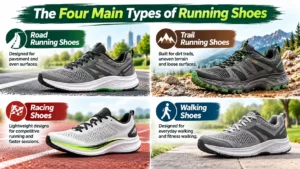
Road Running Shoes
Road running shoes are intended primarily for pavement, sidewalks and other relatively even surfaces. This category includes many everyday trainers as well as lighter or more specialized models.
Start here if: Most of your running takes place on roads, paved paths or treadmills.
Trail Running Shoes
Trail shoes are designed for unpaved and less predictable terrain. Depending on the model and intended conditions, they may use more pronounced outsole lugs, protective construction and different traction patterns.
Start here if: You regularly run on dirt, gravel, rocky trails, mud or other uneven surfaces.
Racing Shoes
A racing shoe places greater emphasis on performance during faster running. Some models use specialized foams or stiffening plates and can feel noticeably different from everyday trainers.
Consider these if: You already understand your basic running-shoe needs and want footwear for races or specific faster sessions.
Walking Shoes
Walking shoes belong in this comparison because many buyers combine walking, light jogging and everyday activity. Some running shoes work well for walking, but footwear designed primarily for walking may differ in flexibility, cushioning and construction.
Start here if: Walking is your main activity and regular running isn’t part of your routine.
Quick Comparison: Which Type Fits Your Main Activity?
| Shoe Type | Best Starting Point For | Common Characteristics | Check Before Buying |
|---|---|---|---|
| Road Running | Pavement, treadmill and even surfaces | Running-focused cushioning and road-oriented outsole | Fit, comfort, training use and outsole durability |
| Trail Running | Dirt, gravel and uneven terrain | Terrain-specific traction and added protection | Trail conditions, traction, protection and fit |
| Racing | Competition and selected faster sessions | Lower weight and performance-oriented construction | Fit, race distance, comfort and intended use |
| Walking | Fitness and everyday walking | Walking-oriented comfort and movement | Fit, flexibility, stability and walking distance |
If you’re deciding between categories, continue with Road Running Shoes vs. Trail Running Shoes vs. Racing Shoes vs. Walking Shoes. That guide handles the detailed category comparison so we don’t duplicate it here. Once you know which category fits the activity, you can start narrowing the shoes within it.
Understand Your Running Style Without Over-complicating It
Two people can run the same route and prefer different shoes. Foot shape, pace, training routine and comfort preferences all influence how footwear feels. You don’t need to diagnose your running mechanics before shopping, but understanding a few common terms makes product descriptions easier to interpret.
Foot Strike
Foot strike describes which area of the foot makes initial contact with the ground during a running step.
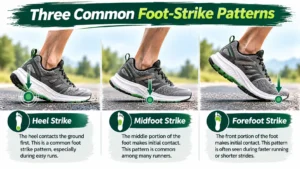
- Heel strike: The heel contacts the ground first.
- Midfoot strike: The middle portion of the foot makes initial contact.
- Forefoot strike: The front portion of the foot makes initial contact.
These descriptions explain movement; they don’t automatically prescribe a particular shoe. Surface, fit, comfort and training use still need to be considered.
What About Pronation?
Pronation is part of normal foot movement. The amount varies between runners, which is one reason manufacturers offer footwear with different support characteristics. Don’t choose a stability shoe solely because of a footprint test, visible pronation or the wear pattern on an old pair of shoes. If support is one of your main questions, continue with Neutral Shoes vs. Stability Shoes: What’s the Difference?. That article deals with the decision in detail.
Think About Your Actual Training
A more useful starting point is what you repeatedly ask the shoes to do. Are you running short recreational distances, training regularly, doing faster sessions, moving between pavement and trails, or combining running with walking?
For many recreational runners, a comfortable daily trainer is a sensible place to begin. Specialized footwear becomes more relevant when the activity creates a specific requirement.
Five Fit Checks Before Buying Running Shoes
A highly rated running shoe is still the wrong shoe if its shape doesn’t fit your feet. The size on the box is a starting point; how the shoe fits while you move is what matters.
1. Check the Toe Box
Your toes need enough room to move without your foot sliding excessively inside the shoe. Pay attention to the toe box. It should accommodate the shape and width of your forefoot without squeezing the toes together or creating obvious pressure points.
2. Check Heel Security
Your heel should feel comfortably contained rather than repeatedly lifting out of the rear of the shoe as you move. Some movement can occur, but persistent slipping can create friction and make the shoe feel unstable.
3. Check Width Separately From Length
If the shoe feels too narrow, automatically moving to a longer size isn’t always the answer. Extra length can introduce new fit problems while leaving the underlying width issue unresolved. Compare another width or a model with a shape better suited to your foot.
4. Wear Your Running Socks
Sock thickness affects the available space inside the shoe. Try prospective footwear with the type of socks you normally use for running. Feet can also change somewhat in volume during the day and during prolonged activity, so an extremely close fit while standing still may become less comfortable later.
5. Walk and Jog in the Shoes
Standing in front of a mirror won’t reveal everything about fit. Walk around and, where the retailer permits it, try a short jog. Pay attention to heel movement, pressure around the toes or sides of the foot, rubbing, and any uncomfortable contact around the upper or arch.
Fit rule: Don’t buy a running shoe that already causes significant discomfort because you expect it to “break in.” Running footwear should feel reasonably comfortable when you try it.
For the complete shopping and fitting process, continue with the Running Shoe Buying Guide.
Compare Cushioning, Support and Construction
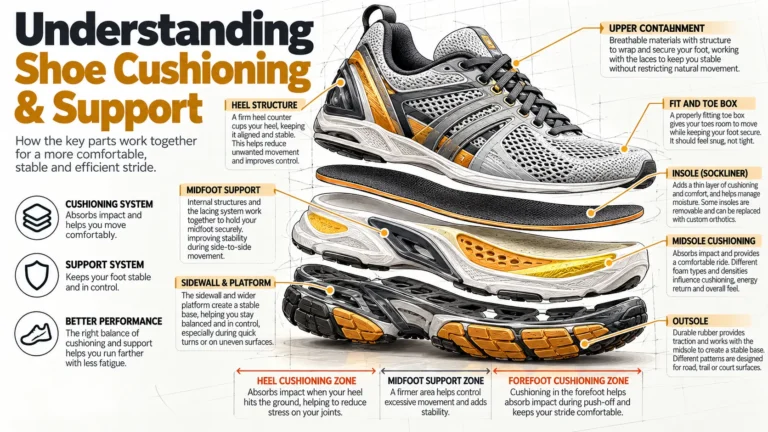
Once you’ve narrowed the shoe category and found models that fit, you can make better use of the specifications manufacturers provide. Three areas come up repeatedly: cushioning, support and the construction of the upper, midsole and outsole.
Cushioning: More Isn’t Automatically Better
Cushioning can feel soft, firm, responsive or somewhere between those descriptions. Runners also differ in how much material they prefer beneath the foot. Broadly, you’ll encounter lower-profile, moderate and maximum-cushioning designs. A visibly taller midsole doesn’t automatically mean the shoe will feel softer, fit better or provide the experience you prefer.
Support: Compare the Shoe, Not Just the Label
Support can come from the shoe’s shape, geometry, foam, sidewalls and other structural features. Terms such as “neutral” and “stability” can help organize the market, but they don’t replace trying the shoe and evaluating how it feels.
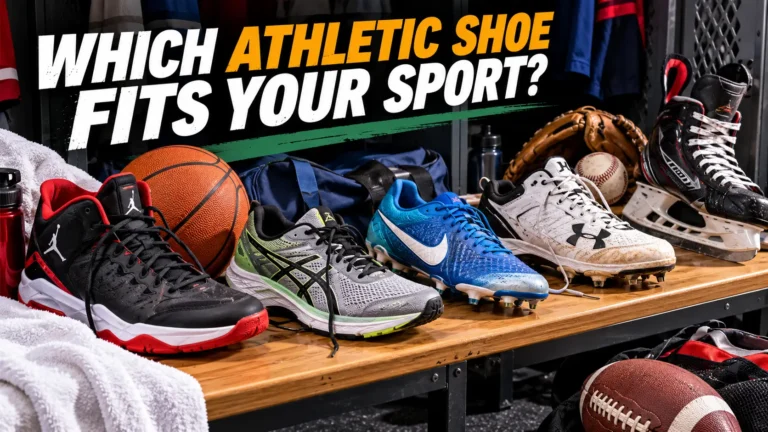
For the deeper explanation, use Athletic Shoe Cushioning and Support and Neutral Shoes vs. Stability Shoes.
Upper, Midsole and Outsole
The upper surrounds and helps secure the foot. Materials such as engineered mesh and knit uppers can be used to balance ventilation, flexibility and containment. The midsole sits beneath the foot and is responsible for much of the shoe’s cushioning and ride characteristics. The outsole meets the ground. Its rubber coverage, tread and overall design influence traction and durability.
A shoe can look ideal on paper and still be uncomfortable on your feet. Use technical specifications to compare suitable candidates—not to override fit and comfort.
Compare Individual Running Shoes, Not Just Brands
Once you’ve narrowed the category and fit requirements, you can compare individual shoes more meaningfully. Brand familiarity can be useful, especially if you’ve previously worn a particular model comfortably. But Nike, Adidas, Brooks, ASICS, New Balance, Saucony and other manufacturers each offer multiple shoe families with different shapes, cushioning systems and intended uses. Even two shoes from the same manufacturer can feel very different.
Use the Same Criteria for Every Shoe
| Buying Factor | What to Compare | Why It Matters |
|---|---|---|
| Primary Use | Road, trail, everyday training, racing or walking | Keeps unsuitable shoe categories out of the comparison |
| Fit | Length, width, toe box and heel security | The shoe’s shape has to work with your foot |
| Cushioning | Amount, firmness and overall underfoot feel | Comfort preferences differ between runners |
| Support | Neutral or stability design and other structural features | Helps compare models when additional support is a consideration |
| Outsole | Traction, tread, rubber coverage and intended surface | Roads and trails place different demands on the outsole |
| Upper | Width, ventilation, flexibility and foot containment | These characteristics affect fit and comfort |
| Price | Regular price, sale price and how you intend to use the shoe | A higher price doesn’t establish a better fit |
| Return Policy | Trial period, wear restrictions, exchanges and return shipping | A shoe may feel different after more than a few minutes |
What About Nike vs. Adidas?
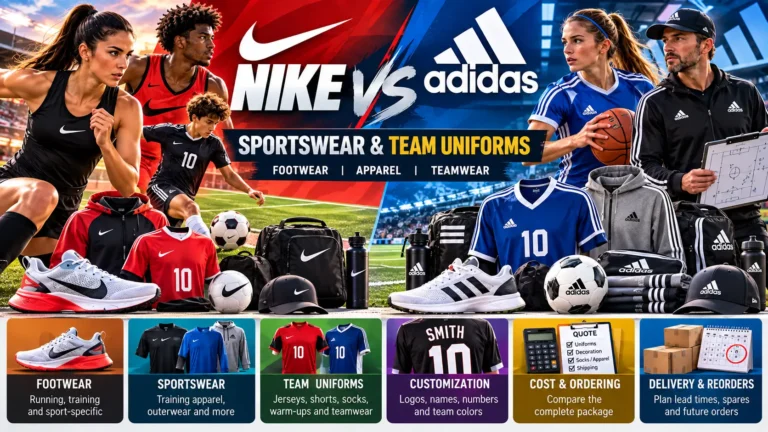
Nike and Adidas are frequently compared, but the same rule applies: start with the actual products rather than assuming one brand is universally better for running.
For the broader comparison—including athletic apparel and team uniforms—see Nike vs. Adidas: Comparing Sportswear, Footwear and Team Uniforms.
Then Compare Where You Buy
Once you have a shortlist, compare retailers as carefully as you compare shoes. A specialty running store may provide fitting help and opportunities to compare several models. Manufacturer websites can be useful for checking current specifications and available widths. Multi-brand retailers make side-by-side comparison easier.
For online purchases, check the footwear return policy before ordering. Also confirm shipping availability, currency and applicable import costs when purchasing across borders. Our Where to Buy Quality Athletic Footwear guide covers the retailer decision separately, including what to check before placing an order.
Six Running Shoe Buying Mistakes to Avoid
- Buying by appearance: Color and styling don’t tell you whether the shoe fits your feet or suits your activity.
- Ignoring the surface: Road and trail footwear can use substantially different outsole and traction designs.
- Assuming your usual size will fit: Shoe shape and sizing can vary between brands and models.
- Judging cushioning by midsole height: A taller-looking shoe isn’t automatically softer or more comfortable.
- Buying specialized footwear without a specialized need: A racing shoe isn’t automatically a better everyday trainer.
- Ignoring the return policy: This matters particularly when you can’t properly try the shoes before purchasing.
You should be able to answer four questions: What surface am I running on? What will I use these shoes for? Do they fit comfortably while moving? And why does this model suit me better than the alternatives I’m considering?
Use the Next Guide for the Decision You’re Making
You don’t need to research every aspect of running footwear at once. Continue with the guide that matches the question you still need to answer.
- Ready to shop? Use the Running Shoe Buying Guide for the full fitting and buying process.
- Unsure about cushioning or support? Read Athletic Shoe Cushioning and Support.
- Comparing neutral and stability shoes? Use Neutral Shoes vs. Stability Shoes.
- Still deciding between road, trail, racing and walking footwear? Use the Running Shoe Types Comparison.
- Know what you want and need a retailer? Continue to Where to Buy Quality Athletic Footwear.
The goal isn’t to find a shoe that wins every comparison. It’s to narrow the market until you’re comparing shoes designed for your activity, your feet and the way you intend to use them.
Frequently Asked Questions About Choosing Running Shoes
How do I choose the best running shoes for me?
Start with your primary running surface and intended use. Then compare shoes that fit comfortably in length, width, toe box and heel. Among the models that fit, compare cushioning, support, construction and price according to your training needs.
Are expensive running shoes always better?
No. Price can reflect materials, specialized construction and product positioning, but it doesn’t guarantee a better fit or more comfortable shoe for a particular runner.
Can I use road running shoes on trails?
Road shoes may work on relatively smooth, maintained paths, but more demanding trails can require different traction and protection. Match the shoe to the conditions you regularly encounter.
Should beginners buy maximum-cushioning running shoes?
Not automatically. Beginners can consider different cushioning levels. Fit, intended use and personal comfort are more useful starting points than simply choosing the shoe with the most material beneath the foot.
Do I need stability running shoes if I pronate?
Pronation is a normal part of foot movement, and visible pronation alone doesn’t determine whether you need a stability shoe. Compare how suitable neutral and stability models feel for you rather than choosing from a footprint test alone.
Can I wear running shoes for walking?
Many running shoes work well for walking. If walking is your primary activity, however, compare running footwear with shoes designed specifically for walking rather than assuming either category is automatically better.
How do I know when my running shoes need replacing?
Look for changes in fit or cushioning feel, worn outsole areas, damaged uppers or persistent discomfort. Replacement timing varies with the shoe, runner, surfaces and amount of use rather than following one mileage number for everyone.
The Running Shoe Buying Guide covers replacement considerations in more detail.