How to Stay Cool and Improve Your Performance with Sportswear Made for Hot Weather
Training or competing in hot weather puts additional demands on the body. As temperature and humidity rise, your body has to work harder to release the heat generated during exercise.
The clothing you wear cannot make hot-weather exercise safe on its own, but it can affect comfort, airflow, moisture management, sun exposure, and how easily body heat can escape.
For many athletes, that means choosing lightweight, breathable sportswear that does not trap unnecessary heat, fits the activity properly, and works with the conditions rather than against them.
Clothing is only one part of hot-weather preparation. Hydration, acclimatization, workout intensity, shade, rest breaks, weather conditions, and recognizing the signs of heat illness are equally important.
✔️ Key Takeaway
Hot-weather sportswear should help your body manage heat rather than add to the problem. Look for lightweight, breathable clothing with good moisture management, enough room for air movement, and appropriate sun protection. Then adjust your workout, hydration, rest, and exposure to the actual heat and humidity. No shirt, short, hat, or “cooling” fabric can make unsafe heat conditions safe.
Hot-Weather Sportswear at a Glance
01
Choose the Right Fabric
Lightweight, breathable materials can improve comfort and help perspiration move away from the skin during activity.
02
Give Heat Somewhere to Go
Hot-weather clothing should allow movement and ventilation without unnecessary layers or heavy fabric trapping heat against the body.
Why Exercising in Hot Weather Feels Harder
Exercise generates heat. Your body responds partly by increasing blood flow to the skin and producing sweat.
Sweat helps cool the body primarily when it evaporates. That becomes more difficult when humidity is high because the surrounding air already contains substantial moisture.
This is why the same temperature can feel very different on a dry day and a humid one.
As conditions become hotter, your body may need to devote more effort to temperature regulation. Exercise that normally feels manageable can begin to feel considerably harder.
Sportswear cannot eliminate that physiological strain. Its job is more modest: avoid unnecessarily interfering with heat loss, sweat evaporation, movement, and comfort.
The first clothing decision is the material sitting directly against your skin.
Choose Lightweight, Breathable Fabric
Hot-weather athletic clothing should generally avoid unnecessary weight and insulation.
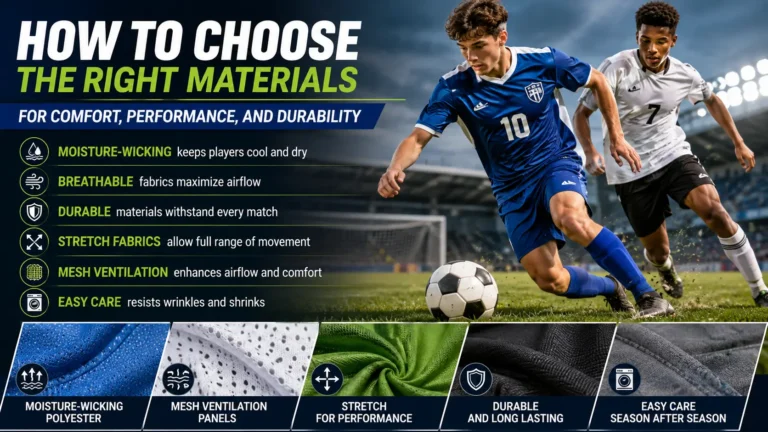
For many sports, lightweight synthetic performance fabrics work well because they can move moisture across the fabric and dry relatively quickly.
Polyester Performance Fabrics
Polyester is widely used in sportswear because it can be lightweight, durable, quick-drying, and engineered with different knit structures for ventilation and moisture management.
Performance polyester is common in soccer jerseys, running shirts, basketball uniforms, training apparel, cycling clothing, and other garments designed for sustained movement.
Polyester Blends
Polyester combined with elastane or spandex can add stretch while maintaining relatively low weight.
This can be useful for fitted training tops, shorts, compression garments, leggings, and sports where unrestricted movement is important.
Mesh and Ventilated Panels
Mesh can increase airflow in high-heat areas without requiring the entire garment to use an extremely open construction.
Depending on the sport and garment, ventilation may be placed:
- Under the arms
- Along the sides of the torso
- Across the upper back
- Behind the knees
- Along the inner leg
- In other areas where heat and moisture tend to build
What About Cotton?
Cotton is comfortable for casual wear, but it absorbs moisture readily and can remain wet longer than many performance synthetics.
For low-intensity activity, shade, or relatively dry conditions, some athletes may still find lightweight cotton comfortable.
For sustained exercise with heavy sweating, a lightweight performance fabric that dries more quickly is often more practical.
The important point is not that one fiber is always “good” and another is always “bad.” Consider the activity, sweat level, humidity, garment weight, and how quickly the fabric dries.
Moisture-Wicking Does Not Mean Sweat-Free
The term moisture-wicking is common in athletic apparel marketing, but it is easy to misunderstand.
A moisture-wicking fabric does not stop you from sweating or automatically lower your body temperature.
Instead, the fabric is designed to move moisture away from concentrated areas of the skin and spread it through the material, where it may evaporate more efficiently when conditions allow.
That can improve comfort and reduce the heavy, saturated feeling associated with some fabrics.
Humidity still matters. When the air is already very humid, evaporation becomes less efficient regardless of what shirt you are wearing.
Fabric matters, but the way the garment sits on the body can also affect hot-weather comfort.
Choose a Fit That Allows Movement and Airflow
Hot-weather sportswear does not necessarily have to be extremely loose, but it should not trap unnecessary heat or restrict movement.
Loose and Relaxed Fits
A slightly looser shirt can allow additional air circulation between the garment and skin.
This can work well for running, walking, recreational training, practices, coaching, and outdoor activities where aerodynamics or close-fitting uniforms are not priorities.
Fitted Performance Clothing
Some sports require or benefit from closer-fitting garments.
Cycling jerseys, compression clothing, fitted soccer apparel, running shorts, and other performance garments may sit relatively close to the body while still using lightweight fabrics, stretch construction, mesh, and moisture management.
The goal is not simply “wear loose clothing.” It is to avoid unnecessary thickness, restriction, and insulation while maintaining the fit required by the sport.
Reduce Unnecessary Layers
Extra layers can trap heat.
When conditions allow, simplify the outfit to the garments actually required for performance, safety, sun protection, or sport regulations.
Protective equipment is different. Helmets, pads, gloves, and other required safety equipment should not be removed simply to stay cooler. Athletes in equipment-heavy sports need additional attention to heat exposure, rest, hydration, and practice conditions.
Staying cooler and protecting yourself from the sun are related, but they are not exactly the same problem.
Consider Color and Sun Protection
Light Colors
Light-colored clothing generally absorbs less solar radiation than very dark clothing when exposed to direct sunlight.
White, light grey, pale blue, and other lighter colors can therefore be practical choices for outdoor training in strong sun.
Color is only one factor, however. Fabric weight, weave, airflow, fit, humidity, and sun exposure also affect how comfortable a garment feels.
UPF-Rated Clothing
Some athletic garments carry a UPF — Ultraviolet Protection Factor — rating.
UPF clothing is designed to reduce the amount of ultraviolet radiation reaching covered skin.
This can be useful for runners, coaches, golfers, cyclists, hikers, tournament staff, and athletes spending extended periods outside.
Short Sleeves vs. Long Sleeves
Less clothing does not always mean better hot-weather protection.
A lightweight, breathable long-sleeve garment with appropriate sun protection may be useful during extended outdoor exposure, particularly when direct sunlight is intense.
The tradeoff is additional coverage, so the fabric needs to be appropriate for warm conditions.
Hats and Headwear
Lightweight hats and visors can provide shade for the face and eyes.
For exercise, look for breathable construction, low weight, sweat management, and a secure fit.
A heavy or poorly ventilated hat can become uncomfortable during prolonged activity.
Build the Entire Hot-Weather Outfit
A breathable shirt will not help much if the rest of the outfit is heavy, restrictive, or poorly suited to the activity.
Hot-Weather Tops
Look for:
- Lightweight construction
- Breathable fabric
- Moisture management
- Ventilation where useful
- Low-friction seams
- Enough stretch for the activity
- Sun protection when appropriate
Hot-Weather Shorts
Shorts should allow unrestricted stride and leg movement without carrying unnecessary fabric.
Running shorts may use very lightweight shells and internal liners. Team-sport shorts may need more durability. Training shorts may require pockets and additional stretch.
Choose for the activity rather than assuming the lightest short is automatically the best one.
Socks
Feet can become hot and damp during summer exercise.
Athletic socks should fit properly, manage moisture, and avoid excessive bunching or friction inside the shoe.
Changing socks during long events or tournaments can sometimes improve comfort when the original pair becomes saturated.
Shoes
Footwear still needs to be chosen primarily for the sport and surface.
Breathable uppers can improve warm-weather comfort, but ventilation should not come at the expense of the traction, stability, protection, or durability required by the activity.
Our guide to choosing athletic shoes for your sport explains how running shoes, training shoes, court shoes, cleats, and other footwear differ.
Hot-Weather Sportswear by Activity
| Activity | Useful Clothing Priorities |
|---|---|
| Running | Lightweight top, breathable shorts, moisture-managing socks, low-friction construction, sun protection. |
| Soccer | Lightweight performance jersey, ventilated fabric, breathable shorts, appropriate socks, sport-specific cleats. |
| Basketball | Breathable sleeveless jersey, lightweight shorts, good moisture management, court-appropriate footwear. |
| Tennis and Pickleball | Lightweight stretch fabrics, sun protection, moisture management, secure pockets if required, court shoes. |
| Cycling | Technical fitted fabric, ventilation, sweat management, sun protection, sport-specific construction. |
| Hiking | Breathable layers, sun protection, quick-drying fabric, appropriate hat and footwear. |
| Gym Training | Breathable shirt, flexible shorts, moisture management, footwear matched to the workout. |
What About “Cooling” Sportswear?
Some athletic clothing is marketed specifically as cooling apparel.
Products may use highly breathable fabric, specialized yarns, mesh structures, moisture-spreading materials, reflective surfaces, or fabrics designed to feel cool against the skin.
Some products are also intended to be wetted before use so evaporation can create a cooling effect.
These features may improve comfort in appropriate conditions, but the term cooling should not be interpreted as protection from heat illness.
When comparing a cooling garment, ask:
- What exactly is producing the cooling effect?
- Does it require water or evaporation?
- Will high humidity reduce its effectiveness?
- How long does the effect last?
- Does the garment remain comfortable when saturated?
- Does it still meet the requirements of your sport?
A useful fabric feature can help with comfort. It does not replace safe decisions about heat exposure.
Hydration Matters More Than the Logo on Your Shirt
Hot-weather exercise increases fluid loss through sweating.
Hydration needs vary with body size, exercise intensity, duration, temperature, humidity, clothing, equipment, and individual sweat rate.
For shorter exercise sessions, water may be sufficient for many people.
Longer periods of heavy sweating may require additional attention to electrolytes and fueling.
Athletes should avoid turning hydration into a contest to consume as much fluid as possible. Both inadequate fluid replacement and excessive fluid intake can create problems.
For organized teams, coaches should have water readily available and build drinking opportunities into practices rather than treating hydration as something athletes must manage only after training.
Timing Your Workout Can Matter More Than Changing Your Shirt
When the weather becomes unusually hot, changing when you exercise can sometimes reduce heat exposure more effectively than changing clothing.
Early morning or later-day sessions may offer cooler conditions than training during the hottest part of the afternoon.
However, time of day alone does not tell the full story. Humidity, direct sun, air movement, surface temperature, and local weather conditions all affect heat stress.
Check the actual conditions rather than relying only on the clock.
When possible:
- Move demanding workouts to cooler conditions.
- Reduce intensity when heat and humidity rise.
- Use shaded areas for breaks.
- Allow additional recovery.
- Shorten sessions if necessary.
- Reschedule training when conditions become unsafe.
Give Your Body Time to Adjust to the Heat
Athletes who are not accustomed to hot conditions generally should not jump immediately into their normal training volume and intensity during a sudden heat wave.
Heat acclimatization involves gradually increasing exposure so the body can adapt to exercising in hotter conditions.
This is particularly important early in summer, after travel to a hotter climate, after an extended period indoors, or when organized practices begin during unusually warm weather.
Coaches should pay particular attention to athletes who are new, returning after an absence, or unfamiliar with the climate.
Good sportswear can improve comfort, but athletes still need to recognize when the problem is no longer clothing.
Know the Warning Signs of Heat Illness
Heat-related illness can develop during strenuous exercise in hot conditions.
Symptoms should never be dismissed as a sign that an athlete simply needs to “toughen up.”
Warning signs can include:
- Weakness
- Dizziness or faintness
- Headache
- Nausea
- Unusual fatigue
- Muscle cramps
- Confusion or altered behavior
If an athlete feels faint or weak, activity should stop and the athlete should move to a cooler location.
Confusion, collapse, loss of consciousness, or suspected heat stroke requires emergency medical attention.
Sportswear is never a reason to continue exercising through serious heat-illness symptoms.
Hot-Weather Clothing Mistakes to Avoid
Wearing Heavy Clothing to “Sweat More”
More sweat does not mean a more productive workout.
Adding unnecessary clothing in hot conditions increases the heat your body must manage and should not be used as a shortcut for fitness or weight loss.
Assuming Moisture-Wicking Means Cooling
Moisture management may improve comfort, but it does not make the body immune to environmental heat.
Ignoring Humidity
A breathable garment may still feel wet when evaporation is limited by high humidity.
Choosing Appearance Before Function
A garment that looks appropriate for summer may still use heavy fabric, poor ventilation, or a restrictive fit.
Forgetting Sun Protection
Staying cool does not eliminate the need to protect exposed skin and eyes during extended outdoor activity.
Believing Special Clothing Makes Extreme Heat Safe
No garment overrides dangerous environmental conditions.
Hot-Weather Sportswear Checklist
Before Training in the Heat
- Check the temperature, humidity, sun exposure, and overall conditions.
- Choose lightweight, breathable clothing appropriate for the sport.
- Use moisture-managing fabric when heavy sweating is expected.
- Avoid unnecessary layers.
- Consider lighter colors during strong direct sun.
- Use appropriate sun protection for outdoor activity.
- Choose socks and footwear suited to the sport and conditions.
- Have water readily available.
- Allow more rest as heat stress increases.
- Reduce intensity or duration when necessary.
- Allow time to become accustomed to unusually hot conditions.
- Know the symptoms of heat-related illness.
- Stop activity if you feel faint, weak, confused, or seriously unwell.
Frequently Asked Questions About Sportswear for Hot Weather
What is the best material for sportswear in hot weather?
Lightweight, breathable materials are generally preferable. Performance polyester and polyester blends are common because they can be lightweight, quick-drying, and designed for moisture management. The best fabric also depends on the activity, humidity, garment construction, and personal preference.
Is cotton bad for hot-weather exercise?
Not necessarily. Lightweight cotton can feel comfortable during casual or lower-intensity activity, but it absorbs substantial moisture and can remain wet. During sustained exercise with heavy sweating, quicker-drying performance fabrics are often more practical.
Do moisture-wicking shirts keep you cooler?
They can improve moisture management and comfort, particularly when sweat can evaporate efficiently. They do not guarantee a lower body temperature or prevent heat illness.
Should you wear loose clothes when exercising in hot weather?
Loose or relaxed clothing can improve airflow in many activities, but some sports require closer-fitting apparel. In those cases, lightweight, breathable fabrics and strategically placed ventilation can still help manage heat and moisture.
Are light-colored clothes better in hot weather?
Light colors generally absorb less solar radiation than dark colors when exposed to direct sunlight. Fabric weight, breathability, fit, and weather conditions still matter.
Do cooling shirts really work?
Some garments can improve comfort through evaporation, ventilation, moisture spreading, specialized fabrics, or cooling treatments. Their effect varies with the product and conditions, and they should not be relied upon to prevent heat illness.
Should athletes use sports drinks during hot-weather workouts?
Water may be adequate for many shorter activities. Longer periods of heavy sweating may require additional electrolytes and fueling depending on the athlete and conditions.
What should I do if I feel dizzy or weak while exercising in the heat?
Stop exercising and move to a cooler location. Heat-related symptoms can become serious and should not be ignored. Confusion, collapse, unconsciousness, or suspected heat stroke requires emergency medical attention.
Dress for the Heat, But Train for the Conditions
Hot-weather sportswear should make exercise more comfortable without creating a false sense of protection.
Start with lightweight, breathable fabric. Choose a fit that allows the movement and ventilation your sport requires. Consider light colors and sun-protective clothing during extended outdoor exposure. Avoid unnecessary layers and choose footwear appropriate for the activity and surface.
Then look beyond the clothing.
Hydration, acclimatization, workout intensity, humidity, shade, rest, and the timing of the session can matter just as much as the fabric in your shirt.
The goal is not to prove that you can endure the hottest conditions. It is to train or compete effectively while recognizing when the environment requires you to adjust.