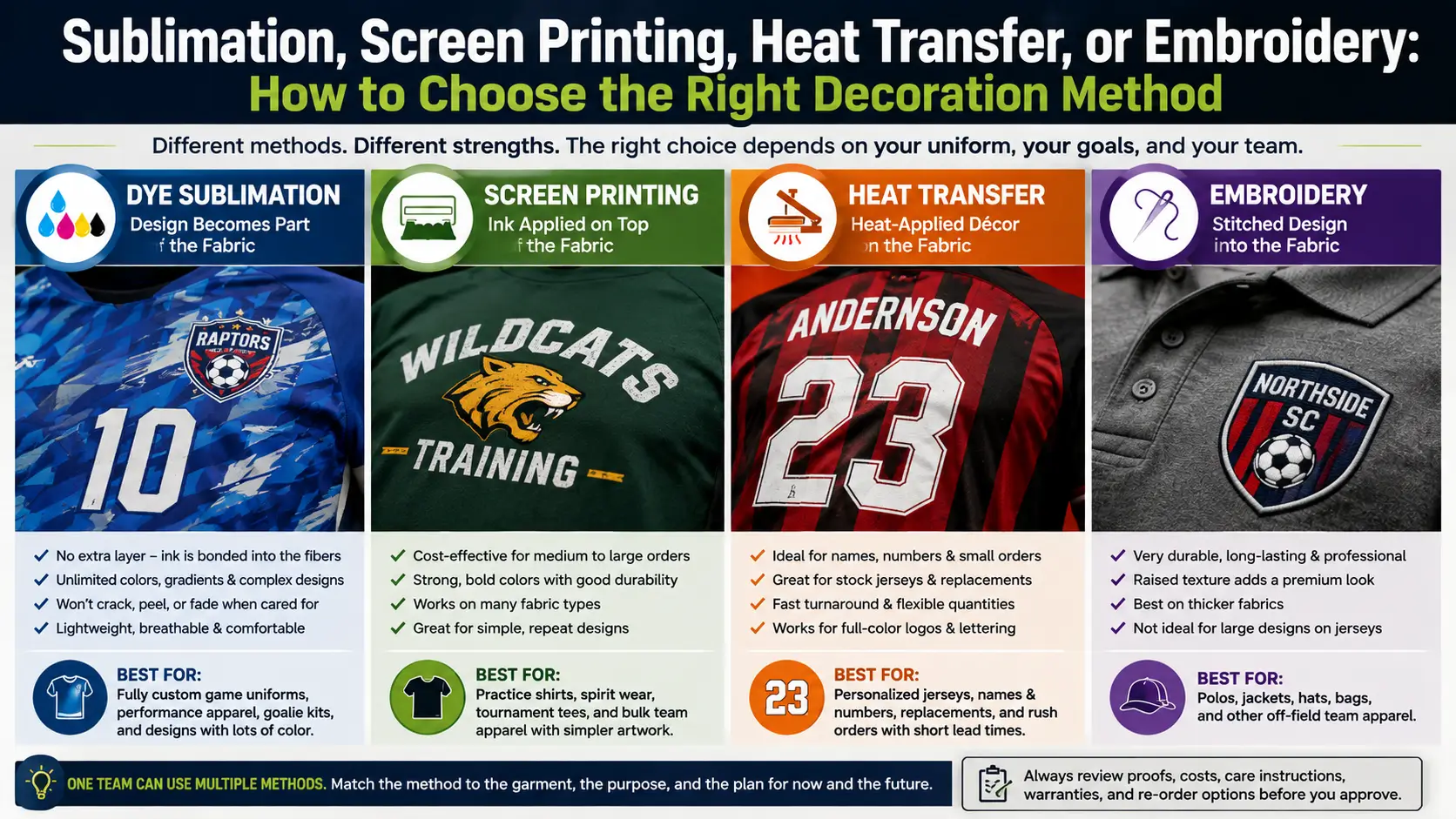
Matching the Look with the Function
Choosing a decoration method can change how a team uniform looks, feels, performs, and holds up over time. Sublimation, screen printing, heat transfer, and embroidery can all produce professional results, but they are designed for different jobs.
The right choice depends on what you are decorating, the best soccer uniform fabrics for the garment, how complicated the design is, the number of garments being ordered, and whether individual player names and numbers are required.
For many teams, the answer is not choosing one method for everything. Game jerseys, practice shirts, warm-ups, and coaching apparel may each benefit from a different decoration process.
✔️ Key Takeaways
- Dye sublimation works best for fully custom polyester performance uniforms because the design becomes part of the fabric rather than sitting on top of it.
- Screen printing is a practical choice for larger quantities of practice shirts and team apparel with relatively simple, repeated designs.
- Heat transfer provides flexibility for stock jerseys, individual player names and numbers, replacement uniforms, and smaller orders.
- Embroidery is highly durable but is generally better suited to polos, jackets, hats, and bags than lightweight game jerseys.
- Consider fabric, order quantity, breathability, personalization, future reorders, and cost before choosing a decoration method.
At A Glance
Dye Sublimation
Best for fully custom performance uniforms where colors, patterns, logos, sponsor graphics, names, and numbers are built directly into the garment design.
Screen Printing
Best for larger orders of practice shirts, team apparel, and simpler designs where the same artwork is repeated across many garments.
Heat Transfer
Best for stock jerseys, player names and numbers, replacement garments, smaller orders, and teams working with shorter production timelines.
Embroidery
Best for coach polos, jackets, hats, backpacks, and equipment bags where durability and a stitched appearance matter more than lightweight performance.
Dye Sublimation: When the Design Becomes Part of the Uniform
Dye sublimation is different from the other three methods because the decoration does not sit in a separate layer on top of the fabric. Heat and pressure are used to bond specialized ink with polyester fibers, making the colors and graphics part of the material.
This gives teams considerable design freedom. Gradients, stripes, geometric patterns, club crests, sponsor logos, player names, and numbers can all be incorporated into the same jersey design. Large graphics can extend across the chest, sleeves, shoulders, or side panels without adding multiple layers of decoration.
For players, one of the main benefits is that the decorated areas do not create the same added thickness that a large surface print or transfer can. The garment remains lightweight, flexible, and breathable.
Where Sublimation Makes the Most Sense
Sublimation is particularly well suited to soccer, basketball, volleyball, track, goalkeeper apparel, and other sports where lightweight polyester uniforms are common. It also works well when a team wants a distinctive design rather than a stock jersey with a logo added afterward.
There are trade-offs. Sublimation works best with polyester or polyester-rich fabrics, and a fully custom uniform may take longer to manufacture than an in-stock jersey that only needs decoration. Some suppliers may also have minimum order requirements.
Reorders deserve consideration as well. Adding one new player to a team later may require the supplier to manufacture another complete jersey rather than simply decorating an existing blank garment.
Screen Printing: A Practical Choice for Larger Quantities
Screen printing applies ink to the surface of a garment through a mesh stencil. Depending on the printing process, separate colors may require separate screens and additional setup.
That setup is one reason screen printing often becomes more economical as quantities increase. Once the job is prepared, the same design can be reproduced efficiently across a large batch.
Consider a club ordering 150 training shirts with the same one-color crest on the chest. Screen printing may be a much better fit for that job than individually producing fully customized garments.
Where the Trade-Off Appears
The printed design sits on the surface of the material. Small logos generally create little concern, but large solid graphics can make lightweight shirts feel heavier or less breathable in the decorated area.
Complexity can also affect the economics. Adding colors may increase setup requirements, while individual player names and numbers remove some of the efficiency gained by repeating the same design.
Screen printing is therefore most useful for practice shirts, tournament apparel, fan clothing, recreational team apparel, and other situations where relatively simple artwork is repeated across a medium or large order.
Heat Transfer: Useful When Every Jersey Is Different
Heat transfer uses heat and pressure to bond lettering, numbers, logos, or other graphics to the surface of a garment. The category includes several processes, such as cut vinyl, printed transfer films, direct-to-film transfers, and manufacturer-specific lettering and numbering systems.
Its biggest advantage for team orders is flexibility.
A supplier can start with stock jerseys and add a different name and number to each one. If another player joins the team later, a matching blank jersey may be decorated without recreating the entire original uniform order.
This can also make heat transfer useful when time is limited. Teams dealing with rush custom soccer uniform orders may be able to combine readily available stock garments with locally applied names, numbers, and logos.
Pay Attention to Transfer Quality
Heat transfers sit on top of the fabric, so the quality of the material and application matters. A properly applied transfer can provide good durability, while poor application can lead to lifting or peeling around the edges.
Large transfers can also create stiffness and reduce breathability over the decorated area. Washing and drying requirements should be checked because excessive heat may damage some transfer materials.
Ask the supplier what type of transfer is being used rather than treating all heat-transfer decoration as identical. Also confirm what happens if a name, number, or logo begins peeling prematurely.
Embroidery: Durable, but Not Ideal for Every Garment
Embroidery creates a design by stitching thread directly into the garment. It produces the raised, textured appearance commonly used for club crests and logos on polos, jackets, hats, backpacks, and equipment bags.
Durability is one of its major advantages. On an appropriate garment, a properly embroidered logo can withstand repeated use and washing while maintaining its appearance.
The problem is weight and stiffness. Embroidery requires thread and usually backing material. Dense stitching can pull on lightweight fabric, and the back of an embroidered area can be uncomfortable against a player’s skin.
A small crest may work on certain heavier jerseys, but large embroidered graphics are generally a poor match for lightweight performance shirts. Embroidery is usually better reserved for coach polos, quarter-zips, warm-up jackets, hats, backpacks, and equipment bags.
Decoration Methods Compared
| Method | Best Use | Durability | Design Freedom | Order Considerations |
|---|---|---|---|---|
| Sublimation | Fully custom performance uniforms | Excellent | Very High | Best when the complete garment is being custom manufactured |
| Screen Printing | Practice shirts and bulk apparel | Good | Moderate | More efficient when the same design is repeated across larger quantities |
| Heat Transfer | Names, numbers, stock jerseys, and replacements | Good when properly applied | High | Useful for personalization and smaller quantities |
| Embroidery | Polos, jackets, hats, and bags | Excellent | Moderate | Better suited to heavier garments |
One Team Order Can Use Several Methods
You do not need to choose one decoration method for the entire club.
A soccer team, for example, could use sublimation for its match jerseys, screen printing for practice shirts, heat transfer for personalized stock warm-ups, and embroidery for coaching apparel.
This allows the decoration method to match the garment rather than forcing every item into the same production process. It can also help teams control costs while reserving more extensive customization for the apparel where it provides the most value.
Think About Reorders Before Choosing
The first order is only part of the decision. Players join teams, jerseys get damaged, sizes change, and additional staff apparel may be needed later.
Ask whether the supplier can reproduce the same colors, logos, fonts, names, and numbers on a single replacement garment. Also find out whether the original artwork and decoration specifications will remain on file.
This is particularly important when comparing a fully custom sublimated uniform with a stock uniform that uses heat-applied personalization. The easiest option for the original order is not necessarily the easiest option when you need a single replacement jersey several months later.
Before You Approve the Decoration
A digital proof should show more than the basic jersey design. Check the size and placement of the club crest, sponsor logos, player names, and numbers. Make sure spelling, capitalization, and player numbers match the final roster.
Also confirm what is included in the quoted price. Names, numbers, additional logo locations, extra colors, artwork preparation, or embroidery stitch counts may affect the final cost depending on the supplier and decoration method.
✔️ Decoration Approval Checklist
- Confirm which decoration method is being used on each garment.
- Review the size and placement of every logo, name, and number.
- Check whether personalization or additional colors create extra charges.
- Ask about washing instructions and decoration warranties.
- Confirm how future replacement garments will be matched.
So, Which Decoration Method Should You Choose?
If you are ordering fully custom polyester game uniforms with extensive graphics, dye sublimation is usually the most natural fit. It provides substantial design freedom without placing additional decoration layers over the performance fabric.
If you need a larger quantity of shirts carrying the same relatively simple design, screen printing may make more sense.
For stock jerseys, individual player names and numbers, replacements, smaller orders, or shorter deadlines, heat transfer provides greater flexibility.
For coach polos, jackets, hats, backpacks, and equipment bags, embroidery provides the durable, raised appearance many teams want without placing that extra stitching on a lightweight game jersey.
Before deciding, consider the garment fabric, how the uniform will be used, order quantity, personalization requirements, future reorders, and your available team uniform budget.
Once those decisions are made, the decoration method becomes part of the larger process of designing custom soccer uniforms rather than something decided after the uniform is already designed.