Jersey Sizing Mistakes to Avoid and How to Measure Properly
Ordering the wrong jersey size can create problems that extend well beyond having one unhappy player. For a team order, sizing mistakes can lead to exchanges, replacement orders, additional shipping costs, delayed distribution, and players starting the season in jerseys that do not fit properly.
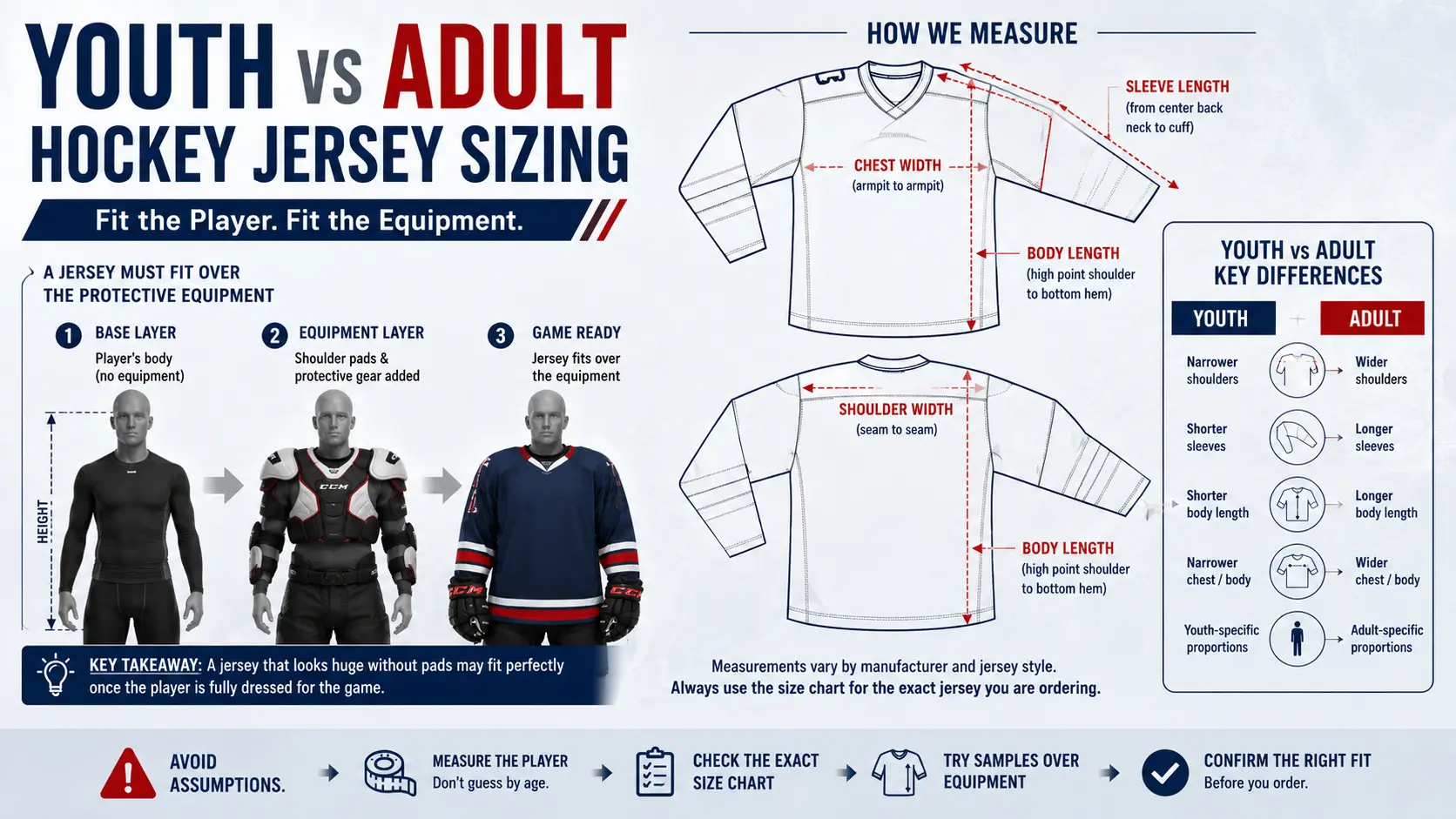
Hockey adds another complication because a jersey is not normally fitted over everyday clothing. It needs to accommodate shoulder pads and other protective equipment without becoming so oversized that the sleeves, body, and overall fit interfere with movement.
Youth vs adult hockey jersey sizing can be particularly confusing. A player who normally wears a youth XL in casual clothing may not automatically need the equivalent hockey jersey size, and moving into an adult size too early can create an unnecessarily loose fit.
The safest approach is to avoid assumptions. Measure players, use the specific manufacturer’s size chart, and whenever possible, have players try on sample jerseys while wearing their equipment before placing the final team order.
Key Takeaways
- Youth and adult hockey jersey sizes should not be treated as one continuous sizing system.
- Record actual player measurements rather than estimating sizes from age or previous jerseys.
- Compare measurements with the exact size chart supplied for the hockey jersey being ordered.
- Account for shoulder pads and protective equipment when determining the correct fit.
- Use sample jerseys whenever possible, especially for players between youth and adult sizing.
01
Fit Over the Equipment
A hockey jersey has to accommodate shoulder pads and protective equipment, not just the player’s body.
02
Youth and Adult Differ
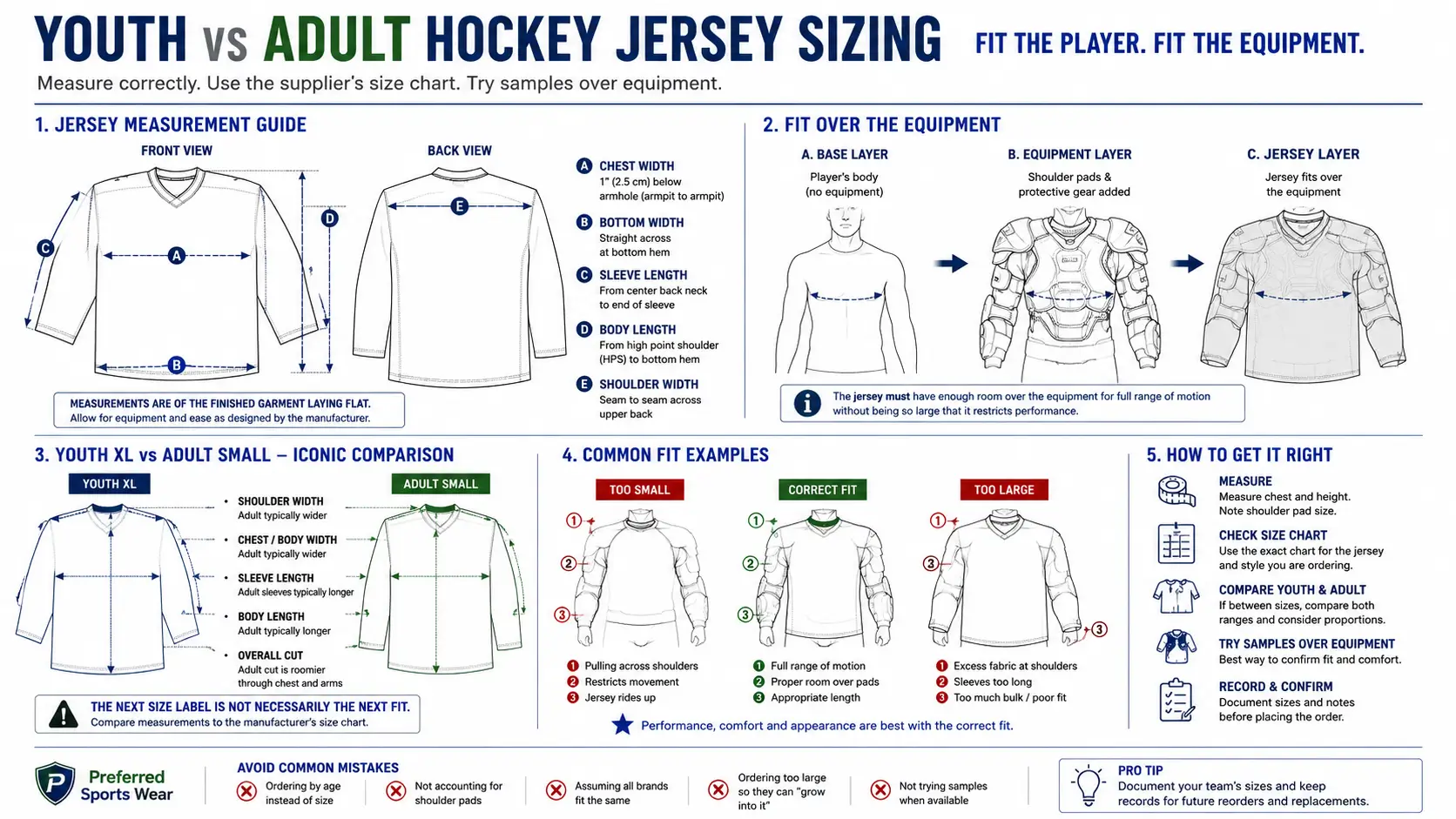
Do not assume youth XL simply leads into adult small or use a player’s age to decide when to switch.
03
Use the Exact Size Chart
Sizes can vary between manufacturers, jersey styles, and product lines, even when the labels are identical.
04
Measure and Try It On
Measure consistently and use sample jerseys over normal equipment whenever a fitting kit is available.
05
Keep Sizing Records
Document confirmed sizes and fitting notes so replacements and later orders are easier to manage.
Why Hockey Jersey Sizing Is Different From Other Sports
Hockey jersey sizing has to account for something that doesn’t affect many other team uniforms (except for heavy contact sports like tackle football maybe) : bulky protective equipment. A baseball or soccer jersey, or a baseball shirt is generally worn over a relatively thin base layer, unless of course someone invents tackle soccer or even better – tackle baseball 😁. Of course, in the real world, there is no no protective equipment underneath. A hockey jersey must fit over shoulder pads, elbow pads, and other equipment while still allowing the player to skate, shoot, pass, and move comfortably.
That changes what “fits” means. A jersey that appears loose when a player is wearing a T-shirt may fit correctly once the player’s shoulder pads are underneath it. Conversely, a jersey that looks appropriately fitted without equipment can become tight across the shoulders, chest, or sleeves once the player is fully dressed. This is why hockey uniform sizing should not be based solely on a player’s everyday clothing size.
The cut of the jersey also matters. Sleeve width, body width, jersey length, and shoulder construction can vary by manufacturer and style. Even when two jerseys carry the same size label, their actual dimensions and fit may be different.
For team managers, the goal is therefore not simply to determine if a player is small, medium, or large but rather to determine which size in the specific jersey being ordered provides enough room for that player’s equipment without creating excessive bulk.
Understanding the Difference Between Youth and Adult Hockey Jersey Sizing
One of the easiest mistakes to make is treating youth vs adult hockey jersey sizing as if the sizes simply go from youth sizes from small through youth XL or Extra Large and then continue directly into adult small. That assumption can cause problems. Youth hockey jersey sizes are generally designed around the proportions of younger players.
Adult jerseys are designed around adult body dimensions and equipment, which can affect chest width, body length, sleeve length, and the overall cut of the garment. The transition from youth to adult sizing is therefore not determined by age alone.
Two 12-year-old players, for example, could require different jersey categories because of differences in height, build, shoulder-pad size, and personal fit preference. One might still fit comfortably into the manufacturer’s youth range while another may require an adult size. Moving a player into an adult jersey simply because they are approaching a certain age can result in sleeves that are too long or excessive material through the body.
At the same time, keeping a larger player in youth sizing for too long can restrict movement once the jersey is worn over equipment. Instead of deciding when a player “should” move into adult sizing, compare the player’s measurements and equipment fit against the manufacturer’s youth and adult size charts.
Always Follow the Manufacturer’s Size Chart
A previous jersey can be a useful reference, but it should not become your team’s size chart. There is no universal hockey jersey size chart that applies to every manufacturer and every style of custom hockey jersey. A medium jersey from one supplier may not have exactly the same chest, length, or sleeve measurements as a medium jersey from another supplier.
Even different jersey lines from the same company can sometimes have different specifications. This becomes especially important when a team changes suppliers or jersey styles. If players simply submit the size printed inside last season’s jersey, the team manager may unknowingly be comparing two different sizing systems.
Before collecting final sizes, obtain the current size chart for the exact jersey your team intends to order. Check how the manufacturer defines its measurements and whether its chart provides garment dimensions, recommended player measurements, or both. If anything on the chart is unclear, ask the supplier how the measurements should be taken. That extra question is considerably easier to deal with than discovering a sizing problem after customized jerseys have already been produced.
Five of the Most Common Mistakes Made when Sizing Hockey Jerseys
Most hockey jersey sizing mistakes come from reasonable shortcuts that turn out to be unreliable.
- Ordering Jerseys Based on Age – Age brackets can provide a rough starting point, but they should not determine a player’s final size. Young players of the same age can differ considerably in height, build, and equipment size.
- Assuming Every Brand Fits the Same – A player who wore a medium last season does not necessarily need a medium from a different supplier. Always compare the player’s information against the size chart for the new jersey.
- Skipping Player Measurements – Collecting only a list of requested sizes is faster, but it removes an important opportunity to identify questionable selections before ordering. Measurements give the team manager and supplier something objective to compare.
- Ordering Too Large So a Player Can “Grow Into It” – Some growth allowance can make sense for youth teams, particularly when uniforms are expected to last more than one season. But deliberately ordering several sizes too large can create sleeves that are too long, excessive material around the body, and an awkward fit. Growth should be considered without turning the jersey into something the player cannot comfortably wear now.
- Forgetting About Shoulder Pads – This is one of the most important errors to avoid. A hockey jersey needs to work with the player’s equipment. A jersey that fits perfectly over ordinary clothes may be too restrictive once shoulder pads are added. The closer a player’s measurements are to the boundary between two sizes, the more valuable an actual fitting becomes.
How to Measure Players Correctly
You do not need an elaborate fitting system to improve the accuracy of your team order. A tape measure, the manufacturer’s instructions, and a consistent process can eliminate much of the guesswork.
- Start with the player’s chest measurement – Follow the manufacturer’s instructions regarding where the tape should be positioned and whether the chart uses body measurements or finished garment measurements.
- Record the player’s height as well – Height can be useful when comparing players who have similar chest measurements but very different body or sleeve-length requirements.
- Identify the player’s normal shoulder-pad size – Protective equipment can affect how much room the jersey needs through the upper body.
- Compare the measurements with the manufacturer’s hockey jersey size chart – rather than immediately converting them into a familiar clothing size. If the player falls clearly within one size range, the choice may be straightforward. If the measurements fall between sizes or different measurements point toward different sizes, flag that player for additional attention. This is where a sample jersey or advice from the supplier can be particularly useful.
- Most importantly, use the same hockey uniform measurement process for the entire team – Consistency makes the final roster easier to review and helps identify unusual size selections before the order is submitted.
Should Players Try Sample Jerseys Before Ordering?
This should be a No-Brainer. Whenever practical, the answer is YES. A sizing session using actual sample jerseys is one of the best ways to reduce uncertainty in team hockey jersey sizing. Ask the supplier whether a fitting kit or sample size run is available.
Ideally, players should try the samples while wearing the shoulder pads they normally use. This gives players and team managers an opportunity to evaluate more than just chest size. They can check sleeve length, jersey length, room through the shoulders, overall mobility, and the difference between youth and adult sizes.
A fitting session is particularly useful for players who are close to transitioning between youth and adult sizing. It can also identify unexpected situations. A player may discover that the size they have worn for another brand does not provide the same fit in the new jersey.
If the entire team cannot attend one fitting session, keep the samples available for a defined period and record each player’s confirmed selection. The objective is to turn sizing from a collection of guesses into a documented part of the ordering process.
Planning for New Players and Mid-Season Replacements
Sizing does not stop being important once the initial order has been submitted. Youth hockey teams can add players, replace damaged jerseys, or need additional uniforms during the season. Maintaining accurate hockey uniform sizing records can make those situations easier to manage.
Keep a roster showing each player’s ordered jersey size along with any measurements or fitting notes used to make the decision. If your supplier identifies jerseys by style number, product line, or fit, record that information as well. This becomes particularly useful when ordering replacement hockey jerseys months later.
Teams should also discuss potential extras before the original order is placed. Depending on the roster situation, budget, and supplier’s reorder policies, having one or more un-decorated or appropriately numbered spare jerseys may be useful.
However, avoid buying a random assortment of sizes without a reason. Ask the supplier about minimum reorder quantities, production times, and whether the same jersey style and colors are expected to remain available. A documented sizing system gives the team a better starting point when a new player arrives than simply asking, “What size jersey do you normally wear?”
Your 15 Point Youth Hockey Jersey Sizing Checklist
- Get the manufacturer’s current size chart for the exact jersey being ordered.
- Confirm whether the chart uses player measurements, garment measurements, or both.
- Measure each player’s chest according to the manufacturer’s instructions.
- Record each player’s height when it is relevant to the sizing chart or fit.
- Account for the player’s normal shoulder pads and protective equipment.
- Do not assign sizes based only on age.
- Do not assume sizes from another manufacturer will fit the same way.
- Identify players who fall between youth and adult hockey jersey sizes.
- Arrange a sample fitting or sizing session whenever possible.
- Have players try jerseys over their normal equipment when samples are available.
- Review unusually large or small selections before placing the order.
- Consider reasonable growth without deliberately over-sizing the jersey.
- Keep a written record of confirmed sizes and fitting notes.
- Ask the supplier about replacement jerseys and future reorder availability.
- Review the completed sizing roster before approving the final custom order.
Better Sizing Now Can Prevent Problems Later
Accurate hockey jersey sizing does not require complicated equipment or a professional fitting service. It requires a consistent process.
Start with the manufacturer’s current sizing chart. Measure players rather than relying on age or previous jersey labels. Account for shoulder pads and other equipment. When sample jerseys are available, use them.
These steps become especially important when determining whether a growing player should remain in youth sizing or move into an adult jersey.
Taking additional time during the sizing stage can help prevent exchanges, replacement orders, delays, and poorly fitting uniforms after production has started. For a team manager organizing a custom hockey jersey order, that makes sizing one of the details worth getting right before the final roster ever reaches the supplier.