What Should You Confirm With a Hockey Jersey Supplier Before Approving Your Order?
Approving a hockey jersey order is the point where planning turns into production. Once the supplier begins manufacturing customized jerseys, changing a size, correcting a player name, replacing a number, or moving a logo may no longer be simple.
Before giving final approval, review the entire order as one package. Confirm the roster, quantities, sizing, personalization, artwork, pricing, production schedule, delivery details, and future reorder terms rather than approving each piece separately.
The goal is not to slow down the order. It is to catch problems while they can still be corrected without replacement costs or missed deadlines.
✔️ Key Takeaway
Do not approve a hockey jersey order based on the design proof alone. Confirm the final roster, jersey quantities, player sizes, names and numbers, team colors, logos, complete price, production timeline, shipping arrangements, and replacement policy before authorizing production.
At A Glance
01
Roster and Quantities
Verify every player, goalkeeper, spare jersey, staff item, home jersey, and away jersey before the final order is submitted.
02
Sizes, Names and Numbers
Check each garment size, player number, name spelling, goalkeeper requirement, and any special fit information.
03
Final Artwork
Review colors, logos, sponsors, number placement, fonts, contrast, and every jersey view shown on the production proof.
04
Price, Timeline and Reorders
Confirm the complete delivered price, production start date, expected arrival date, correction policy, and future reorder terms.
A supplier may have already provided several emails, spreadsheets, mockups, price estimates, and roster revisions by the time you reach final approval. Before production begins, consolidate those details into one final version.
Do not assume the supplier will automatically identify a conflict between an old roster, a newer size list, and a revised artwork proof. One person from the team or organization should be responsible for reviewing and approving the final order.
Confirm the Final Roster and Jersey Quantities
Start with the people and garments included in the order. Compare the supplier’s final order document with your current roster rather than an earlier version. Also confirm:
- Number of skaters receiving jerseys
- Number of goalkeepers
- Home and away jersey quantities
- Goalkeeper jersey quantities and colors
- Spare or replacement jerseys
- Coach or staff apparel, if included
- Any warm-ups, socks, shells, pants, or other garments included in the package
- Pay particular attention to late roster changes. A player added after the original quote may appear on your current roster but not on the supplier’s production list.
- Also confirm whether the order includes any spare jerseys. Ordering one or two appropriate spares may be useful when a jersey is damaged, a player joins late, or an unexpected sizing problem occurs.
Verify Every Size, Player Name, and Number
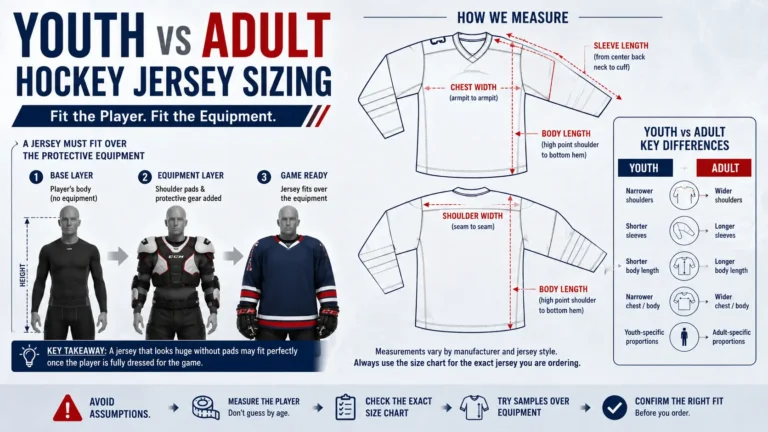
Customized jerseys may not be returnable simply because the team selected the wrong size. Use the supplier’s current sizing information rather than assuming that a player’s usual clothing size will transfer directly to a hockey jersey.
Hockey sizing also needs to account for the equipment worn underneath the jersey. Goalkeeper sizing should be reviewed separately because the required fit can be substantially different from a skater’s jersey.
If your order includes both youth and adult players, review the supplier’s size ranges carefully. Our guide to Youth vs Adult Hockey Jersey Sizing: Common Mistakes to Avoid covers several issues that can affect mixed-size team orders.
Check Personalization Separately
Do not treat the roster as correct simply because all of the players are listed. Review each line individually.
- Player name
- Exact spelling that will appear on the jersey
- Player number
- Jersey size
- Home and away assignments
- Goalkeeper designation
- Captain or alternate captain letters, when applicable
Check for duplicate numbers before approval. Also confirm capitalization, punctuation, accented characters, and any name-length restrictions with the supplier.
Treat the Final Artwork Proof as a Production Document
A digital jersey proof should not be treated as a general illustration of what the uniform might look like. If the supplier considers your approval authorization to begin production, review the proof as though you were inspecting the finished jersey.
Check the front, back, sleeves, shoulders, and any other decorated areas.
- Team crest
- Primary and secondary colors
- Player-number color and readability
- Player-name placement
- Captain and alternate captain letters
- Sponsor logos
- Shoulder or sleeve graphics
- League-required markings
- Home and away jersey contrast
- Goalkeeper jersey colors and graphics
Numbers and names should remain readable from a distance, not merely look attractive on a computer screen. Sponsor graphics should also be positioned without interfering with the crest, player numbers, or other required markings.
If the team is using one of the more detailed styles discussed in our Hockey Jersey Design Trends for 2027 guide, pay particular attention to contrast around gradients, patterns, and graphic backgrounds.
Before You Click “Approved”
Save a copy of the exact artwork proof you approved. Record the approval date and the name of the person who authorized production. If the delivered jerseys differ from the approved design, this gives the team a clear reference document.
Confirm the Complete Price, Production Timeline, and Reorder Terms
The final approval should also confirm what the team is paying. Compare the final amount with the original quote and make sure any changes made during sizing, artwork, or roster revisions are reflected. Ask whether the final price includes:
- Jerseys and any additional garments
- Player names and numbers
- Team and sponsor logos
- Artwork or setup charges
- Extended-size charges
- Shipping or freight
- Taxes, duties, or brokerage when applicable
- Rush-production charges
Know When the Production Clock Starts
Do not rely only on a statement such as “four-week turnaround.” Ask what event actually starts that four-week period. Depending on the supplier, production may not begin until final artwork, roster information, sizes, payment, and written approval have all been received.
Confirm the expected production completion date, shipping method, delivery address, and required arrival date. Leave enough room between expected delivery and the first game for sorting the shipment and correcting problems.
Ask About Reorders Before You Need One
A replacement jersey ordered later may have different pricing or minimum-order requirements than the original team order. Before approving the first order, ask these six questions:
- Can one matching replacement jersey be ordered later?
- Is there a minimum reorder quantity?
- Will the same colors, fabric, and design remain available?
- Will the supplier retain the approved artwork?
- How much would a single replacement jersey cost?
- What is the expected turnaround time for a reorder?
Keeping this information with the original order records can save the next coach or team manager from having to reconstruct the uniform specifications later.
Get the Final Order Confirmation in Writing
Before authorizing production, ask the supplier for one final written order confirmation that reflects every approved change. Your records should contain:
- Final roster and quantities
- Approved sizes
- Names and numbers
- Approved artwork
- Final price
- Deposit and remaining payment terms
- Production start date
- Expected completion and shipping dates
- Delivery address
- Correction and replacement policy
- Future reorder terms
Once those details agree, the team can approve production with considerably more confidence. The important point is not simply that the jerseys look right on the proof. The complete order needs to be right.
That final review gives the supplier one clear set of instructions and gives your team a documented record of exactly what was approved before the jerseys entered production.