Who Owns Your Team Uniform Design and Logo?
Let’s say that your story starts like this. – Your sports club have been using the same logo for years. The uniform supplier you’ve been using takes that logo, creates a new jersey design, and produces uniforms for the entire team. Two seasons later, you decide to change suppliers. That’s when an unexpected question comes up:
Who owns the design?
Your club may control its original logo, but the supplier may have created additional artwork, patterns, lettering, and production files. Paying for the uniforms doesn’t necessarily establish who owns those additional materials or whether another manufacturer can can reproduce them.
For coaches, equipment managers, and club administrators, this distinction matters a great deal. It can affect replacement jerseys, future orders, supplier changes, fundraising apparel, and the cost of keeping the appearance of a team consistent.
This guide explains how to separate the different rights involved, what to ask before approving a design, and which files and permissions your organization should retain.
✔️ Five Key Lessons Learned
- Ownership of a team logo is separate from ownership of a completed uniform design.
- Paying an artwork or setup fee does not automatically settle every copyright or file-access question.
- Editable production files and permission to reproduce artwork are different things.
- Written agreements should explain how artwork may be used, modified, transferred, and reordered.
- Keep approved artwork, supplier terms, and branding permissions available and accessible in the club’s records.
At a Glance: Understanding Your Team’s Artwork Rights
START WITH THE ORIGINAL LOGO
Who Actually Owns Your Team Logo?
Many sports organizations assume they own their logo because it appears on their uniforms, website, registration forms, and promotional materials for years. That may be correct, but long-term use alone does not answer every question concerning ownership. The logo might have been created by a volunteer, commissioned from a graphic designer, purchased from a design service, or developed under an agreement with another organization.
The rights involved can also differ. Copyright may protect original artwork, while trademark rights may protect names, symbols, and other branding used to identify an organization. Those rights do not always belong to the same person or entity.
Example 1: The Volunteer Who Designed the Club Crest
A parent designs a crest for a new youth soccer club. The club adopts it, prints it on uniforms, and uses it for the next ten seasons. Nobody keeps a written agreement explaining whether the parent transferred ownership or granted permission for the club to use or keep the design.
Years later, the club wants to redesign its uniforms and authorize a commercial merchandise program. The absence of documentation raises questions about the scope of the original permission. Whether the club owns the artwork, has a licence to use it, or needs additional permission depends on the circumstances and applicable law.
The first practical lesson to learn is to identify who created the original artwork and preserve any agreement governing its use. If the documentation is missing, resolve that uncertainty first before commissioning new products that depend on the design.
Keep Your Original Logo Separate
Maintain a copy of the organization’s approved logo independently of any uniform supplier. Keep its source, permitted uses, and ownership documentation with the club’s official records.
Who Owns a Uniform Design Created by a Supplier?
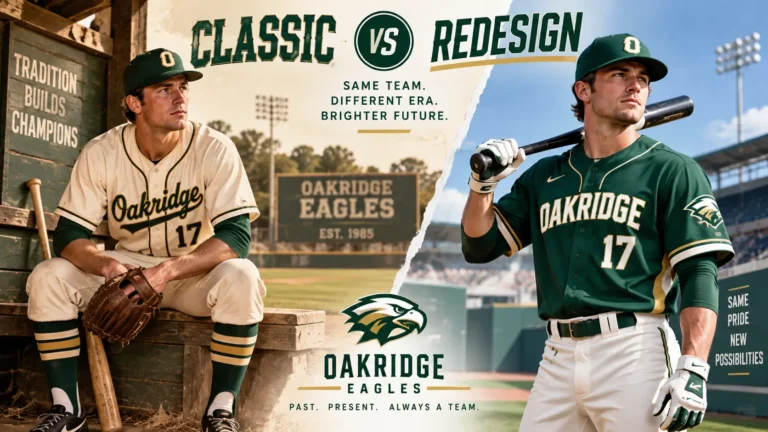
When a supplier creates a custom jersey, it may combine the team’s existing logo with new design elements. These could include striping, gradients, illustrations, patterns, typography, or other original graphics. As such, the finished uniform may contain material originating from several sources. The club might control its crest, a sponsor might control its logo, and a designer or manufacturer might have rights in newly created artwork.
The fact that these elements appear together on one jersey does not automatically transfer all rights to the organization purchasing the uniforms.
Example 2: The Manufacturer Creates a New Jersey Pattern
A hockey club provides its crest and asks a manufacturer to create a distinctive jersey for them. The supplier develops a shoulder pattern, sleeve graphics, and a coordinated number style. The club approves the proof and purchases the uniforms. The jerseys belong to the club or its players under the purchase arrangement, but ownership of the underlying design elements is a separate issue all together.
The agreement might grant permission to use the design for future orders, reserve certain rights to the supplier, or transfer specified rights to the club. Without clear terms, the club may not know what it can reproduce elsewhere. Before commissioning the work, ask whether the supplier is creating original artwork, using licensed design elements, or adapting an existing template. Then establish what rights the club will receive.
Does Paying an Artwork Fee Mean You Own the Design?
Not necessarily. An artwork fee might mean compensation for the time it takes to make the design, to prepare files, digitizing, revisions, or setup work but may not include such for transferring copyrights or providing unrestricted access to the underlying files. For example, a supplier may charge a one-time setup fee to prepare a logo for embroidery. That fee might cover the creation of a machine-ready file used in production, but the agreement may not require the supplier to release that file to the customer.
A separate agreement might expressly include file delivery, a licence for future reproduction, or an assignment of specified rights. These arrangements should not be assumed from the invoice description alone.
Ask What the Artwork Fee Includes
Before paying, confirm whether or not the fee covers design services only, delivery of specified files, future modifications, reproduction rights, or a transfer of ownership. Get the answer in writing.
Why the Written Agreement Matters in Canada and the United States
Copyright rules differ between jurisdictions, and the treatment of commissioned work can depend on factors such as employment, authorship, contractual terms, and applicable statutory requirements.
In Canada, commissioning artwork does not generally mean the customer automatically owns the copyright merely because it paid for the work in the United States. Commissioned work also requires careful attention to ownership and any applicable written work-made-for-hire or assignment provisions.
For teams ordering across borders, don’t assume that the same ownership rules applies in every situation. A clear agreement is more useful than relying on an informal understanding of who paid the designer.
KNOW WHAT YOU WILL RECEIVE
Which Uniform Artwork Files Should Your Team Keep?
A photograph of a jersey or a PDF proof may show exactly how a uniform should look. That doesn’t mean either file can be used to reproduce the design accurately. Manufacturers often need editable artwork, garment templates, colour specifications, and other production information. The precise requirements depend on the decoration method and manufacturing process.
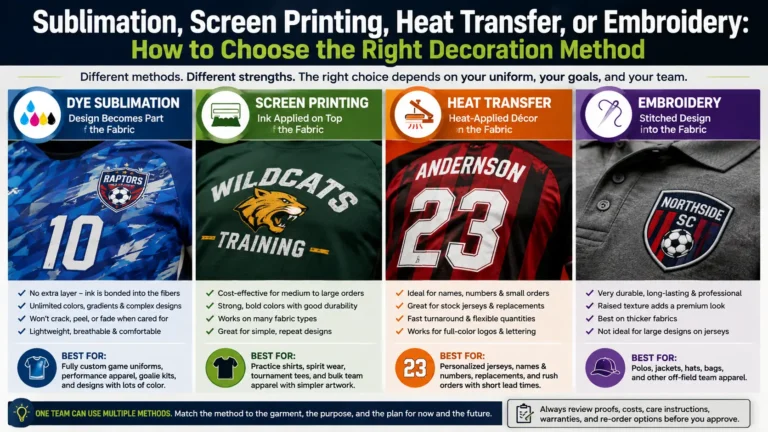
For example, a supplier producing sublimated uniforms may use files prepared for its particular garment patterns. An embroidery shop may require stitch data, while a screen printer may need separated artwork suitable for its production process.
Common Artwork File Types
| File Type | Typical Use | What to Confirm |
|---|---|---|
| AI | Editable Adobe Illustrator artwork | Are fonts, linked images, and design elements included? |
| EPS | Vector artwork exchange and production | Does the file contain usable vector paths rather than only an embedded image |
| SVG | Scalable vector artwork | Is the artwork editable and suitable for the intended manufacturer |
| Design proofs or, in some cases, production artwork | Whether the PDF is merely a visual proof or contains usable production elements | |
| PNG / JPG | Previews and reference images | Whether higher-quality or editable originals are also available |
No single file format guarantees that another manufacturer can reproduce the uniform. A usable transfer may also require the approved colour values, fonts, placement measurements, garment specifications, and permission to reuse the design.
Example 3: The Team Has a PDF but Needs an Editable File
A softball club keeps the PDF proof from its original order. When it requests replacement jerseys from a new manufacturer, the supplier asks for editable vector artwork and the original garment design. The PDF shows the colours and placement, but the new supplier cannot easily modify the graphics or adapt them to its garment pattern. The club may need to request additional files or pay for artwork reconstruction.
Before the original order is completed, ask which files will be delivered, in what formats, and whether the club has permission to provide them to another manufacturer.
Can You Take Your Uniform Design to Another Supplier?
That depends on the rights your organization holds and the terms of the original supplier agreement. A club might have permission to order unlimited uniforms from the original manufacturer without having permission to give the artwork to a competitor. Another agreement might allow the club to use the design with any supplier. A third could transfer ownership of specified artwork but leave certain licensed elements excluded.
Before switching suppliers, ponder on these three questions:
- Can the club obtain the files
- Can it legally reproduce the design
- Can the new manufacturer produce a suitable match?
Example 4: The Club Wants the Same Jersey but at a Lower Price
A youth basketball organization has used the same jersey design for several seasons. A new manufacturer offers a lower price, and the club wants the new jerseys to match the old ones. The original supplier provides a copy of the team logo but explains that its custom background pattern and production template are not included in the materials available for transfer.
The club must review the original agreement to determine what rights it has. It may be able to negotiate permission, commission a replacement design, or continue ordering the existing jersey through the original supplier. The least expensive quote is not necessarily the least expensive solution once artwork reconstruction, design changes, and replacement compatibility are considered.
Related guide: Changing Team Uniform Suppliers: Artwork, Reorders and Contracts
What About School Logos, League Marks, and Sponsor Artwork?
A uniform can include graphics that the team itself doesn’t control. These may include a school emblem, a league badge, a tournament mark, or a sponsor’s corporate logo. Permission to use one of those marks on competition uniforms may not extend to every other product or commercial activity.
For example, a sponsor may authorize its logo on game jerseys but require separate approval before the same design appears on merchandise sold to parents. A school may allow its emblem on official team uniforms while restricting independent online merchandise sales. Before reproducing the artwork, confirm the intended products, permitted uses, approval requirements, and any restrictions imposed by the rights holder.
One Uniform Can Involve Several Permissions
Keep separate records for the team logo, supplier-created artwork, sponsor marks, and any school or league branding. Permission for one element does not automatically cover permissions for the other elements.
Related guide: Can Parents Put Team Logos on Spirit Wear?
BEFORE APPROVING PRODUCTION
Team Uniform Artwork Ownership Checklist
Before approving a custom design, review these 10 points with the people responsible for purchasing and branding.
- Original logo: Identify who created it and who controls its use.
- Design elements: Establish which graphics are supplied by the club and which are created by the manufacturer.
- Artwork fees: Confirm what the charges cover and whether file delivery is included.
- Ownership: Determine whether rights are retained, licensed, or transferred under the agreement.
- Reproduction: Ask whether another manufacturer may use the completed design.
- Editable files: Identify the formats that will be delivered and whether they are usable.
- Third-party marks: Confirm permissions for sponsor, school, league, and tournament logos.
- Future changes: Establish whether the club may modify colours, patterns, names, and other elements.
- Reorders: Ask how long the artwork will be retained and what replacement orders will cost.
- Records: Save the approved agreement, proof, permissions, and final files in an organization-controlled location.
If an answer is unclear, ask the supplier to explain it before production begins. An unresolved question is easier to address before the order is placed than after the club needs replacement uniforms.
File Access Is Not the Same as Reproduction Permission
Receiving an editable file does not necessarily grant unrestricted rights to use it. Likewise, having permission to reproduce artwork does not guarantee that the supplier must provide its internal production files. Confirm both matters separately.
Top 10 Questions to Ask Your Uniform Supplier About Artwork Rights
These questions can help turn a general conversation about design ownership into specific written terms.
- Who will own the original artwork created for this order?
- Are you using any pre-existing or third-party design elements?
- What exactly is included in the artwork or setup fee?
- Will our organization receive editable artwork files?
- Which file formats will be provided?
- May we reproduce the completed design through another manufacturer?
- May we modify the design for future seasons or different garments?
- Are there fees for releasing files or authorizing a transfer?
- How long will you retain the production artwork?
- What happens to our artwork and reorder rights if our agreement ends?
Some suppliers may provide broad artwork rights as part of their standard service. Others may offer different arrangements depending on the product, design work, and contract. Compare the answers along with price, product quality, lead times, and replacement-order policies. A slightly cheaper initial order may be less attractive if the organization must pay to recreate its artwork every time it changes suppliers.
Keep the Agreement With the Team, Not Just the Current Coach
Uniform projects frequently outlast the volunteers who organized them. When the current equipment manager steps down, the next person should be able to find the approved design, original logo, artwork agreement, supplier contact information, and reorder instructions.
Use an organization-controlled folder or record-keeping system with access for authorized club representatives. This reduces the risk of important files being lost when someone changes email accounts or leaves the team.
Frequently Asked Questions About Team Uniform Artwork
Does our club own the logo if we’ve used it for years?
Long-term use may be relevant, but it does not by itself establish ownership of every right in the logo. Review who created the artwork, any agreements, and the organization’s trademark or other rights.
Does paying for custom jersey artwork give us the copyright?
Not automatically. The answer depends on applicable law and the terms of the arrangement. Ask whether the fee includes a licence, an assignment of rights, file delivery, or only design and production services.
Can we ask a new supplier to copy our existing jersey?
You can ask, but the club should first establish whether it has permission to reproduce the relevant artwork. The new supplier must also determine whether it can manufacture a suitable match using its own materials and garment patterns.
Can our supplier refuse to provide editable artwork files?
The supplier’s obligation to deliver files depends on the agreement and applicable law. A supplier may have no contractual duty to release certain internal production materials unless that obligation was established.
Is a PDF proof enough for future orders?
A PDF proof can preserve a useful visual reference, but it may not contain editable artwork or the production information needed by another manufacturer. Ask for the specific files and specifications your team is entitled to receive.
Can parents use the team logo on hoodies?
That depends on the organization’s permission and any applicable branding, licensing, or supplier restrictions. The club’s permission to use a logo on official jerseys does not automatically authorize independent merchandise production.
Protect Your Team’s Design Before the Next Order
The best time to clarify artwork ownership is before a manufacturer begins designing or producing your uniforms.
Identify who controls the original logo, establish the rights associated with newly created artwork, confirm what files will be delivered, and document the conditions for future reproduction.
Those steps help your organization preserve its identity while retaining practical options for replacements, redesigns, and future supplier decisions.
Continue With the Team Uniform Rights Series
Return to Team Uniform Rights & Supplier Agreements for the complete overview, or review whether your sports league can require an exclusive uniform supplier.
This article provides general purchasing and rights-management information, not legal advice. Ownership and licensing questions depend on the applicable law, agreements, and specific facts.