From Game Jerseys to Warm-ups, Coach Gear and Spirit Wear: Building the Right Team Package
When a coach or team organizer says, “We need new uniforms,” the conversation often starts with jerseys and shorts, which is understandable, because the game uniform is the most visible part of the order. But, it is also only one part of what many teams, clubs, schools, and sports organizations actually need.
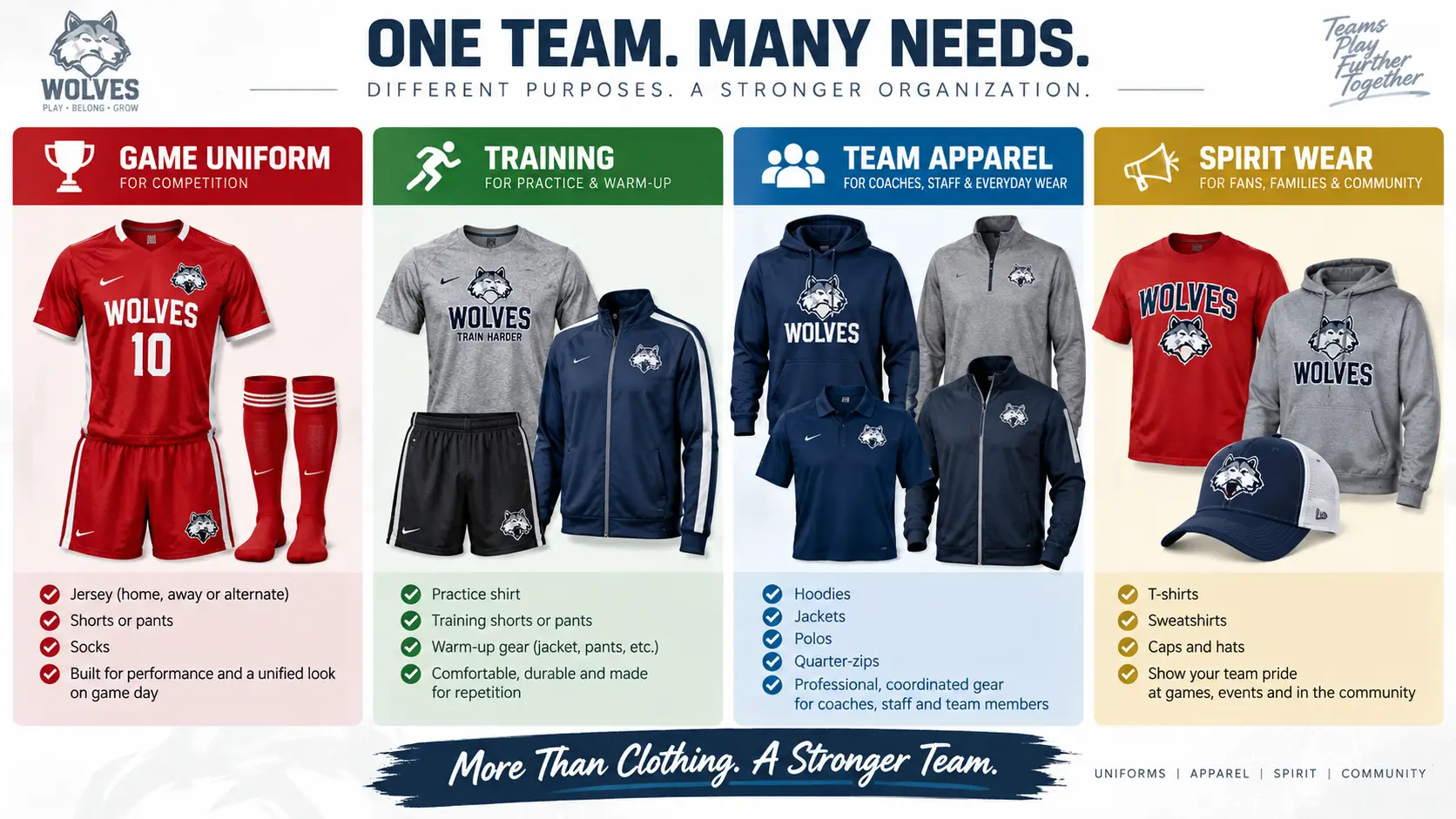
Players may need practice apparel, warm-ups, travel clothing, bags, or weather-specific layers. Goalkeepers and other specialized roles may need different pieces from the rest of the roster. Coaches and staff may need polos, jackets, hats, or sideline apparel. Parents and supporters may want branded hoodies, T-shirts, caps, and other spirit wear.
The better question to ask is not “which uniform to buy”, but rather “who are you outfitting, what does each group actually need, and which items belong in the first order?”
This guide separates team uniforms vs. team apparel, then shows how to build a sensible package without turning a straightforward uniform order into an expensive collection of items your organization may not need.
What to Take Away
Start with required competition clothing, then build outward. Decide what players need to compete, what they need to train and travel, what coaches and staff require, and which supporter items should remain optional. A clear apparel list makes quantities, supplier quotes, sizing, and budgeting much easier later.
On this Roster
Team Uniforms vs. Team Apparel: What Is the Difference?
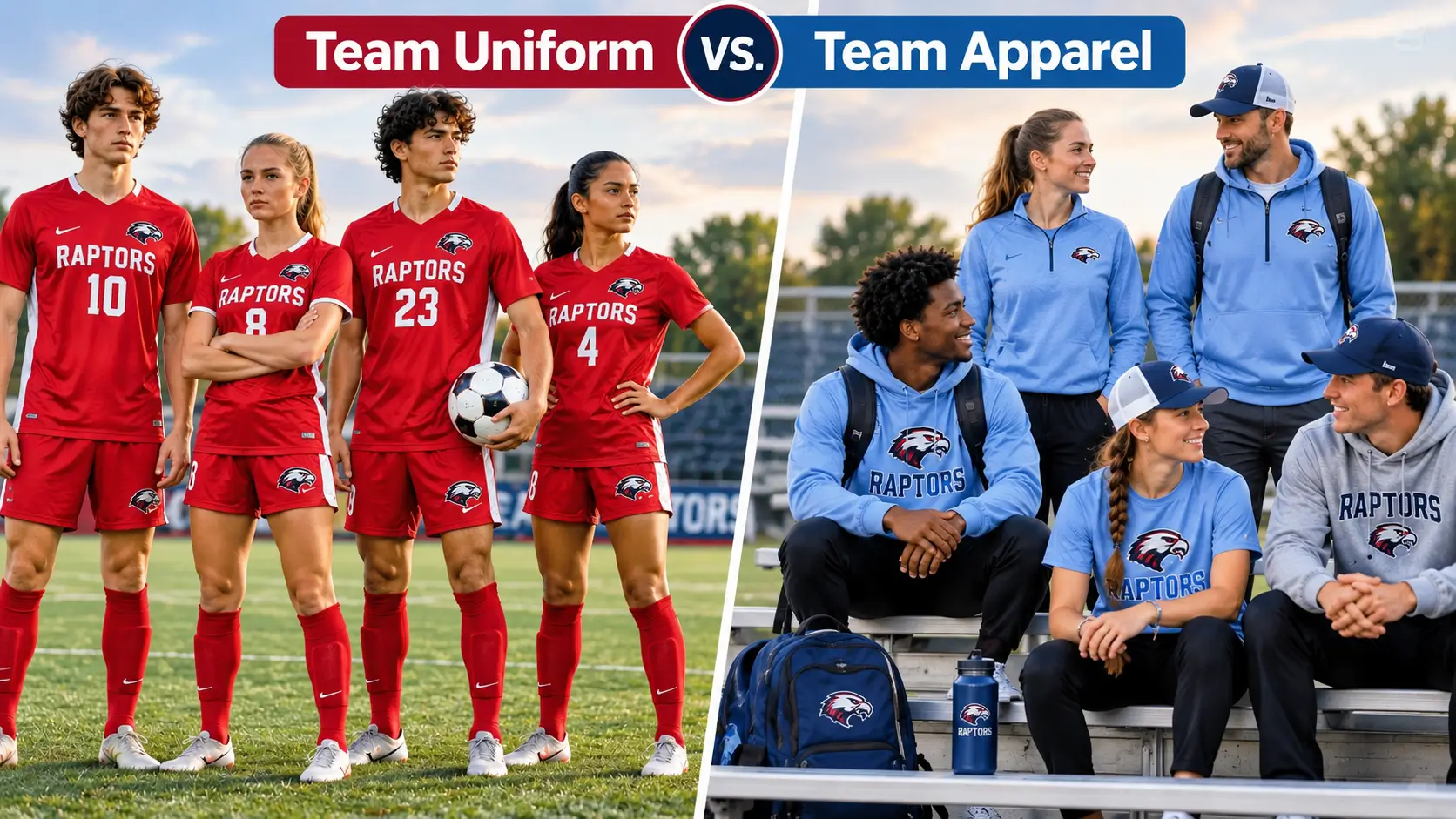
A team uniform is the coordinated clothing athletes wear to represent the team during competition. Depending on the sport, that may include a jersey, shorts or pants, socks, a skirt, shell, or other sport-specific pieces. The uniform normally has to satisfy the team’s design requirements and any applicable league, association, tournament, or governing-body rules.
Team apparel is the broader category. It can include the competition uniform, but it also covers clothing and accessories used for practice, warm-ups, travel, coaching, team events, school or club identification, and supporter merchandise. That distinction is useful because not every piece of team apparel should be treated as mandatory.
A player may need a game jersey to participate but may not need two hoodies, a travel jacket, a backpack, and a premium warm-up set. A parent may want a team sweatshirt, but that purchase does not belong in the same decision as a required player uniform.
Think in layers. The competition uniform is the required layer. Practice and team-operation apparel form the next layer. Spirit wear and optional extras form another. Keeping those layers separate makes the order easier to understand and easier to budget for.
Start With the People You Are Outfitting
Before choosing products, build a list of the groups connected to the order. This prevents a common planning mistake: choosing attractive garments first and trying to decide who should receive them afterwards. A typical organization may be outfitting several different groups, each with a different purpose.
Players
Competition uniforms come first. Practice clothing, warm-ups, travel pieces, bags, and other items can then be added according to the program.
Goalkeepers & Special Roles
Some sports or positions require different colors, cuts, protective considerations, or specialized garments that should be identified separately.
Coaches
Polos, jackets, quarter-zips, hats, or weather-appropriate outerwear can give coaches a consistent sideline appearance without copying the player uniform.
Team Staff
Managers, trainers, volunteers, and other staff may need practical branded clothing so their role is easy to recognize at games and events.
Parents & Supporters
Spirit wear can extend the team identity to families and fans without adding those optional purchases to the required player package.
The Organization
Shared equipment bags, event apparel, tournament clothing, volunteer shirts, or travel pieces may belong to the club or program rather than to one athlete. Once those groups are visible on paper, it becomes much easier to decide which items are essential, which are operationally useful, and which should be offered as optional purchases.
What Players Typically Need
For players, begin with the clothing required to take part in the games. The exact pieces vary by sport, but the planning principle is the same: identify the complete competition uniform before adding extras. A complete player package might include a jersey and shorts, a jersey and pants, socks, or other sport-specific pieces. Some programs also require separate home and away combinations. Others can operate with one primary set and a contrasting option. Do not assume that every team needs the same number of sets.
If your organization is still deciding whether it needs one set, home and away uniforms, or an alternate, use our guide to home, away and alternate team uniforms before finalizing quantities. After the competition pieces are clear, consider the practical items players use around games and practices. A training shirt may reduce wear on the game jersey. A warmup may be useful for pre-game routines or colder facilities. A travel jacket may make sense for a competitive club that travels frequently but add little value for a short recreational season.
A more useful question is not, “What can we put our logo on?”,
but rather “What will players actually use often enough to justify including it?”
What Goalkeepers and Other Special Roles May Need
Specialized positions should be identified before the main order is copied across the entire roster. A goalkeeper may need a different jersey color, a different cut, additional room for protective equipment, or a garment that is not part of the standard field-player package. Other sports may have captains, officials, liberos, pitchers, catchers, or position groups with their own apparel considerations.
Record those differences as part of the package plan instead of treating them as last-minute exceptions. This is especially important when the order includes individual names, numbers, or other personalization because correcting a specialized garment after production can be more difficult than changing a blank stock item.
Do not multiply the standard player package by the roster size until special roles are separated. One goalkeeper jersey, coach jacket, or staff shirt entered in the wrong quantity can distort the order surprisingly quickly.
What Coaches and Team Staff May Need
Coaches and staff usually need clothing that identifies them with the team while still being practical for their job. They do not necessarily need the same garments as the athletes. Coach apparel can include polos, quarter-zips, lightweight jackets, hats, warmups, or weather-resistant outerwear. A trainer or team manager may prefer a different combination. Tournament volunteers may only need a clearly branded shirt for a specific event.
Think about where the person will wear the garment, how often it will be used, and whether the item needs to look coordinated with the player package. A coach working outdoors in spring weather has different needs from a volunteer staffing a registration table indoors.
This is also an area where organizations can overspend by trying to give every adult the same package.
Define roles first, then assign apparel according to function.
Practice Wear, Warm-ups, and Travel Apparel
- Practice wear can be one of the most useful additions to a uniform program because it gives athletes something team-specific to wear without putting unnecessary wear on the competition uniform. Depending on the sport and level of play, this might be a training shirt, reversible practice jersey, shorts, pants, or a simple branded top.
- Warmups serve a different purpose. Jackets, pants, quarter-zips, or coordinated tracksuits can be useful before competition, on the bench or sideline, during travel, and at team events. They can also create a consistent team appearance when athletes are not wearing the game uniform.
- Travel apparel makes the most sense when the team actually travels. A competitive program with tournaments, hotel stays, and regular road trips may get substantial use from a travel jacket, hoodie, polo, or team bag. A local recreational team may be better served by keeping those pieces optional.
Fabric choice also changes with the job the garment has to do. A performance fabric may be useful for active training apparel, while a heavier fleece can make more sense for a supporter hoodie or cold-weather travel piece. The same fabric does not need to be used across the entire apparel program.
A useful test: If you removed the team logo, would the garment still solve a practical need? If the answer is no, it may belong in the optional or spirit-wear category rather than the required player package.
Spirit Wear and Supporter Apparel
Spirit wear gives parents, fans, students, alumni, volunteers, and players a way to wear the team identity away from competition. Common choices include T-shirts, hoodies, sweatshirts, hats, jackets, and casual branded apparel. The important planning distinction is that spirit wear is usually a choice, not a requirement for participation. Keeping it separate from the mandatory player package protects the team budget and gives families more control over what they purchase.
For larger clubs and organizations, an online team store can simplify this side of the program. Instead of a coach collecting individual hoodie sizes, payments, and order forms, families can place their own orders through the store when that service is available from the supplier. Some store programs can also support fundraising by allowing the organization to build a margin into selected products.
That’s an important point to note because it creates a useful distinction within the uniform buying plan plan. In other words, the organization can manage the required uniforms centrally while allowing optional supporter merchandise to operate through a separate ordering path. Spirit wear can eventually connect the uniform program to fundraising, sponsorship, school pride, and supporter engagement, but it should not make the initial uniform decision more complicated than it needs to be.
Should Everything Be Ordered From the Same Supplier?
Using one supplier for uniforms, warmups, staff apparel, and spirit wear can certainly simplify the entire program. You would get:
- one contact
- fewer artwork files to manage
- more consistent logo placement
- a clearer process for approvals and reorders
- and it can also make it easier to coordinate colors across several garment types
However, convenience should not automatically decide the order. A supplier that produces an excellent custom game uniform may have limited options for coach clothing, extended sizing, jackets, bags, or fan merchandise. Another may offer a strong online team store but not the exact uniform construction your athletes need.
Before committing the entire apparel program to one source, compare the supplier’s strengths against the categories you actually plan to buy. Ask about minimum quantities, sizing samples, decoration methods, lead times, reorder availability, individual shipping, and whether team-store products can be kept consistent with the organization’s approved colors and logos.
If multiple suppliers are used, establish one set of brand references before ordering. The same “navy” or “green” can look noticeably different across fabrics and decoration methods, so provide approved logo files and color specifications rather than relying on a color name alone.
One supplier can make administration easier.
The right supplier mix can make the products better.
Choose based on the complete program rather than assuming that one purchasing model is automatically best.
Build a Core Package Before Adding Optional Pieces
A good apparel plan has a clear starting point. Build the smallest package that allows the team to compete properly and operate comfortably, then evaluate additional items one category at a time. For many organizations, the package can be divided into three levels:
- Required competition items are the garments athletes must have to participate and comply with team or competition requirements.
- Operational team items are useful pieces such as practice apparel, warmups, coach clothing, travel apparel, or bags that support how the program functions.
- Optional community items include spirit wear, fan apparel, premium extras, and additional garments that people can choose to purchase.
This approach makes trade-offs visible. If the budget becomes tight, the organization can protect the competition package first rather than cutting randomly across the entire order. It also makes supplier quotes easier to compare. Instead of asking for “everything we might want,” request pricing for the core package and have optional categories priced separately. You can then see what each addition does to the total order.
Common Ways Organizations Over-Order or Forget Items
Apparel orders become expensive when the package grows without a clear reason. They also become frustrating when one small group or garment is discovered after the main order has already entered production. Watch for these planning problems before requesting quotes:
- Ordering the same package for everyone. Players, goalkeepers, coaches, staff, and supporters do not necessarily need the same number or type of garments.
- Adding optional apparel too early. Hoodies, jackets, bags, and travel pieces can consume budget before the required competition uniform is fully defined.
- Forgetting special roles. Goalkeepers, coaches, managers, trainers, or volunteers may need separate garments or quantities.
- Assuming every player needs matching garment sizes. Jersey, shorts, pants, and other pieces should be sized independently when the supplier allows it. Our team uniform sizing guide explains how to build the sizing process before production.
- Mixing required and optional purchases. Families should be able to see which items are necessary for participation and which are elective.
- Ignoring reorders. Ask whether individual replacement pieces can be reproduced later and whether minimum reorder quantities apply.
- Comparing only the jersey price. The final cost can change substantially once additional garments, decoration, personalization, shipping, and other order costs are included. See our guide to custom team uniform costs before approving the final package.
Create the Final Apparel List Before Requesting Quotes
Before contacting suppliers, turn the ideas into one working apparel list. This does not need to be complicated. The goal is to give every item a purpose, an audience, a quantity basis, and a priority. For each proposed item, record:
- Who receives it. Identify players, goalkeepers, coaches, staff, volunteers, parents, or another group.
- What the item is for. Mark it as competition, practice, warmup, travel, staff, event, or spirit wear.
- Whether it is required or optional. This keeps the core order separate from nice-to-have additions.
- How quantity will be determined. Some items follow roster count, some depend on role, and optional items may be ordered individually.
- Whether personalization is needed. Names, numbers, role labels, or other individual details affect both administration and cost.
- Whether it must match another garment. Note any color, logo, fabric, or design relationships that the supplier needs to preserve.
Once the list is complete, you can move into quantities without guessing. That is the point where a planning tool becomes more useful than another product catalog.
Next planning task: Turn the apparel list into actual quantities for players, special roles, staff, and extras.
Use the Stage 1 Quantity & Package Planner in the Preferred Sports Wear Tools & Resources area
Frequently Asked Questions About Team Uniforms and Team Apparel
Are team uniforms and team apparel the same thing?
No. Team uniforms are the coordinated garments athletes wear for competition. Team apparel is the broader category and can include uniforms, practice wear, warmups, travel clothing, coach apparel, staff clothing, spirit wear, bags, and other branded items.
What should be included in a basic team uniform package?
Start with the sport-specific garments every athlete needs to compete. Depending on the sport, that may be a jersey and shorts, a jersey and pants, socks, or other required pieces. Home, away, alternate, goalkeeper, or position-specific garments should be added only when the program requires them.
Does every player need practice wear and warmups?
Not necessarily. Practice apparel and warmups can be useful, particularly for programs with frequent training, travel, or team presentation requirements, but they should be evaluated separately from the mandatory competition uniform.
Should coaches wear the same apparel as players?
Usually the team identity should be coordinated, but the garments can be different. Coaches often need polos, jackets, hats, quarter-zips, or other sideline clothing that fits their role better than the athlete uniform.
Should spirit wear be part of the player uniform fee?
Only when the organization has a clear reason to include it. In many programs, spirit wear works better as an optional purchase so families can choose what they want without increasing the required cost of participation.
Is it better to buy all team apparel from one supplier?
It can simplify administration and branding, but it is not automatically the best choice. Compare product quality, available sizes and cuts, decoration, minimum quantities, lead times, reorder options, team-store services, and total cost before deciding whether one supplier should handle the entire program.
When should we decide quantities?
Decide the apparel categories and who receives each item first. Then build quantities from the actual roster, staff count, special roles, required uniform sets, and planned extras. This reduces the chance of ordering the wrong number of garments simply because a package was chosen too early.
Your Next Step: Decide How Many Uniform Sets the Team Actually Needs
At this point, you should know the difference between the competition uniform and the wider apparel program, who needs to be outfitted, and which items belong in the core package.
The next decision is quantity. Does the team need one competition set, separate home and away uniforms, an alternate set, or only selected additional pieces? That decision affects the number of garments, the sizing workload, and the budget.