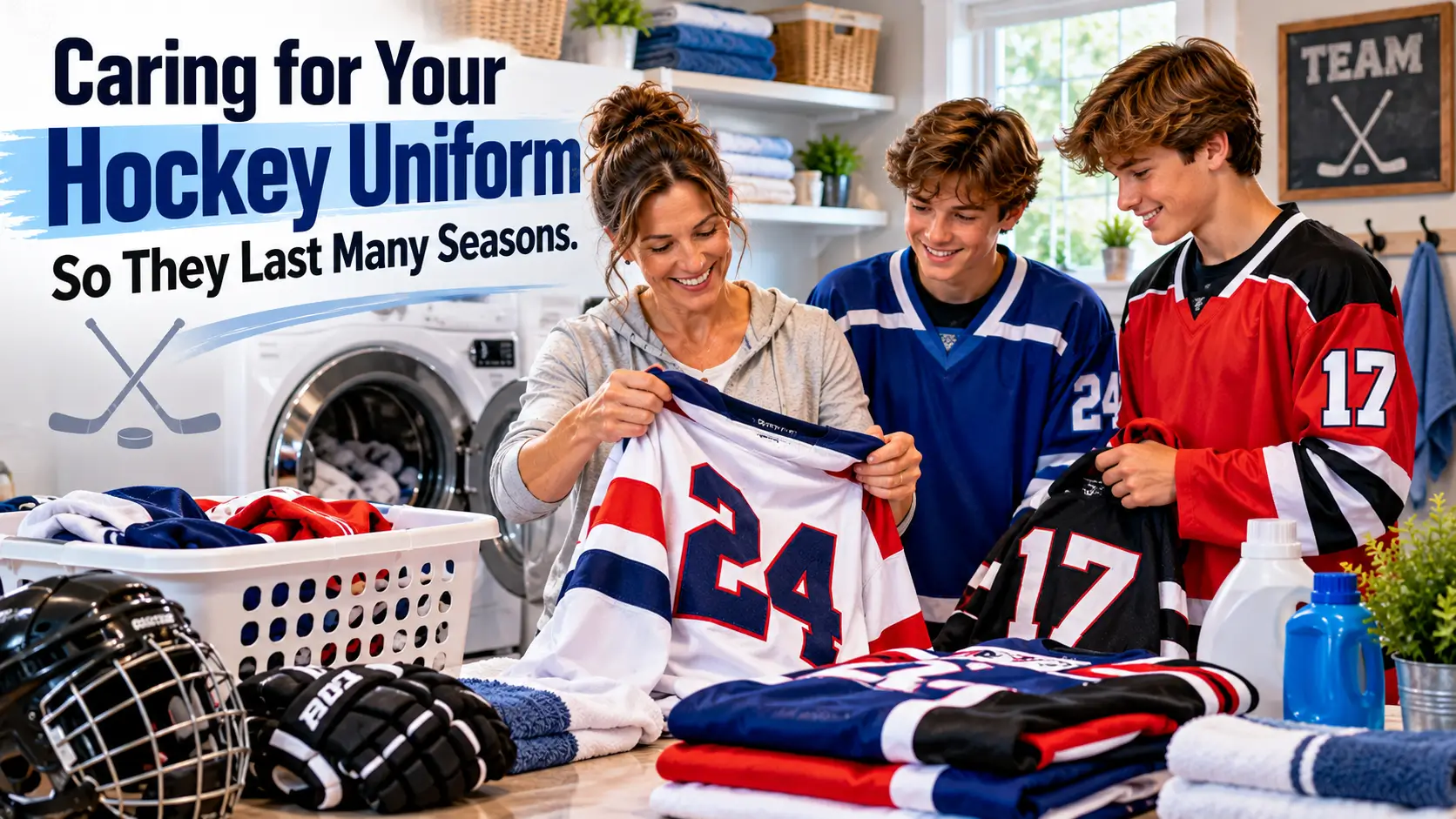
How to Care for Your Hockey Uniform so It Lasts Multiple Seasons

Keep Your Hockey Jerseys Looking Great
Season After Season

Hockey uniforms take a beating over the course of a season. Jerseys and hockey socks are exposed to sweat, rink grime, spills, equipment bags, tournament travel, repeated washing, and constant contact with protective gear. For families and clubs hoping to use their uniforms for more than one season, proper care can make the difference between a jersey that stays clean and presentable and one that needs to be replaced earlier than expected.

Fortunately, good hockey uniform care does not require a complicated routine. How you wash and dry a jersey, how quickly you deal with stains, and what you do with the uniform after a game can all affect its useful life. A few consistent habits can help protect the fabric, stitching, colors, player names, numbers, logos, and other decoration.

The manufacturer’s care label should always come first. Beyond that, the following washing, drying, stain-removal, and storage practices can help keep hockey uniforms looking good and ready for another season.

Key Takeaways

  1. Follow the manufacturer’s care label before using any general washing or drying recommendation.
  2. Keep hockey jerseys away from excessive heat, harsh cleaning products, Velcro, buckles, and abrasive equipment.
  3. Treat stains promptly and let uniforms dry completely before returning them to an equipment bag.
  4. Consistent care can help preserve fabric, stitching, colors, names, numbers, logos, and other decoration for future seasons.
01

Wash Them Correctly

Use the care label, mild detergent, appropriate water temperature, and a jersey-friendly wash cycle.

02

Control the Heat

Air drying is often the safer choice when permitted by the garment’s care instructions.

03

Treat Stains Early

Address blood, spills, rink grime, and other stains before they have time to set.

04

Know the Decoration

Sublimated, transferred, printed, and embroidered elements can have different care considerations.

05

Separate the Equipment

Velcro, buckles, straps, and rough protective gear can snag or abrade jersey fabric.

06

Store Uniforms Dry

Never leave damp jerseys and socks buried in an equipment bag between games.

07

Avoid Common Mistakes

Excessive heat, harsh chemicals, delayed stain treatment, and damp storage can shorten uniform life.

08

Follow a Routine

A simple post-game checklist makes consistent uniform care easier for players and parents.
The Importance of Looking After Your Hockey Uniforms

Hockey jerseys are athletic garments, but repeated wear still takes a toll. Fabric rubs against equipment, stitching is pulled and stretched, uniforms become wet with sweat, and jerseys may be washed several times during a busy week. Tournament weekends can add several games and additional wash cycles within only a few days.

Proper hockey uniform care helps protect more than the fabric itself. Names, numbers, crests, sponsor graphics, seams, cuffs, collars, and other details all contribute to how long a jersey remains usable and how professional the team looks on the ice.

Uniform life also affects the team budget. A jersey that remains structurally sound but develops damaged lettering, permanent stains, loose stitching, or distorted decoration may still have to be replaced earlier than planned. Clubs trying to control uniform expenses can combine proper maintenance with the strategies covered in ways youth sports clubs can reduce uniform costs.

Start With the Care Label

Before deciding how to wash, dry, or treat a hockey jersey, read the garment’s care label. Instructions from the manufacturer or supplier should take precedence over general hockey jersey care advice because uniforms can differ in fabric construction, trim, stitching, decoration, and finishing methods.

Two jerseys that look similar may not have identical cleaning requirements. One may be fully sublimated while another uses heat-applied player numbers, embroidered crests, or other separately attached elements. A cleaning method that works well for one garment is not automatically appropriate for another.

This is also information worth obtaining when a new team order is being organized. Asking about washing instructions, drying recommendations, replacement garments, decoration, and reorder availability before production can prevent problems later. See what information to send a hockey uniform supplier before ordering for other details worth confirming before the order is finalized.

How to Wash Hockey Jerseys Correctly

Good hockey jersey care begins before the jersey reaches the washing machine. Remove the jersey and socks from the equipment bag after the game rather than allowing them to remain damp and compressed with protective gear. This also gives you an opportunity to spot stains or damage that should be addressed before washing.

When appropriate for the garment, turning the jersey inside out can reduce direct friction against exterior decoration during the wash. Jerseys should also be separated from items containing Velcro, buckles, hooks, rough straps, or other hardware capable of catching lightweight fabric.

Cold water and mild detergent are commonly appropriate for synthetic athletic garments, but the care label should determine the actual method used. Avoid automatically reaching for chlorine bleach, strong cleaning agents, or fabric softener without first confirming that the product is compatible with the garment.

An aggressive wash does not necessarily produce a better result. The objective is to remove sweat, dirt, and odor while placing as little unnecessary stress as possible on the fabric and decoration.

Drying Hockey Jerseys Without Damaging Them

Heat is one of the factors that deserves particular attention when maintaining hockey uniforms. Excessive dryer temperatures can place additional stress on synthetic fabrics and may affect certain applied names, numbers, logos, adhesives, or other decorative elements.

When permitted by the care instructions, air drying is a conservative option. Hang the jersey in an area with good air circulation and allow it to dry completely before folding it, storing it, or putting it back into the equipment bag.

If the manufacturer permits machine drying, use the recommended temperature and cycle. Automatically choosing the hottest setting simply because it dries the uniform faster can expose the garment to more heat than necessary.

This matters particularly when the goal is to extend the life of hockey uniforms over several seasons. Damage is not always immediate. Small amounts of stress repeated through dozens of wash-and-dry cycles can gradually affect the garment even when no single cycle appears to cause a problem.

What Can Be Hard on a Hockey Jersey?

Click or tap the examples around the jersey. We may have exaggerated the consequences just a little.


27

Choose a jersey hazard.


Treating Blood, Sweat and Other Hockey Jersey Stains

Blood, sweat residue, sports drinks, food, adhesive, rink grime, and other marks are easier to manage when they are noticed quickly. Leaving a stained jersey in the equipment bag until the next practice gives the stain additional time to set.

Before applying a stain-removal product, check the garment’s care instructions. Treat the affected area carefully rather than aggressively scrubbing the fabric, especially around names, numbers, logos, or other decoration. When using an unfamiliar cleaning product, testing it on an inconspicuous area can help determine whether it affects the material or color.

Stronger chemicals are not automatically better. A treatment that removes a stain but damages the fabric or decoration has not solved the problem. Prompt treatment using a method compatible with the specific garment is usually the better approach.

Caring for Sublimated Hockey Jerseys

Sublimated hockey jerseys are different from garments that depend primarily on separately applied graphics. During sublimation, the design is incorporated into the polyester fabric rather than sitting on top as a separate decorative layer. As a result, sublimated colors, names, and design elements do not peel in the same way that some surface-applied transfers can.

That does not make a sublimated jersey maintenance-free. The polyester fabric, stitching, seams, cuffs, collar, and overall garment shape still need proper care. Follow the manufacturer’s washing instructions, avoid unnecessary heat, and dry the jersey completely before storing it.

Other decoration methods create their own maintenance considerations. Heat-transfer graphics, screen printing, embroidery, and sublimation are constructed differently, so teams should understand what is being applied to the garment before deciding how it will be maintained. Our comparison of sublimation, screen printing, heat transfer, and embroidery explains the differences between these common decoration methods.

Keep Hockey Jerseys Away From Abrasive Equipment

The jersey may spend the entire game against protective equipment, but the two do not necessarily belong together in the washing machine.

Velcro, buckles, hooks, rough straps, and other abrasive surfaces can catch lightweight jersey material. Repeated contact may contribute to snags, pulled threads, surface wear, and damage around stitched or decorated areas.

Separating the uniform from protective equipment also allows each item to be cleaned using a method appropriate for its construction. The washing requirements for shoulder pads or other protective gear are not necessarily the same as the care requirements for a custom polyester hockey jersey.

A useful post-game habit is to remove the jersey and hockey socks first, inspect them, and keep them separate from anything that could snag or abrade the fabric.

Proper Storage During the Season and Off-Season

During the season, one of the simplest hockey uniform care rules is also one of the most important: do not leave damp jerseys and socks sitting in an equipment bag. Remove them after games and practices, allow them to dry completely, and repack them only when they are ready to be used again.

Off-season storage deserves similar attention. Wash the uniform according to its care instructions and allow every garment to dry completely before putting it away for several months. Choose a clean, dry storage location rather than leaving jerseys compressed with dirty or damp equipment until the next season.

The end of the season is also a useful time to inspect seams, stitching, cuffs, names, numbers, and logos. Identifying small problems early gives the team an opportunity to address them before registration, fitting sessions, or the first practices of the next season.

Teams planning to reissue uniforms also need to consider whether existing jerseys will fit the players receiving them next. The article Youth vs Adult Hockey Jersey Sizing: Common Mistakes to Avoid explains why sizing decisions can affect both current fit and future uniform use.

7 Hockey Uniform Care Mistakes That Shorten Jersey Life

Many uniform problems develop gradually rather than from one obvious mistake. Avoiding a few repeated habits can reduce unnecessary wear throughout the season.

  1. Leaving damp uniforms in the equipment bag — Jerseys and socks remain wet and compressed instead of being allowed to dry between uses.
  2. Washing jerseys with abrasive equipment — Velcro, straps, buckles, hooks, and rough surfaces can snag or rub against lightweight jersey fabric.
  3. Automatically using hot water — More heat is not necessarily better, particularly when the garment’s care label recommends a lower temperature.
  4. Regularly using excessive dryer heat — Repeated high temperatures can place additional stress on fabric and certain types of decoration.
  5. Using harsh stain treatments without checking compatibility — A cleaning product may affect color, fabric, or decoration even if it successfully removes the stain.
  6. Ironing directly over names, numbers, logos, or transfers — Direct heat can damage some applied decorative elements.
  7. Waiting too long to treat stains — Prompt attention can reduce the need for aggressive scrubbing or stronger cleaning products later.

Post-Game Hockey Uniform Care Checklist

A repeatable routine makes it easier for players and parents to take care of hockey uniforms without having to remember every step after a late game or tournament. Use the following checklist whenever the jersey and socks need cleaning.

  1. Remove the uniform from the equipment bag — Take out the jersey and hockey socks instead of leaving them damp with protective equipment.
  2. Check for stains — Look for blood, sports drinks, food, grime, adhesive, or other marks that should be treated promptly.
  3. Inspect for damage — Check seams, stitching, cuffs, names, numbers, logos, and other decoration before washing.
  4. Separate abrasive equipment — Keep the jersey away from Velcro, buckles, straps, hooks, and rough protective gear.
  5. Read the care label — Confirm the recommended washing temperature, cycle, detergent restrictions, and drying method.
  6. Turn the jersey inside out when appropriate — This can reduce direct friction against exterior decoration during washing.
  7. Wash according to the garment instructions — Avoid unnecessary heat, harsh cleaners, and washing methods that place additional stress on the jersey.
  8. Dry the uniform properly — Air dry when appropriate or follow the machine-drying instructions supplied by the manufacturer.
  9. Make sure everything is completely dry — Do not return damp garments to the equipment bag or long-term storage.
  10. Store or repack the uniform — Keep the clean jersey and socks dry and ready for the next practice or game.

Help Your Hockey Uniform Last Beyond One Season

Extending the life of a hockey uniform usually comes down to doing a few basic things consistently. Remove wet garments from equipment bags, follow the care label, minimize unnecessary heat, treat stains promptly, keep jerseys away from abrasive equipment, and make sure everything is completely dry before storage.

For a team or club, however, multi-season uniform planning begins even earlier. Jersey sizing, player-number assignments, decoration choices, replacement availability, supplier records, and the ability to reorder matching garments all affect whether an existing uniform program can continue smoothly into another season.

Maintaining uniforms carefully therefore becomes part of the larger uniform-management process rather than simply a laundry issue. Teams that protect the uniforms they already own while planning for replacements and future players are in a better position to control costs and maintain a consistent team appearance.

Players, parents, coaches, and managers who encounter unfamiliar uniform terminology can also use the Hockey Uniform Glossary as a reference when reviewing garment specifications, decoration methods, and supplier information.

Similar Posts