When to Plan, Size, Approve, Produce, and Distribute Your Team Kits
One of the most stressful moments for a youth soccer coach is realizing that the first game is only three weeks away and the team still has nothing suitable to wear. Custom soccer uniforms take time to plan, size, design, approve, produce, and ship. Waiting too long can mean rush fees, fewer design choices, or players taking the field in temporary or mismatched gear.
For most teams, a practical approach is to begin the uniform-ordering process 8 to 10 weeks before the first required use date. Larger club orders, fully custom designs, international production, and purchases made during busy spring or fall ordering periods may require additional time.
That does not mean you need every player name, number, and size finalized 10 weeks in advance. It means the planning process should already be underway so the final order is not delayed by decisions that could have been made earlier.
✔️ Key Takeaway
Start planning about 8 to 10 weeks before the first date your team actually needs its uniforms. Confirm the kit, budget, supplier, sizing process, and design before the final roster deadline; then protect enough time for proof approval, production, shipping, inspection, and distribution. If you wait until every roster detail is final before beginning, you may lose much of your production window.
At A Glance
Find Your Real Deadline
Use the earliest event when players must appear in uniform—not automatically the first regular-season game.
Plan the Order Early
Use the first weeks to define the kit, establish the budget, review league requirements, and compare suppliers.
Finalize Players and Design
Collect sizes, resolve numbers, confirm goalkeeper requirements, and carefully approve the final design proof.
Protect Production and Delivery
Know when production begins, whether shipping is included, and leave time to inspect the order before game day.
Before counting backward eight or ten weeks, establish the date that actually matters.
Start With the First Date Your Team Actually Needs Its Uniforms
Do not automatically use the first regular-season game as your deadline.
Your team may need its uniforms earlier for a preseason practice, exhibition game, evaluation game, tournament, team photograph, sponsor event, or league uniform inspection.
If your first league game is October 10 but your team has a tournament on September 20, then September 20—not October 10—is the date that should control your uniform schedule.
Try to have the uniforms arrive before that date rather than on it. The team manager still needs time to inspect the shipment, sort the garments, distribute them to players, and deal with any obvious problems.
How Far in Advance Should You Start?
For a standard team order, beginning about 8 to 10 weeks before the first required use date provides a useful planning window.
That time is not all spent manufacturing uniforms. Before production begins, the team may still need to determine what garments are required, establish the budget, compare suppliers, collect sizes, resolve player numbers, prepare logos, finalize the design, and approve a proof.
More complicated orders may justify starting earlier. A club coordinating several teams, a fully custom sublimated package, an international order, or a purchase made during a supplier’s busiest season may need more than ten weeks.
The important distinction is between starting the planning process and submitting the final personalized order. You can begin many of the early decisions before the final roster is known.
The first stage should establish exactly what you are buying and the constraints that will affect the order.
Weeks 8 to 10: Define the Kit, Budget, and Supplier Requirements
Begin by deciding what each player actually needs.
A recreational team may need one jersey, shorts, and socks. Another team may require separate home and away jerseys, goalkeeper kits, training shirts, warm-up apparel, coach clothing, or spare uniforms.
Review your soccer uniform quantity requirements before requesting serious quotes. Suppliers cannot accurately price an order without knowing the approximate number of players, garment types, logos, numbers, names, and other customization requirements.
Establish the Real Budget
Set both a target budget and a maximum amount the team should not exceed.
Do not compare suppliers using only the advertised jersey price. The complete order may also include shorts, socks, player names and numbers, team crests, sponsor logos, artwork or setup charges, shipping, taxes, duties, and possible rush fees.
Send suppliers the same basic requirements so their quotes can be compared on a like-for-like basis.
Also ask when each supplier’s production timeline officially begins. The production clock may not start until final sizes, roster information, payment, and written proof approval have all been received.
Compare More Than Price
A useful supplier comparison should include the total order cost, current turnaround time, estimated delivery date, minimum quantities, replacement policy, and cost of adding one or two players later.
A slightly higher initial price may be worthwhile if the supplier offers better sizing support, reliable delivery, easier reorders, or fewer additional charges.
Once the basic order and supplier have been established, the focus shifts from team-level decisions to player-specific information.
Weeks 5 to 8: Collect Sizes, Numbers, and Design Details
Collect Accurate Player Sizes
Do not assign uniform sizes based only on player age. Youth athletes of the same age can vary considerably in height and build, and sizing systems differ between manufacturers.
If the supplier offers a physical sizing kit, arrange a fitting session. If samples are unavailable, use that supplier’s specific measurement chart and give families clear instructions.
Set your family sizing deadline several days before the supplier’s actual deadline. If the supplier needs final sizes on March 15, for example, ask families to submit them by March 10. That gives you time to follow up with anyone who has not responded.
Maintain one master roster containing each player’s name, jersey number, jersey size, shorts size, sock size, and relevant fit notes. Goalkeeper garments should be identified separately because their colors, cuts, or sizing may differ.
Resolve Numbers and Personalization
Ask players for more than one jersey-number choice when possible. Duplicate requests are common, particularly when players are joining from different teams.
Verify exactly how each printed name should appear. A registration record may contain a player’s full legal name while the family expects a surname or shortened name on the jersey.
Do not rely on memory or scattered text messages. The master roster should become the source used to verify the final order.
Finalize the Base Design
Much of the design can usually be completed before every player detail is final.
Team colors, crest placement, sponsor locations, number style, jersey pattern, shorts, socks, and goalkeeper color direction can often be established while the roster is still being finalized.
This prevents the entire design process from being postponed until the last player registers.
Weeks 4 to 6: Review and Approve the Final Proof
The supplier’s proof should be treated as an approval document, not simply as a preview of what the jersey might look like.
Compare it directly with the master roster and your approved team requirements.
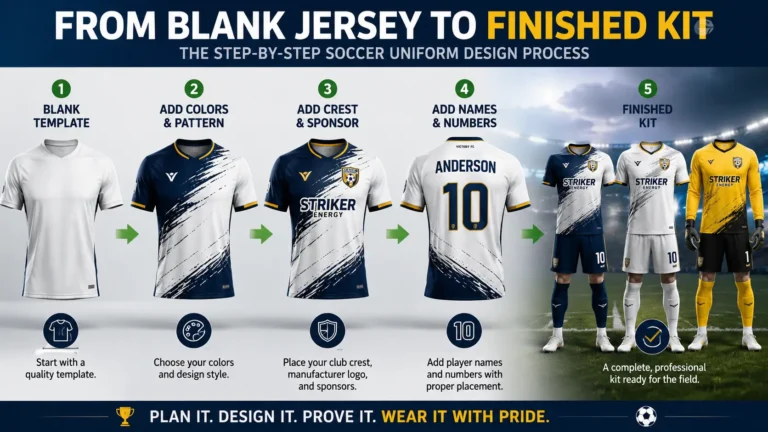
Check the team name, sponsor names, logos, colors, number locations, player names, player numbers, goalkeeper uniforms, garment quantities, and any home and away versions.
Have another coach, manager, or club official review the proof before final approval. A second set of eyes can catch a spelling error, duplicate number, missing logo, or incorrect color that the person managing the order has stopped noticing.
Once the proof is approved, changes may cause additional charges or restart part of the production process.
After the proof, roster, payment, and other required information have been accepted, the order can move into production.
Weeks 2 to 5: Production and Shipping
This is usually the stage where the team has the least direct control over the schedule.
Fully custom sublimated uniforms may require different production processes than stocked garments decorated with screen printing or heat transfer. Supplier workload, order size, garment construction, customization, and manufacturing location can all affect timing.
Do not assume an advertised four-week turnaround means four weeks from the day you first contact the supplier. The quoted production time may begin only after the final proof, roster, payment, and other requirements have been approved.
Also confirm whether shipping is included in the quoted turnaround.
Allow additional time for transit, particularly for international orders. Customs processing, weather, carrier delays, remote delivery locations, and address problems can all affect the final arrival date.
Once production begins, avoid unnecessary changes. If a late player joins the team, ask whether that jersey can be handled as a separate reorder instead of changing the main production order.
The Final 1 to 2 Weeks: Inspect and Distribute
Ideally, the uniforms should arrive at least one to two weeks before the first required use date.
Open the shipment when it arrives. Do not leave the boxes sealed until the night before the first game.
Compare the shipment with the master roster, approved proof, and invoice. Verify the quantity of jerseys, shorts, and socks; garment sizes; player names and numbers; team and sponsor logos; goalkeeper items; colors; and the condition of the garments and decoration.
If something is wrong, photograph the affected garment, size label, and decoration problem and contact the supplier promptly with a clear explanation.
Once everything has been checked, sort each player’s items into a labelled bag and distribute them during a practice rather than immediately before a game. Players then have time to check the fit and report any problems.
What If Your Final Roster Is Not Ready?
Tryouts, late registrations, and roster changes make early ordering difficult for many youth teams. The solution is usually to separate team planning from final player personalization.
You may still be able to choose the supplier, establish the budget, select the garment style, prepare artwork, confirm league requirements, develop the base design, and organize the sizing process before every player is confirmed.
Ask the supplier when final names, numbers, sizes, and quantities are actually required. You can then establish a team deadline that gives you enough time to collect and verify that information.
Also ask about late additions. Some suppliers may allow a single jersey or small reorder after the main order has entered production.
When the budget permits, a few unassigned spare jerseys in useful sizes can provide another option for late registrations or emergencies.
What If You Need Soccer Uniforms in Three Weeks or Less?
At three weeks or less, the priority changes. Instead of trying to preserve every original design preference, focus on what can realistically put the team on the field by the required date.
Possible options include in-stock jerseys, standard supplier colors, locally applied numbers, simplified logos, standard black or white shorts, delayed sponsor decoration, or temporary practice shirts or numbered pinnies.
For example, instead of waiting for a fully custom home-and-away package, a team may be able to purchase stocked jerseys, shorts, and socks and have a local decorator apply the crest and numbers.
Before paying for emergency production, review our guide to rush soccer uniform orders and backup plans.
A Sample 10-Week Soccer Uniform Timeline
If the first required use date is May 16, a practical schedule might look like this:
| Timing | Main Task |
|---|---|
| Weeks 9–10 | Confirm the kit scope, budget, quantities, league requirements, and first required use date. |
| Week 8 | Compare supplier quotes and select the preferred supplier. |
| Week 7 | Hold fittings and collect player names and number choices. |
| Week 6 | Finalize the roster and approve the design proof. |
| Weeks 2–5 | Production. |
| Week 2 | Shipping and delivery. |
| Week 1 | Inspect, sort, and distribute the uniforms. |
Frequently Asked Questions About Soccer Uniform Ordering Timelines
How early should a soccer team order uniforms?
A practical planning target for many teams is about 8 to 10 weeks before the uniforms are first required. More complex orders, large clubs, international production, or busy seasonal ordering periods may justify starting earlier.
Do we need the final roster before starting the uniform order?
No. The team can usually establish its budget, supplier, garment requirements, base design, league requirements, artwork, and sizing process before every player is confirmed. Final names, numbers, quantities, and sizes can be added when required by the supplier.
When should players be fitted for soccer uniforms?
Fittings should happen early enough that the team has time to resolve missing sizes and submit the final roster before the supplier’s production deadline. Use the supplier’s own size chart or fitting samples rather than assigning sizes based only on age.
Does a supplier’s turnaround time include design and shipping?
Not necessarily. Ask exactly when the quoted turnaround begins and whether it includes artwork, proof revisions, production, and shipping. A four-week production estimate may begin only after the team has approved the proof and submitted all required information.
What should we do if the season starts in less than three weeks?
Contact suppliers immediately and focus on options that can meet the required date. In-stock garments, simpler decoration, local printing, standard colors, and temporary uniforms may be more realistic than a fully custom package.
Give the Team Time to Make Good Decisions
Most soccer teams should begin planning their uniform order about 8 to 10 weeks before the first required use date. Starting earlier may be appropriate for fully custom designs, multi-team club orders, international production, or purchases made during busy seasonal periods.
The purpose of that extra time is not simply to wait for production. It gives the team room to define the kit, establish the budget, collect accurate sizes, resolve number conflicts, approve artwork, receive the shipment, inspect every garment, and correct problems before the uniforms are needed.
When the timeline is built around the entire ordering process instead of just the manufacturing estimate, the team has more choices and much less chance of reaching opening day without the uniforms it expected.