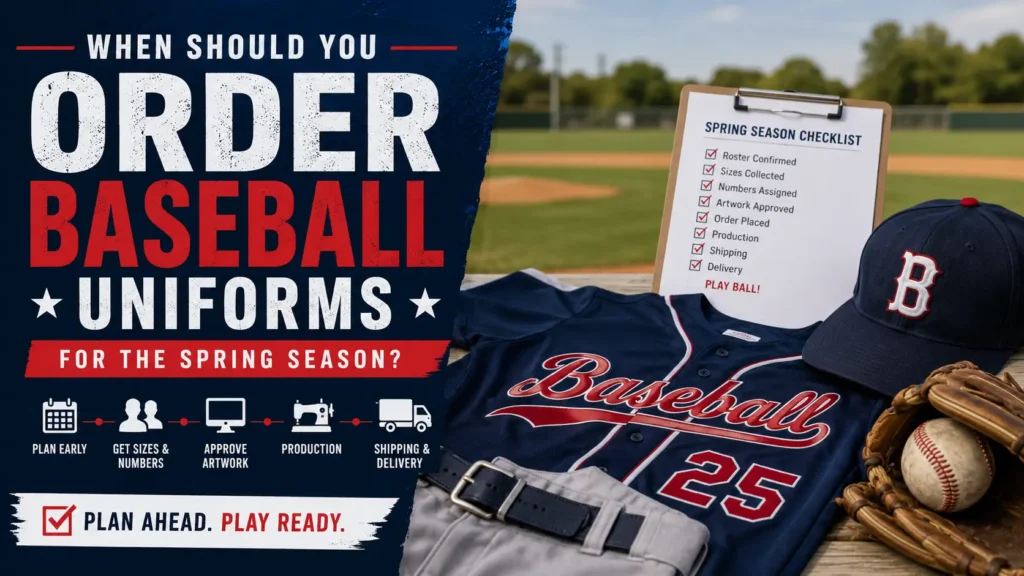
When Should You Order Baseball Uniforms for the Spring Season?
Baseball uniform planning should begin well before your team is ready to submit its final sizes, quantities and player numbers. Instead of choosing an arbitrary order date, start with the date players actually need their uniforms and work backward through delivery, production, proof approval, sizing and roster deadlines.
Registration changes, missing sizes, artwork revisions, shipping delays and incorrect items can all affect the schedule. Starting the process early gives coaches, team managers and club administrators more time to deal with those problems without turning the uniform order into a last-minute rush.
Lessons Learned:
- Start planning before your final baseball roster is complete.
- Use the date players need uniforms in hand as your real deadline—not the supplier’s production date.
- Confirm the supplier’s current turnaround before establishing your final ordering deadline.
- Set firm internal deadlines for player sizes, numbers, artwork and approvals.
- Leave time after delivery to inspect, sort and distribute the uniforms before they are needed.
Today’s Agenda
Set the Real Deadline
Start with the first date players must actually have their uniforms—not simply the supplier’s production date.
Start Before the Roster Is Final
Supplier research, budgeting, package decisions and design can begin while registration is still underway.
1. Start With the Date Players Need Their Uniforms
Your first question shouldn’t be “When should we place the order?” It should be, “When do our players need their uniforms in their hands?”
Opening Day may seem like the obvious answer, but your team could need its uniforms earlier. Look at the complete preseason schedule first and identify the first event where players are expected to be fully outfitted. That event might be an exhibition game, preseason tournament, team photo day or another club event before regular league play begins.
Treat this date as your required-in-hand date. Ideally, the uniforms should be distributed before that date rather than having the shipment arrive at the last possible moment.
Once the required-in-hand date is established, work backward through the:
- Player distribution
- Order inspection and sorting
- Shipping
- Uniform production
- Artwork and proof approval
- Final order submission
- Player sizing and number assignment
- Roster confirmation
This creates a much more useful baseball uniform schedule than relying on a production estimate by itself.
2. Build Your Baseball Uniform Timeline Backward
A spring baseball uniform order is really a sequence of connected deadlines. If one stage is delayed, every stage that follows has less time available. Build your schedule in reverse, beginning with the required-in-hand date.
- Determine the first required uniform date. Identify the earliest game, tournament, photo session or other event for which players need their uniforms.
- Allow time for inspection and distribution. Do not assume the shipment can arrive and immediately be handed to players.
- Confirm shipping and production requirements. Ask the supplier for its current turnaround rather than relying on an estimate received earlier.
- Allow for artwork and proof approval. Custom designs, logos, numbers and other decoration may need to be reviewed before production begins.
- Set your final order deadline. Determine when quantities, sizes, numbers and personalization must be submitted.
- Set your internal player deadline. Give yourself time to resolve missing sizes, duplicate number requests and roster changes before the supplier’s deadline.
The resulting schedule tells you when the team needs to complete each decision rather than reducing the entire project to a single order date.
Spring Ordering Plan
Work Backward From the First Game
Open each stage to see what should be settled before the team moves closer to production and delivery.
01 Planning Set the In-Hand Date
Identify the first event when players must be fully outfitted. Build every other deadline backward from this date.
- First required uniform event
- League requirements checked
- Distribution time reserved
- Delivery buffer included
02 Preparation Choose the Supplier and Uniform Package
Confirm what the team is ordering and obtain the supplier’s current turnaround before collecting final player information.
- Supplier selected
- Uniform package defined
- Budget reviewed
- Current turnaround confirmed
03 Roster Lock Finalize Sizes, Quantities and Numbers
Set an internal deadline for player information instead of allowing late responses to consume the production buffer.
- Jersey sizes confirmed
- Pants sizes confirmed separately
- Player numbers verified
- Final quantities approved
04 Approval Review and Approve the Proof
Check spelling, colors, logos, numbers, quantities and placement carefully. Production normally should not begin until the proof is approved.
- Artwork checked
- Colors reviewed
- Numbers verified
- Approval submitted promptly
05 Production Production and Shipping
Track the supplier’s confirmed schedule, but remember that a production estimate is not the same as an in-hand guarantee.
- Production underway
- Shipping method confirmed
- Tracking monitored
- Delivery buffer preserved
06 Team Delivery Inspect, Sort and Distribute
Open the shipment before distribution day. Compare the contents with the approved order and deal with discrepancies immediately.
- Shipment counted
- Personalization checked
- Player packages sorted
- Uniforms distributed
3. Don’t Wait for the Final Roster to Start Planning
Starting early does not mean submitting the final order before registration closes. It means completing the decisions that do not depend on knowing every player’s name, number and size.
While registration is still underway, you can begin comparing suppliers and determining what the baseball uniform package will include. Depending on the program, that could involve decisions about:
- Game jerseys
- Baseball pants
- Caps
- Belts
- Socks
- Practice shirts
- Other team apparel
You can also establish the budget, confirm team colors and logos, select jersey and pants styles and develop the general design direction before final quantities are known.
Use this planning period to ask potential suppliers exactly what they need before an order can move into production. Find out when they require final quantities, sizes, player numbers, artwork and approvals.
Once you know those requirements, you can establish your team’s internal deadlines instead of discovering them after registration closes.
4. Set a Firm Deadline for Baseball Uniform Sizes and Player Numbers
Once the roster becomes reasonably stable, establish a firm deadline for players and families to submit their uniform information. Without an internal deadline, one missing size or unresolved player number can delay the final order.
Collect jersey and baseball pants sizes separately rather than assuming a player will require the same size for both garments. Confirm the sizing system used by the supplier and determine whether the garments are youth, adult, unisex or baseball-specific.
Caps need separate attention as well. Determine whether the selected cap is adjustable, fitted or ordered by size, and collect the required information accordingly.
Player numbers should be settled before the final order is submitted. Resolve duplicate number requests and decide in advance how numbers will be assigned to players who join after the main ordering deadline.
Create Two Deadlines
Keep the supplier’s final submission deadline separate from the deadline you give players and families. Your internal deadline should leave enough time to find missing information and resolve problems before the team submits the order.
5. Don’t Forget the Artwork and Proof Approval Stage
Submitting player sizes and numbers does not necessarily mean the uniforms move directly into production. Custom baseball uniforms may require an artwork and proof stage first.
The supplier may prepare a digital proof showing elements such as:
- Uniform colors
- Team logos
- Player numbers
- Player names, when used
- Sponsor artwork
- Decoration placement
Review the proof carefully before authorizing production. Check spelling, colors, numbers, logos, positioning and personalization against the approved order. If something is not right, correct it before giving final approval.
The team should also designate one person with authority to approve the final proof. This prevents a supplier from receiving conflicting instructions from coaches, parents, committee members or other team representatives.
6. Production Time Isn’t the Same as Total Lead Time
One of the easiest scheduling mistakes is treating a supplier’s production estimate as the complete baseball uniform ordering timeline. Production is only one stage.
The team’s actual timeline can include initial planning, supplier selection, uniform package decisions, roster confirmation, player sizing, number assignment, artwork preparation, proof review and corrections, final approval, production, shipping, inspection, sorting and player distribution.
If changes are required during any of these stages, the schedule may need additional time. That is why the team’s ordering deadline should be based on the complete process rather than a single turnaround number.
Even when production runs as expected, a delayed proof approval, missing player size or late roster decision can move the order closer to the season.
Ask for the Current Turnaround
A turnaround estimate obtained while comparing suppliers may not represent the supplier’s schedule when you are finally ready to order. Confirm the current production and shipping expectations before authorizing the order.
7. Leave Time to Inspect and Distribute the Uniforms
The uniform shipment arriving does not mean the project is finished. Someone still needs to confirm that the team received what it ordered.
Count the garments against the approved order before distributing anything. Check jersey and baseball pants quantities and sizes, caps and other uniform pieces, player numbers and names, team colors, logos, decoration and player assignments.
Report missing, damaged or incorrect items to the supplier promptly and keep the affected items separate until you know how the problem will be handled.
After inspection, sort the order into complete player packages. This provides another opportunity to find a missing jersey, incorrect pair of pants or other problem before uniform distribution.
Building inspection and distribution into the original schedule gives the team some room to deal with errors before the uniforms are actually required.
8. Plan for Late Registrations and Roster Changes
Spring baseball rosters do not always remain exactly as expected. A player may register late, leave the team, require a different size or create a number conflict after the main order has been submitted.
Ask the supplier about reorders before placing the original order. Find out whether the same uniform can be reproduced later, whether small reorders are accepted, whether minimum quantities apply and whether reorder pricing differs from the original team order.
You should also know what information needs to be retained so the supplier can reproduce the original uniform accurately.
The team should decide in advance how it will handle players who miss the primary sizing and ordering deadline. A standard late-player procedure prevents every roster change from becoming a new purchasing decision and makes the process easier to explain to families.
9. What If You’re Already Behind Schedule?
If the spring season is approaching and the uniform order has not been placed, stop relying on assumptions about what should still be possible. Find out what is possible now.
Contact suppliers and ask for their current turnaround. Give them your actual required-in-hand date so they know when players need the uniforms, not simply when Opening Day occurs.
Next, identify what is creating the bottleneck. Garment availability, artwork, personalization, production or another requirement may be extending the schedule.
If the original uniform configuration cannot meet the deadline, ask whether something can be simplified. A different garment, decoration method or personalization option may shorten the process.
You can also ask whether essential game uniforms can be completed ahead of optional apparel if the complete package cannot arrive together.
The objective is not to preserve every original choice at the expense of having no usable uniforms when they are needed. Determine which requirements are essential and which can be adjusted if the schedule demands it.
10. Baseball Uniform Spring Ordering Checklist
Before authorizing the final baseball uniform order, take one last pass through the schedule. The goal is to make sure the team, supplier and families are working toward the same delivery date and that no unresolved decision is likely to hold up production.
Confirm the Season Deadline
Confirm the first event for which players must be fully outfitted. This could be Opening Day, but it could also be a preseason tournament, exhibition game, team photo session or another event that occurs earlier.
Use that event to establish the team’s required-in-hand date. The shipment should arrive early enough to leave time for inspection, sorting and distribution rather than being scheduled to arrive immediately before the uniforms are needed.
Make Sure the Main Planning Decisions Are Finished
By this stage, the team should have selected its supplier, decided what will be included in the uniform package and established the available budget. The general design direction, colors, logos and garment styles should also be settled.
Confirm the supplier’s current turnaround before submitting the order. An estimate provided several weeks earlier may no longer reflect the supplier’s production schedule, particularly during a busy spring ordering period.
Review the Roster, Sizes and Player Numbers
Make sure the roster is stable enough to place the order and that players and families have submitted the required information. Jersey sizes and baseball pants sizes should be recorded separately, and any cap sizing requirements should also be confirmed.
Review player numbers for duplicates or errors before sending them to the supplier. If late registrations are still possible, make sure the team already has a procedure for handling additional players.
Review the Final Order and Proof
Compare the final quantities, sizes, player numbers and personalization with the information collected from the team. Then compare the supplier’s proof with that same information.
Check team colors, logos, spelling, player numbers, names and decoration placement before approving production. Correct any discrepancy before the final proof is authorized.
Once the proof is approved, confirm that the supplier has everything required to begin production. Verify both the expected production schedule and the shipping arrangements so you know when the order is expected to leave the supplier and when it should reach the team.
Do One Final Cross-Check
Compare the final supplier order with your roster and sizing records before approving production. A few minutes spent checking quantities, sizes, numbers and names can prevent an error from becoming much harder to correct after production begins.
Prepare for Delivery Before the Boxes Arrive
Decide who will receive and inspect the shipment. That person should have a copy of the approved order so there is a clear record of exactly what should have been delivered.
When the uniforms arrive, count the garments before distributing anything. Verify the jersey and baseball pants quantities and sizes, caps and other ordered pieces, player numbers, names and assignments.
Inspect the team colors, logos and decoration at the same time. Missing, damaged or incorrect items should be separated from the rest of the order and reported to the supplier promptly.
Once everything has been checked, sort the uniforms into complete player packages. This makes it easier to spot a missing jersey, incorrect pair of pants or other problem while there is still time to deal with it.
Distribute the uniforms before the required-in-hand date whenever possible. Players and families then have an opportunity to check their packages before the first event where the uniforms are required.
Printable Spring Baseball Uniform Order Check
Check off completed tasks, then print the checklist for your team records. Your selections are included in the printed copy.
Season deadline
Order readiness
Player information
Final approval
Delivery
Give Your Baseball Uniform Schedule Some Breathing Room
The goal is not simply to order baseball uniforms as early as possible. It is to give each stage enough time so the entire project does not depend on every roster deadline, proof approval, production schedule and shipment going perfectly.
Start with the first date players need their uniforms and work backward. Begin supplier research, budgeting, package planning and design before the roster is final. Then establish firm internal deadlines for the player information that cannot be completed until registration is further along.
Give players and families an earlier deadline than the supplier gives you. That creates time to follow up on a missing size, settle a duplicate player number or correct incomplete information without immediately putting the production schedule at risk.
Most importantly, confirm the supplier’s current production and shipping expectations when you are actually ready to order. Base the final order deadline on the complete uniform-ordering process, not production time alone.
Once the schedule is established, the next decision is determining exactly what should be included in each player’s baseball uniform package and how many uniform pieces the team will need for the spring season.