When You Play to Win
The More You May Need
One of the first questions a soccer uniform supplier is likely to ask is, “How many kits do you need?” The answer involves more than counting the players on your roster.
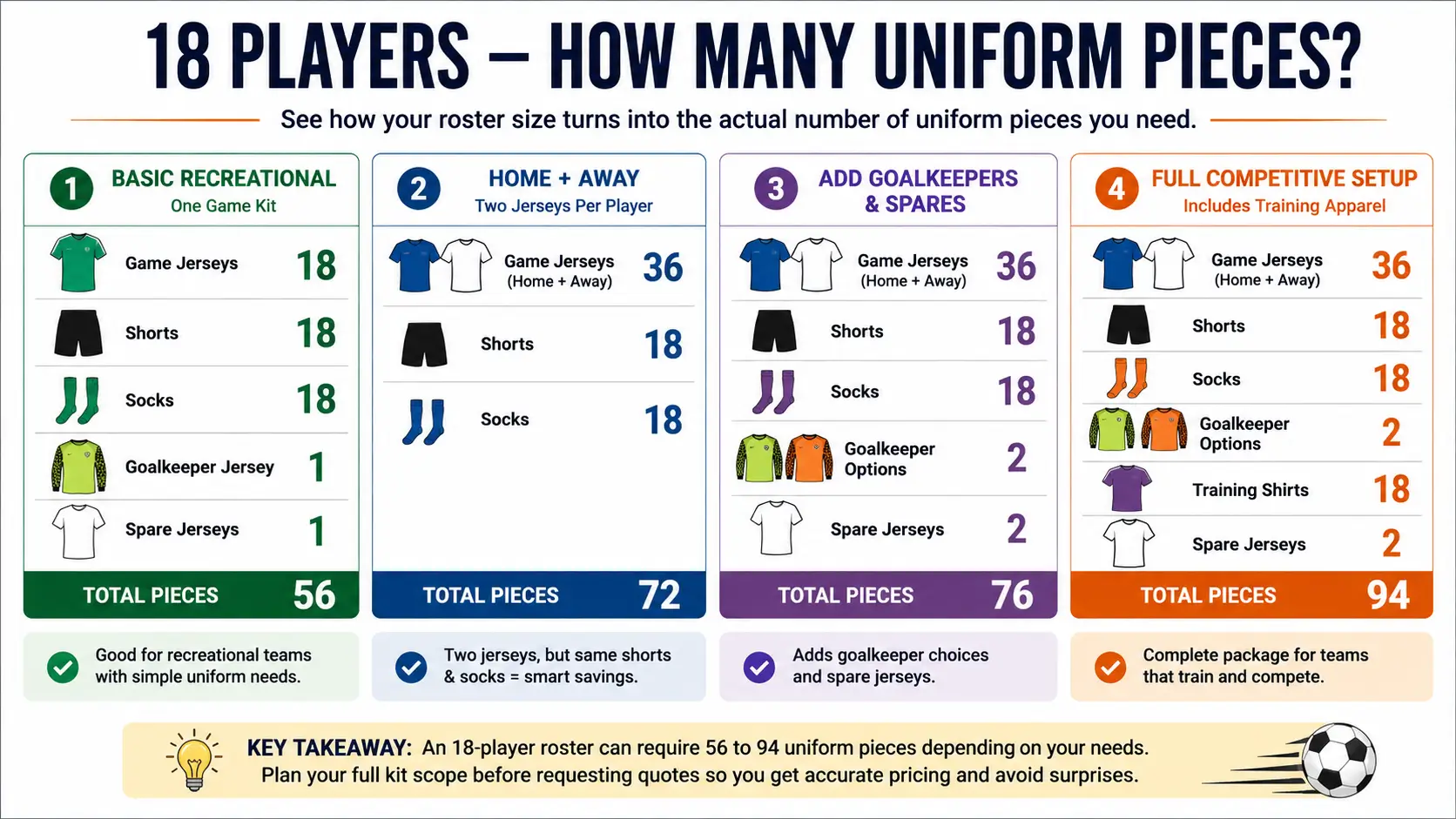
An 18-player team may need 18 game jerseys, 36 game jerseys, or considerably more apparel once goalkeeper uniforms, training shirts, shorts, socks, staff clothing, and spare garments are included.
Order too little and you may face single-item reorders, rush charges, or missing uniforms later in the season. Order too much and part of your uniform budget may sit unused.
The right quantity depends on your roster size, league requirements, age group, level of competition, practice schedule, and budget. A recreational youth team may be adequately equipped with one game kit, while a competitive travel team may need home and away jerseys, goalkeeper options, training apparel, and replacements.
This guide will help you turn your roster into a practical soccer uniform order before requesting quotes from suppliers.
✔️ Key Takeaway
Do not calculate your soccer uniform order by roster size alone. Start with the number of players, then account for home and away requirements, goalkeepers, training apparel, staff clothing, and spare uniforms. Defining the complete kit before requesting quotes gives suppliers the same specifications to price and makes their proposals easier to compare.
At A Glance
01
Game Jersey Quantity
Start with your roster, then decide whether each player needs one game jersey, separate home and away jerseys, or a reversible option.
02
Goalkeeper Kits
Calculate goalkeeper apparel separately from field-player quantities, including any additional color option your team may need.
03
Training Apparel
Frequent practices may justify separate training shirts or kits to reduce wear on more expensive game uniforms.
04
Spare Jerseys
Add a small replacement margin for damaged uniforms, late registrations, roster changes, and unexpected replacements.
Start With Your Roster, But Don’t Stop There
Your roster provides the starting number for your order, not the finished quantity.
If you have 18 field players and every player needs one game jersey, the initial count is simple: 18 jerseys. If the same players need separate home and away jerseys, that number becomes 36. Add 18 training shirts and the team now needs 54 player tops before goalkeeper uniforms, spares, coaches, shorts, or socks are considered.
This is why it helps to think in terms of individual garments rather than simply saying that you need “18 uniforms.”
Your complete kit scope may include:
- Home jerseys
- Away jerseys
- Shorts
- Socks
- Goalkeeper jerseys and other goalkeeper apparel
- Training shirts
- Training shorts and socks
- Warm-up jackets and pants
- Coach and staff apparel
- Spare replacement garments
Defining this list before requesting quotes also makes supplier comparisons more useful. One supplier may quote jerseys, shorts, and socks, while another includes goalkeeper apparel, training shirts, personalization, or other items. Unless every supplier is pricing approximately the same package, the lowest-looking quote may not represent the lowest overall cost.
Decide Whether Players Need One Game Jersey or Two
This is usually the largest quantity decision in the order.
One Game Jersey May Be Enough for Recreational Teams
Recreational leagues, community programs, school intramurals, and younger age groups may be able to operate with one primary game jersey per player.
Some leagues provide jerseys themselves. Others have simple color requirements or allow a team to use training bibs or pinnies when two opponents arrive in similar colors.
If your league requires teams to provide contrasting colors but the budget does not support two separate jerseys, reversible jerseys can be another option. One side can use your primary team color while the reverse provides a contrasting color.
Reversible jerseys can reduce the total number of garments the team has to purchase and store. The trade-off is that some reversible designs use more material than a standard single-layer performance jersey, which may affect weight and breathability.
Competitive Teams Often Need Home and Away Jerseys
Teams competing in club soccer, travel leagues, academies, tournaments, or school programs are more likely to need separate home and away options.
The primary jersey normally uses the club’s main colors. The alternate should provide enough contrast to avoid confusion when the opponent wears a similar color.
For an 18-player team, two game jerseys per player means:
- 18 home jerseys
- 18 away jerseys
- 36 player jerseys in total
Before ordering, check the current uniform requirements for the league or competition in which your team will play. Do not assume that a color combination accepted in one league will automatically satisfy another.
You May Not Need Two Pairs of Shorts and Socks
Home and away jerseys do not always require two completely different uniform sets.
A team might wear royal blue jerseys at home and white jerseys away while using the same blue shorts and blue socks with both combinations.
For an 18-player roster, that could mean:
- 18 home jerseys
- 18 away jerseys
- 18 pairs of shorts
- 18 pairs of socks
Instead of buying 36 shorts and 36 pairs of socks, the team purchases one lower-half set per player and changes only the jersey.
18 Players Does Not Automatically Mean 18 Uniforms
An 18-player competitive team could require 36 game jerseys but only 18 pairs of shorts and 18 pairs of socks. Separating your order by garment type can prevent unnecessary purchases while still providing the home and away combinations your team needs.
Whether this approach works depends on your team colors, uniform design, and league requirements. Decide on the complete home and away combinations before calculating final quantities.
Calculate Goalkeeper Quantities Separately
Goalkeepers should not simply be included in the field-player jersey count.
Goalkeeper colors need to be distinguishable from the other players and match officials. At minimum, plan for a dedicated goalkeeper jersey rather than assuming the goalkeeper can use one of the team’s regular game jerseys.
A basic goalkeeper setup may include:
- Goalkeeper jersey
- Goalkeeper shorts or pants
- Goalkeeper socks
- Optional padded apparel
Competitive teams should also consider whether a second goalkeeper jersey color would be useful. A bright yellow goalkeeper jersey may normally provide excellent contrast, but that can become a problem if an opposing team arrives wearing a similar color.
A second option such as green, orange, pink, or another clearly different color can provide a practical backup.
If your team has two or more goalkeepers, decide whether each goalkeeper receives individual apparel or whether some pieces can be shared. Account for goalkeeper sizing separately as well, particularly when the players are different ages or body sizes.
When Training Apparel Earns Its Place in the Budget
Not every team needs dedicated training uniforms.
A recreational team practicing once a week may be comfortable using ordinary athletic clothing or inexpensive practice shirts.
The calculation changes for a competitive team training two or three times each week. Game jerseys used at every practice are exposed to grass, dirt, perspiration, repeated washing, and routine wear that does not need to be placed on more expensive match apparel.
A simple training kit might include:
- Moisture-wicking performance shirt
- Training shorts
- Optional training socks
If fabric performance is an important part of the decision, review our guide to the best soccer uniform fabrics for games, practices, and tournaments.
Training shirts also do not need to duplicate the design or construction of the game jersey. A stock performance shirt with simple team decoration may be sufficient for regular practices.
Some clubs order two training-shirt colors so coaches can divide players during drills and small-sided games without relying on separate pinnies.
The practical question is not simply whether training shirts cost more. It is whether lower-cost practice apparel helps protect the more expensive uniforms your players need on game day.
Build a Replacement Margin Into the Original Order
Ordering exactly one jersey for every player leaves no room for problems during the season.
Uniforms can be lost, torn, stained, incorrectly washed, or otherwise made unusable. Players can also register after the main order has been submitted.
For many teams, one or two spare player jerseys provide a useful margin without substantially increasing the size of the original order.
Plan Spares Around Your Actual Roster
Do not automatically order spare jerseys only in Adult Medium or Adult Large because they are common sizes. That approach may be useless for a youth team or a roster where most players fall into different size ranges.
Review the size distribution of your actual roster and choose spare sizes that are most likely to be usable.
Also ask your supplier how spare jerseys should be handled if names and numbers are part of the design. Depending on the production method, it may be easier to keep a spare unassigned until it is needed, while other uniform systems may require the number or personalization to be established during the original production run.
Late Registrations Are Easier With a Backup Plan
Roster changes do not always stop when the uniform order is submitted. A new player may join after registration, transfer between teams, or replace someone who leaves during the season.
A suitable spare can help the team avoid immediately placing a single-garment reorder.
When choosing a supplier, also find out how future reorders are handled. A low initial price becomes less attractive if adding one replacement jersey later is difficult, expensive, or impossible to match.
Don’t Forget Coaches and Team Staff
Player uniforms may be the largest part of the order, but they are not always the entire order.
Coaches, assistant coaches, team managers, trainers, and other staff may also need club apparel.
Staff clothing can include:
- Performance shirts
- Coaching polos
- Jackets
- Quarter-zip pullovers
- Caps or visors
These garments do not need to match the players’ uniforms exactly, but consistent colors and branding can give the team a coordinated appearance.
Decide who receives staff apparel and what each person needs before requesting the main quote. That prevents coaching clothing from becoming a separate unplanned purchase after the player order is already underway.
Sample Soccer Uniform Quantities
There is no universal quantity that works for every team, but these examples show how the order can change based on roster size, competition level, and training needs.
Recreational U10 Team
15 Players
- 15 game jerseys
- 15 pairs of shorts
- 15 pairs of socks
- 1 goalkeeper jersey
- 1 spare player jersey
A simple setup for a recreational team using one primary game uniform.
Budget-Conscious Competitive Team
18 Players
- 18 home jerseys
- 18 away jerseys
- 18 pairs of shorts
- 18 pairs of socks
- 2 goalkeeper options
- 2 spare player jerseys
Using the same shorts and socks with both jerseys helps reduce the total number of garments required.
Competitive Club Team
18 Players
- 18 home jerseys
- 18 away jerseys
- 18 pairs of shorts
- 18 pairs of socks
- 2 goalkeeper options
- 18 training shirts
- 2 spare player jerseys
A fuller setup for teams that train frequently and want to reduce wear on their game uniforms.
Turn Your Roster Into a Supplier-Ready Order
When you are ready to request quotes, avoid sending suppliers a message that simply says, “We have an 18-player team.”
Instead, turn the roster into an actual garment count.
For example:
Example Supplier Request
18 home jerseys + 18 away jerseys + 18 pairs of shorts + 18 pairs of socks + 2 goalkeeper options + 18 training shirts + 2 spare player jerseys.
Now the supplier knows exactly what to price, and you have a much better basis for comparing proposals from different companies.
Before submitting the request, check:
- Your final roster size
- League home and away color requirements
- Whether home and away jerseys can share shorts and socks
- The number of goalkeepers and goalkeeper color options required
- Whether training apparel is included
- Coach and staff apparel
- The number and sizes of spare jerseys
- How late additions and replacement orders will be handled
Confirm the Quantity Before Moving to Design and Production
The goal is not to order the largest possible uniform package. It is to order enough apparel to cover the way your team actually plays, practices, travels, and manages replacements.
A recreational team may be perfectly served by one game kit. A competitive team may need two jerseys per player but only one pair of shorts and socks. Teams practicing several times each week may get better value from adding inexpensive training apparel than from repeatedly wearing their game uniforms.
Once your quantities are established, you can move on to fabrics, decoration, design, sizing, supplier comparisons, and production timing with a much clearer idea of what the complete order will contain.
The next step is to determine when to order your soccer uniforms so there is enough time for sizing, design approval, production, delivery, and any corrections before the season begins.